

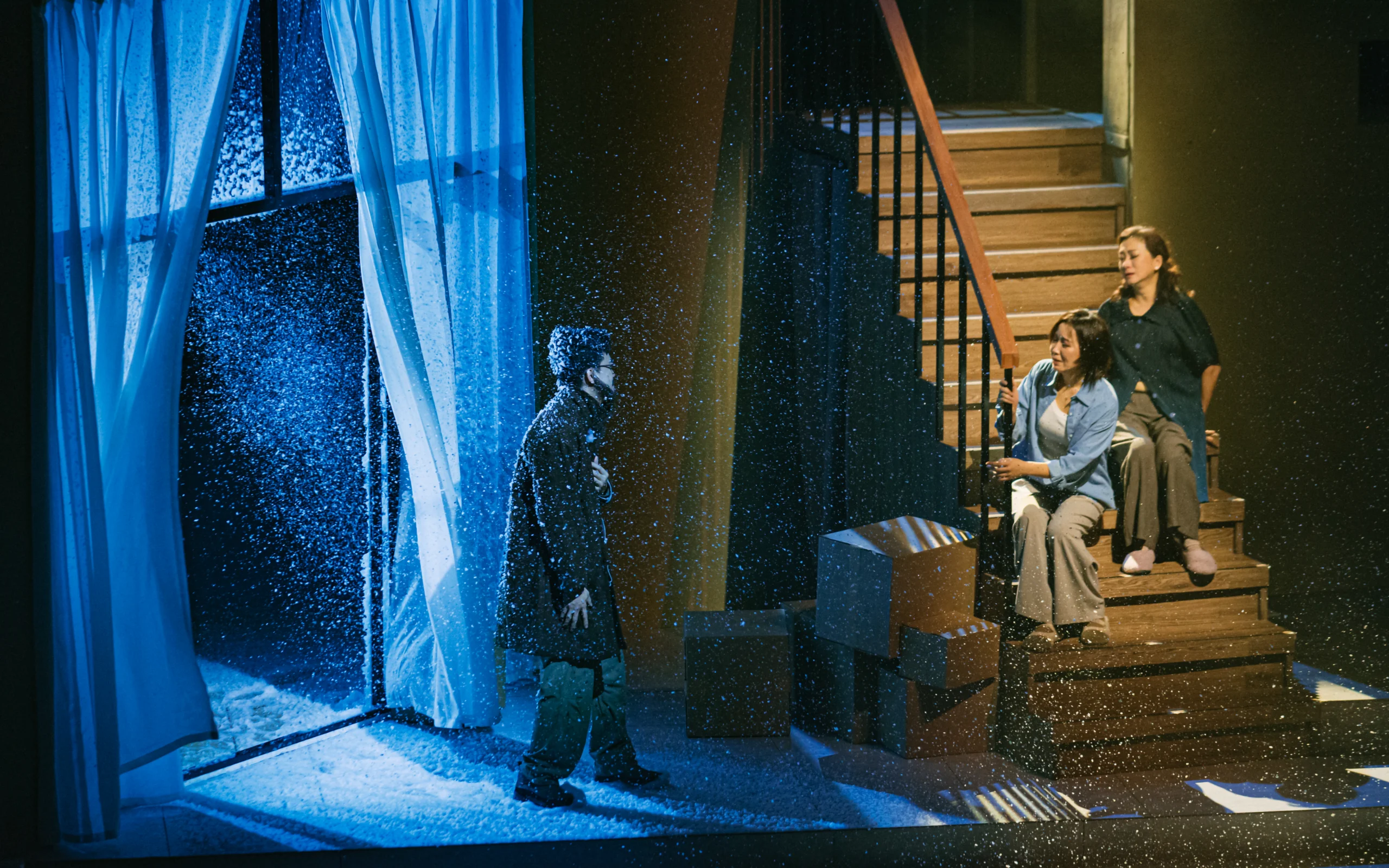
– Can you share with us the inspiration behind “Hide and Seek”?
Lawrence Lei: The play was inspired by a murder case in Canada that shocked the public: the daughter of a Vietnamese-Chinese immigrant family hired someone to kill her own parents. The crime happened near where my daughter lives. Everyone was asking how an apparently exemplary girl could commit such an act. This case was later adapted into the Netflix documentary “What Jennifer Did”.
After reading several articles, I began to reflect on deeper social and family issues that could be behind the case — topics not addressed by the media. That led me to write “Hide and Seek”, which explores family conflicts stemming from the differences between Eastern and Western values. The play is partially based on the real case but also includes stories from immigrant friends and fictional elements.
My focus in writing is not just to recount an event, but to relate the content to social reality, human nature, and contemporary issues.
– “Hide and Seek” is the first play from Macau to win the Cao Yu Award. How did you feel receiving this recognition?
I was very happy — and honestly, surprised. It’s the most prestigious playwriting award in China and usually goes to established writers from major cities like Beijing or Shanghai. I never thought I could win. This award means a lot to Macau: it’s a huge encouragement and proves that even a small city can be recognized. It’s important not only for Macau, but also for the Greater Bay Area, for Hong Kong, Macau, and Taiwan, as it’s the first time a play from these regions has won this prize.
– The play was produced by the Hiu Kok Theatre Association last year, with support from China’s National Arts Fund for a tour on the mainland…
That support was crucial. I feel very lucky — winning required three things: the right timing, the right place, and the right people. Timing was essential: the award is biennial and only works premiered in 2023 or 2024 could be considered for the 2025 edition. If “Hide and Seek” had premiered in 2022, it wouldn’t have been eligible.
Location was another factor — we were able to present the play on the mainland, where experts, academics, and the public could see it, generating enough attention to get noticed. Performing in China is not easy. And the “right people” refers to everyone who supported us: from the Liaison Office of the Central Government in Macau to the Federation of Cultural Sector Associations of Macau. Without those three factors, it wouldn’t have been possible.
– Do you believe this award could boost the development of Macau’s theatre scene in mainland China?
Absolutely. In the past, the mainland barely knew Macau, let alone its theatre. We had very few performances there. But during our last tour, we managed to connect with audiences in several cities. The response was immediate.
For example, after “February 29” and “Hide and Seek” were presented by Hiu Kok in China, the reception was excellent. This year, during the Greater Bay Area Theatre Culture Festival in Macau, there were posts on Xiaohongshu (Little Red Book) saying: “Hiu Kok is performing. Let’s go to Macau to see “Bridge Theory”.” This exchange impacts not only future tours, but also local performances, as it’s now easier to attract Chinese audiences to attend shows in Macau.
Of course, travel and accommodation costs remain high — which is why I insist that everything needs to align in our favor. Only by performing in China can our work be seen.
– So it’s a market that Macau’s artistic groups need to explore.
No doubt. Macau is a very small city, with just over 600,000 residents, while other cities have tens of millions. Currently, even putting on three shows is a challenge, such are the market limitations. If we want Macau’s theatre to truly develop, we must be rooted locally, but with our eyes on the entire Chinese-speaking world. That’s the path. Only by being seen can we be recognized — and with recognition comes a bigger market.
– Is that why your play “February 29” will be performed in Malaysia in July?
Yes, it’s part of our effort to conquer the broader Chinese-speaking market. We want to solidify the reputation of Macau’s theatre not only in mainland China but also in other Chinese-speaking cities. Macau’s theatre has made significant progress in recent years, and the goal is to continue growing, both nationally and internationally.
– As an experienced playwright, how do you view the evolution of the new generation of authors?
Today there are many more authors than before — which is excellent. A city that only stages translated plays can hardly build a cultural identity — it’s like being just a hired factory, transmitting others’ values. I believe that local theatre only truly develops with original works. With more local authors and more plays written in Macau, I see a lot of potential for the future.
But we must keep in mind that beyond personal effort, there are always external factors — what we call “luck.” Many works go unnoticed. So the most important thing is to create good works and wait for the right opportunity.
The beginning is always hard for newcomers. It depends on the writer’s resilience — if they give up before being recognized, they won’t make it. Sometimes, it takes years for a play to be noticed. But if we persist, good works eventually get seen.
If the script is good, theatre groups will pick it up. Today, there’s much talk about the “lack of scripts,” so there’s no need to fear lack of demand. But young writers must know how to handle criticism — some give up, others keep writing but avoid feedback. In the end, it all depends on each individual.
– What suggestions do you have to further develop theatre in Macau?
Artistic groups need to work hard. The biggest challenge now is the decline in audience numbers. Local groups should reflect on how to create a stronger connection with the population, so they feel motivated to go to the theatre. This is essential. Besides individual effort, external conditions are needed — government support is fundamental to creating an ecosystem that allows theatre to flourish in Macau.
– What’s behind the drop in audiences?
That could be an entire essay. There are many factors. In the past, Macau was more closed off, there wasn’t much internet or digital platforms, and entertainment options were few — theatre was one of them. Today, even cinemas are struggling. You just pick up your phone and there’s endless content — TikTok, videos, whatever you want.
With so many options, theatre easily drops to the bottom of the list. And people are very busy nowadays — children have lots of homework, parents have to help, and there’s little free time left.
It’s a vicious circle: fewer audiences lead to fewer performances, which reduces opportunities for productions to mature, and that drives audiences away even more.
