


The Web Summit has chosen Rio de Janeiro to hold its first edition outside Europe. To PLATAFORMA, Alexandre Vermeulen, vice president of the city council’s investment promotion and attraction agency, describes the choice as an opportunity to “transform Rio into the technology and innovation capital of Latin America.”
After six years in Lisbon, the organizers of the Web Summit technology conference have decided to expand the event to Brazil, with the first edition outside Europe to take place in Rio de Janeiro in May 2023.
After receiving proposals from several Brazilian cities, the Marvelous City was selected to host for the next six years what is already one of the largest technology conferences in the world.
Also read: Zelenska at Web Summit: Russia puts technology “at the service of terror”
“Since last year, Rio’s city council has been coming to the event. Our perfect (Eduardo Paes) came here to know the event where he realized how important it was in the city of Lisbon by bringing many startups and a lot of entrepreneurship,” Alexandre Vermeulen, vice president Invest.Rio – the city council’s investment promotion and attraction agency – tells PLATAFORMA.
“One of our missions in Rio de Janeiro is to transform the city into the technology and innovation capital of Latin America. We are working hard for that. So taking the Web Summit to Rio de Janeiro is one of the missions we have and one of the steps to transform Rio into a capital of innovation.”
LARGEST EVER ATTENDANCE AT WEB SUMMIT
The decision to replicate the event seems to have already generated great interest in the South American country, with the Lisbon edition recording the largest ever participation of Brazilian startups and entrepreneurs in its history.
This year’s event, held from November 1 to 4, welcomed about 71,000 participants, over 2,600 startups and companies, 1,120 investors, and 1,040 speakers.
Also read: Web Summit: Bet in Brazil aims to increase recognition of the summit
According to Web Summit, of the 116 nationalities present at the show, Brazil represented the third largest contingent, accounting for more than five percent of the total attendees.
The most populous country in Lusophony had a prominent place at Web Summit, with an imposing ‘stand’ of the Brazilian Export and Investment Promotion Agency (ApexBrasil) – which took along 60 startups and 20 companies – and ‘stands’ of the municipal authorities of Rio de Janeiro and São Paulo.
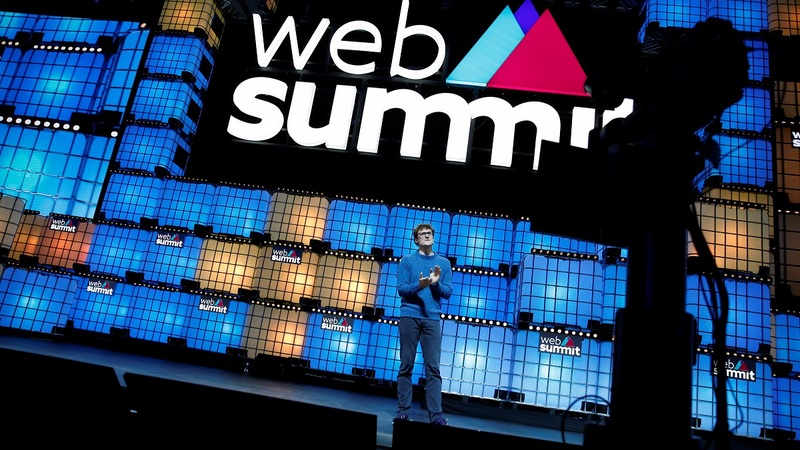
The co-founder and CEO of the Web Summit himself, Paddy Cosgrave, highlighted the largest ever Brazilian presence at the opening session of the event. The enthusiasm and amount of sky-blue flags were only rivaled by the considerable Ukrainian presence.

“I think we are one of the three nationalities that brought the most startups to the event. We have great stands representing Brazil at the Web Summit because we have every interest in showing the whole world that we are not only a city of fun or natural beauty, but also a capital of innovation,” Vermeulen points out to PLATAFORMA.
Read more on the subject: Web Summit is going to be completely online
According to the representative of Invest. Rio, the city already has extensive experience in organizing large events, from Rock in Rio to the Olympic Games and the World Cup.
Rodrigo Stallone, president of Invest. Rio, had already indicated that the city authorities expect the event to generate 2 billion reais per year, and that it will attract 15,000 participants in the first year.
This number is expected to grow over the six years that the event will be held in the city, with around 20 to 25 percent coming from outside Brazil in the first editions.
CLEARING UP A “VIOLENT” IMAGE
Vermeulen emphasizes that hosting one of the largest technology and innovation conferences will be an opportunity to change the perception of Rio as a “violent” city that only has “natural beauty” to offer and “little else.”
“People will come to Rio de Janeiro and understand that Rio is much, much more than that. We have the best universities in Brazil, we have a university that is among the best in the world in mathematics […] we have a great creative industry […] and many initiatives within the city to help really turn it into a technology capital,” he points out.
Read also: Web Summit scheduled for December. Conference will take place online and offline
As examples he points to Programadores Cariocas, an initiative that offers 1,200 places for a training course in the areas of information technology, with priority given to young people in situations of social vulnerability.
The program, announced this year by Rio authorities, offers full and partial scholarships to students living in the city between 17 and 29 years old, with completed high school education in the public network.
“The plan will help train over 5,000 low-income and vulnerable youth. We want to help them get out of a risky situation and become ‘full stack’ web programmers with a high employability rate. This way they will be able to receive a salary four times higher than the one they currently receive and it will certainly help them transform their lives,” he predicts.
The same program also aims at filling the “deficit” of IT professionals that is felt not only in Brazil, but globally.
Read also: Web Summit scheduled for December. Conference will take place online and offline
According to the representative, Rio city authorities are also working to make Rio a ‘cryptofriendly’ city, having the largest cryptocurrency companies in the world, such as Binance and Tezos.
In March of this year, for example, the municipality announced that starting in 2023 it will become the first city in the country to accept tax payments in crypto-actives.
At the same time, city officials plan to establish the “largest innovation hub in Latin America” in Rio de Janeiro’s Port Zone.
Thought to be the ‘Silicon Valley Carioca’ the Porto Maravelley project will occupy an area of around ten thousand square meters in Rio de Janeiro’s Port Zone, with city authorities planning an investment of around 40 million reais.
According to Invest.Rio, the project has as one of its main purposes the formation of an ecosystem of companies of various sizes that are technology-based or offer services to this market, from startups and digital agencies to billion-dollar organizations in the edutech market.
“This hub will concentrate an education and innovation hub in the same place. We already have several foundations and multinationals interested and construction should begin in 2023,” Vermeulen reveals.
WEB SUMMIT IN CHINA?
When he announced Rio de Janeiro as the new destination for the event, Web Summit co-founder and CEO Paddy Cosgrave justified its ‘cloning’ to Brazil with the need to attract more participants from other locations and admitted to taking the conference to other regions of the globe. Initially organized in his hometown of Dublin, the Web Summit moved exclusively to Lisbon in 2016 where it has been organized annually, except for the interregnum created by the pandemic.
The entrepreneur then surprised everyone and everything when he announced Brazil as the destination for the first edition of the Web Summit outside Europe. During this year’s edition, from November 1st to 4th, Cosgrave also pointed out other possible destinations for future editions.
First, he announced that the technological event will arrive in Africa in three to four years, in 2025 or 2026, to then reveal that China could also host the event in 2025.
“It’s the most populous country in the world and I think having something in Shanghai, Shenzhen, Guangzhou or even Beijing would be amazing. We just have to pick the ideal city, but who knows, maybe in 2025 we can bring the world to Beijing,” Cosgrave revealed to CGTN, the international branch of China’s public television, CCTV.
The same company that organizes Web Summit is also responsible for RISE, Asia’s largest technology conference held in Hong Kong, however, due to pandemic restrictions, the event will only return to the special administrative region in March 2024.
