

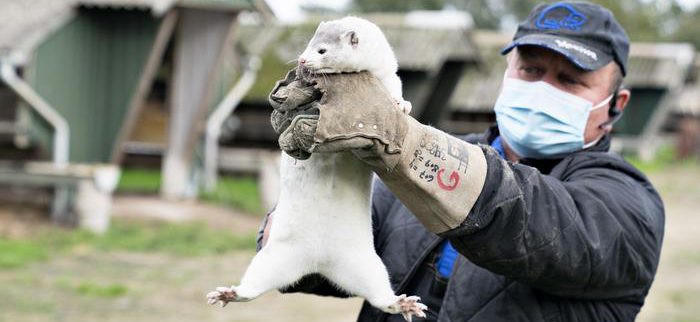
Six countries, including Denmark and the United States, have reported cases of covid-19 in mink breeding so far, the World Health Organization (WHO) said on Saturday (7).
“To date, six countries, namely Denmark, the Netherlands, Spain, Sweden, Italy and the United States have reported cases of SARS-CoV-2 in mink breeding to the World Organization for Animal Health,” the WHO said in a statement.
This announcement comes after Danish Prime Minister Mette Frederiksen announced on Wednesday the sacrifice of all over 15 million mink in the country, claiming that a mutated version of SARS-Cov-2, which could threatening the effectiveness of a future vaccine, was transmitted by these animals to twelve people.
This mutation has been identified on five different farms. The 12 cases of human transmission of the mutated virus were detected in northern Jutland (west), where most breeding sites are concentrated.
“The cases occurred among people between 7 and 79 years old, eight of them related to the mink farming industry and four from the local community,” said the WHO.
Mutating a virus is normal, and a mutation does not mean it will behave differently, say scientists. In addition, determining the concrete consequences of a mutation is complex.
But in the case of this strain, called “Cluster 5”, this implies, according to the first studies, a lower efficiency of human antibodies, which threatens the development of a vaccine against covid-19.
“Initial observations suggest that the clinical presentation, severity and transmission of infected individuals are similar to those of other circulating SARS-CoV-2 viruses,” noted the WHO.
“However, this variant, called variant + cluster 5+, presents a combination of mutations or changes that had not been seen before,” added the UN specialized agency, noting that “the implications of the changes identified in this variant are not yet fully understood. understood ”.
Preliminary results, the WHO noted, indicate that this variant associated with mink, identified in both mink and 12 human cases, has “moderately reduced sensitivity to neutralizing antibodies”.
In this context, WHO called for further scientific and laboratory studies to verify these results and determine the consequences for the development of treatments and vaccines.
“Although it is believed that the virus is ancestrally linked to bats, the origin of the virus and the intermediate host (s) of SARS-CoV-2 have not yet been identified,” recalled the WHO.
An international mission, composed of international experts from WHO, the United Nations Food and Agriculture Organization and the World Organization for Animal Health, was created in collaboration with Beijing to determine the origin of the virus.
On October 30, these experts met their Chinese colleagues for the first time, but virtually.
“Given the scale and complexity of the covid-19 pandemic, we need a complete set of scientific investigations in China and elsewhere to find the intermediate host (s) and the origins of the virus,” said this WHO spokeswoman, Farah Dakhlallah, told AFP
