

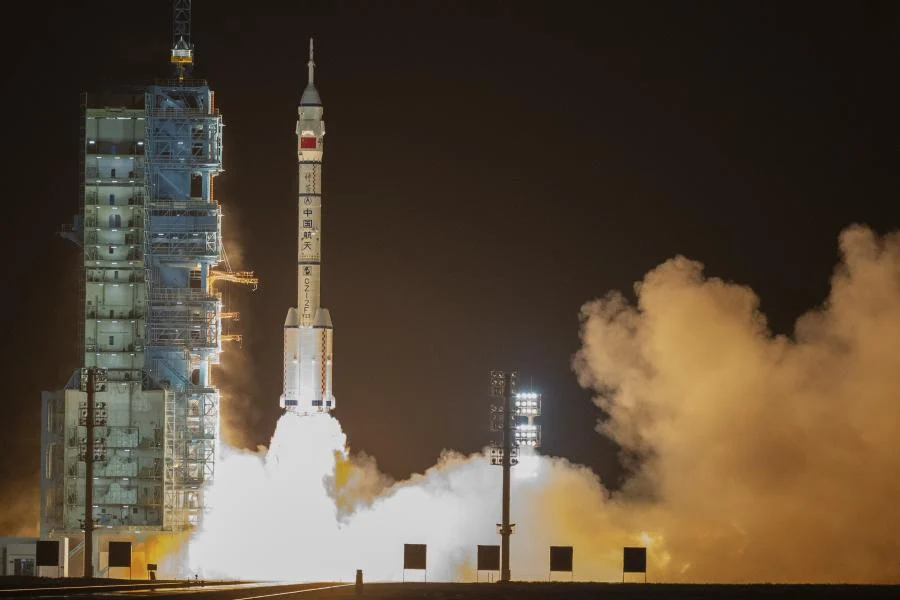
China has postponed the launch of its Chang’e-7 lunar mission after space authorities determined that the required conditions for liftoff were not met.
The decision was made in accordance with principles of prudence, reliability, and risk avoidance, the agency overseeing China’s space program announced in a brief statement on Sunday evening. Authorities stated that the Chang’e-7 mission did not meet the launch criteria and will not proceed within this year’s targeted window. Specific causes for the delay were not provided, and a revised launch date has not yet been announced.
Prior to the announcement, industry observers had anticipated the launch to take place at 08:00 on Monday (01:00 Lisbon time). On August 19, the Chang’e-7 probe and its Long March 5 Y14 carrier rocket were transferred to the launch pad at the Wenchang Space Launch Site on Hainan Island following assembly and testing. State news agency Xinhua reported at the time that functional checks, joint testing, and fuel loading would take place prior to liftoff.
Read more: China launches Shenzhou-23 mission with Hong Kong astronaut (with videos)
The Chang’e-7 mission is designed to explore the lunar south pole, a region of high scientific interest due to potential water ice deposits within permanently shadowed craters. The spacecraft configuration includes an orbiter, lander, rover, a small hopping detector, and a relay satellite to execute orbital operations, surface landing, and localized exploration.
Scientific objectives for the mission encompass analyzing the lunar environment, regolith composition, volatile substances, surface structure, seismic activity, magnetic fields, and thermal properties. Data gathered by Chang’e-7 is intended to support the subsequent Chang’e-8 mission, planned for around 2029 to test technologies required for a future international lunar research station.
China previously achieved the first landing on the far side of the Moon with Chang’e-4 in 2019 and returned samples from the region via the Chang’e-6 mission in 2024, maintaining a long-term goal to land Chinese astronauts on the Moon before 2030.
