

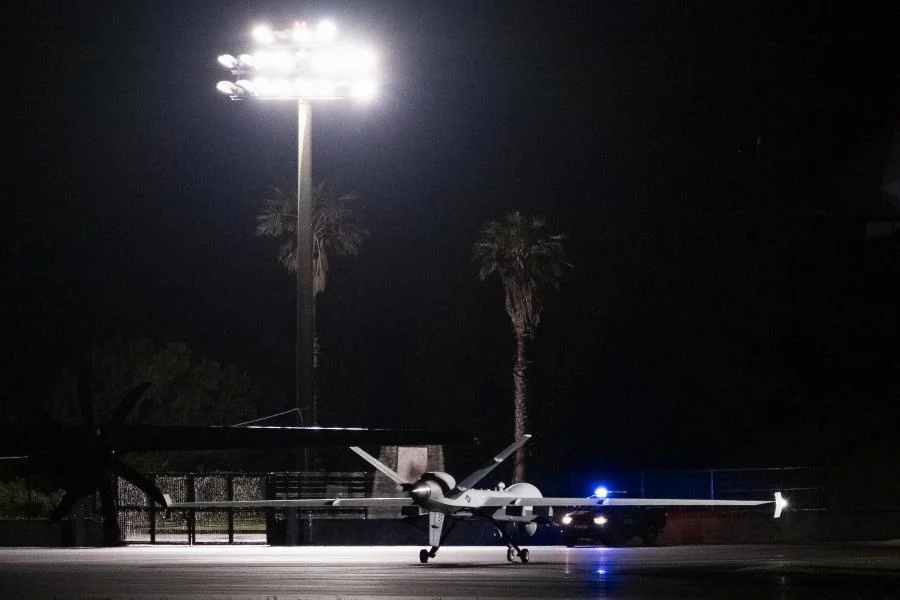
The drone that entered Latvian airspace early this morning was shot down by fighter jets from NATO’s Baltic Air Policing Mission in the Balvi region, the country’s armed forces informed in a statement.
The aircraft was brought down in the Balvi region, where soldiers and police officers were deployed to search for the wreckage of the drone. According to the EFE agency, the alarm sounded around 4:00 AM (2:00 AM in Lisbon), leading hundreds of pilgrims gathered for northern Europe’s largest Catholic religious festival to seek shelter.
The threat alert extended to the Augsdaugava, Preili, Rezekne, Balvi, and Aluksne regions, and temporary restrictions were instituted, remaining in effect until 7:30 AM (5:30 AM in Lisbon) for airspace and up to 15 minutes later for the maritime area, according to authorities.
In June, French NATO Rafale fighter jets stationed in the Baltic states had already shot down a drone in Latvia. The Baltic states, which border Russia, have recorded an increasing number of intrusions and crashes involving these types of devices within their territories.
Read more: Trump threatens to cut all trade ties with Spain over NATO (with video)
Authorities in the Leningrad region of northwestern Russia indicated today, for their part, that they had shot down more than 50 Ukrainian drones overnight and that a fire had broken out at the Russian port of Ust-Luga, located in the Gulf of Finland. Latvia is located halfway between Ukraine and the Russian region of Leningrad.
Meanwhile, the Finnish military announced today that it had issued a temporary restriction on airspace and maritime traffic in the eastern part of the Gulf of Finland, without detailing the cause, in a message published on the platform X.
Last week, at the German airport of Leipzig, a crucial logistics hub for NATO and for sending military and civilian material to Ukraine, a drone carrying an “unidentified explosive device” was discovered, causing a temporary disruption to air traffic.
Driven by European support, Ukraine is betting on long-range strikes to inflict increasingly greater economic and social damage on its adversary. By bombing oil refineries, it triggered a fuel crisis in Russia this summer and is now attacking warehouses belonging to the Russian e-commerce giant, Wildberries.
Read more: Arctic sovereignty vs. Transatlantic defense: How Trump’s revived push for Greenland pushes NATO to a breaking point in Ankara
Its multiple attacks on Crimea, annexed in 2014 by Moscow, have also led to an energy crisis on the peninsula, which was declared in a “state of emergency” this summer.
Russia, for its part, is intensifying its massive attacks on Kyiv and other regions of Ukraine and has disrupted Ukrainian exports in the Black Sea by attacking its ports and ships, with particular intensity at a time when Moscow is reportedly taking advantage of the fact that Ukraine’s stock of Patriot interceptor missiles is nearly exhausted.
Ukrainian President Volodymyr Zelensky recently appealed to the United States to sell Ukraine between 5% and 10% of its Patriot missile reserves in light of the declining quantity of ballistic missile interceptors in the country.
