

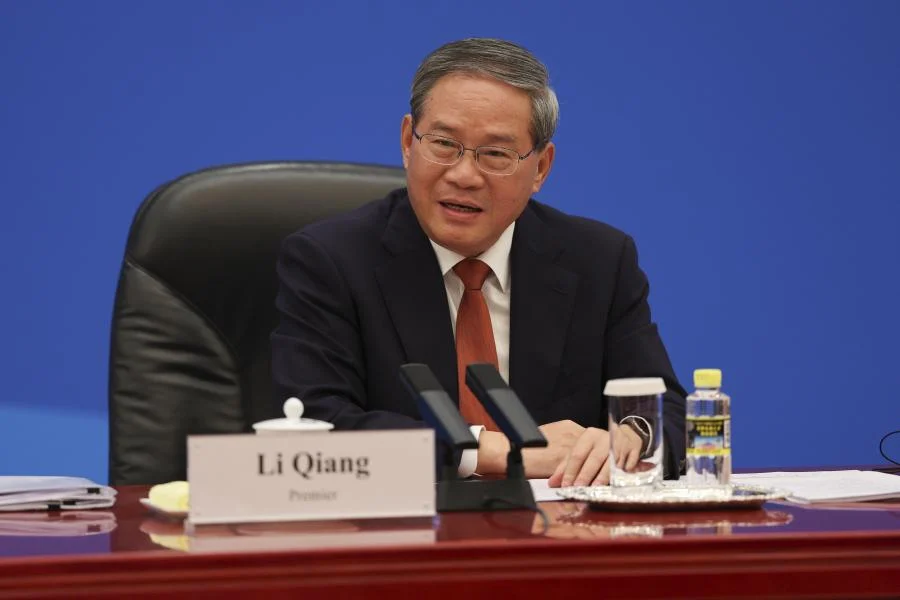
Chinese Prime Minister Li Qiang rejected criticism today regarding the influence of public support on China’s industrial competitiveness, asserting that “the Chinese government is not that rich that it can provide subsidies.”
Li made the remarks during the plenary session of the 17th Annual Meeting of the New Champions, popularly known as the “Summer Davos,” which is taking place this week in the northeastern Chinese city of Dalian.
The head of the Chinese government was addressing persistent criticisms that the competitive edge of Chinese products stems primarily from state assistance. This issue has fueled recent trade friction between Beijing, the United States, and the European Union in sectors such as electric vehicles, batteries, semiconductors, and clean technologies.
“That is not the case,” Li affirmed, attributing China’s competitiveness instead to the “scale of the domestic market,” the “strength of the manufacturing industry,” and the rapid application of new technologies. He argued that the development of sectors like new energy and intelligent connected vehicles is the result of advances in materials, batteries, and communications, rather than public support policies alone.
Read more: China plans to expand Tiangong space station to boost scientific capacity (with video)
The Chinese premier also targeted trade protectionism and restrictions—recurrent themes in Beijing’s rhetoric in recent months amidst rising tariffs, technology controls, and trade defense measures enacted by several Western economies.
Li stated that Chinese goods imports grew by 20.5% in the first five months of the year, presenting the figure as proof of China’s deep integration into the global economy. Last year, China recorded a historic trade surplus of nearly $1.2 trillion. Its trade surplus with the European Union currently sits at approximately one billion euros per day.
The speech took place at a forum edition dedicated to innovation, trade, artificial intelligence, employment, and the energy transition under the theme “Innovating on Scale.” The World Economic Forum framed the meeting within a broader global context of tariff tensions, supply chain pressures, and commercial and financial fragmentation.
The “Summer Davos” brings together more than 1,700 political, business, academic, and media representatives from over 90 countries and regions in Dalian through Thursday. High-profile attendees include the heads of government from Bangladesh, Guinea-Conakry, Kazakhstan, South Korea, Mongolia, and Montenegro.
