

US President Donald Trump declared today that he is fully prepared to reinstate stringent sanctions on Russian oil exports, capitalizing on the preliminary peace agreement with Iran and the anticipated drop in global crude prices.
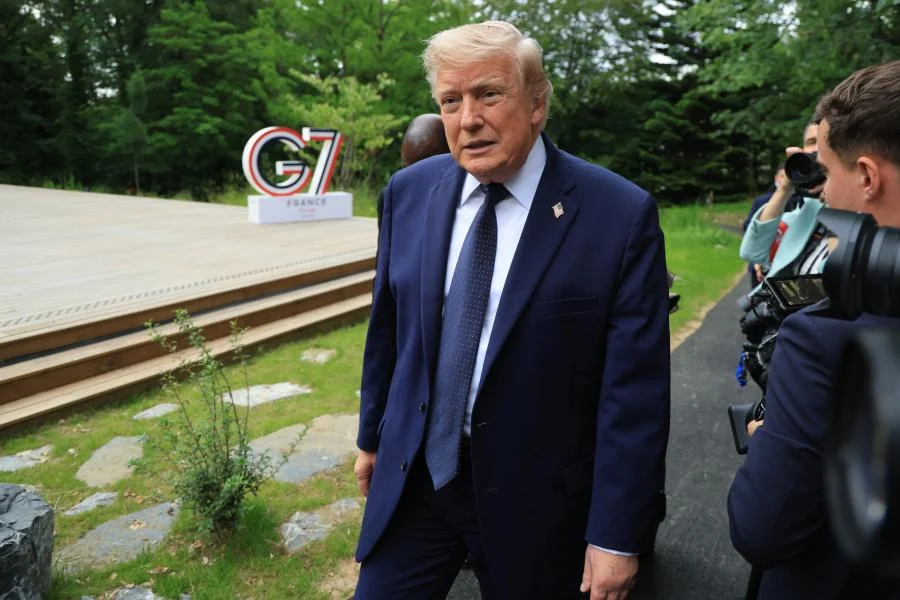
Speaking after a high-profile meeting with Ukrainian President Volodymyr Zelensky at the G7 summit in Évian, France, Trump indicated that the restrictions could be reintroduced “very soon,” though he declined to offer specific operational details or an exact timeline.
“We can do it now because the oil is flowing,” the White House leader justified, referring to the diplomatic breakthrough with Iran that aims to end the warfare initiated on February 28. The conflict had previously sent energy markets into a tailspin, forcing Washington to temporarily ease restrictions on Russian crude to prevent a catastrophic domestic price spike.
The preliminary peace accord outlines the immediate resumption of commercial maritime traffic through the strategic Strait of Hormuz—a crucial chokepoint that handled a fifth of the world’s oil and liquefied natural gas before facing direct military threats from Tehran.
Read more about this topic: Trump: “Iran won’t buy or develop nuclear weapons” (with video)
It also establishes the lifting of the United States’ maritime blockade on Iranian ports. With Iranian supplies poised to return to the global marketplace, Washington is moving swiftly to clamp down once again on Moscow’s primary revenue stream, which has been under scrutiny since the 2022 invasion of Ukraine.
Beyond energy policy, Trump used his platform at the G7 summit to aggressively push for a resolution to the stalled war in Eastern Europe, revealing plans for subsequent bilateral talks with Zelensky.
“Russia should come to an agreement. Russia has lost a phenomenal number of people, as has Ukraine,” Trump remarked following a meeting with the Emir of Qatar. Since his return to the White House in January 2025, Trump’s administration has consistently advocated for peace talks between Moscow and Kyiv, though tangible results have remained elusive as global attention shifted heavily toward the Middle East.
The American leader emphasized that his renewed focus on Ukraine is driven entirely by the mounting human toll rather than financial or strategic concerns. Trump lamented the loss of “25,000 young Russian soldiers dying every month” alongside severe Ukrainian casualties, calling the ongoing warfare “ridiculous.”
Read more about this topic: Ukraine: Trump claims openness from Putin and Zelensky (with video)
The US President candidly noted that the conflict poses no direct geographical or strategic threat to the United States, stating, “It doesn’t affect us at all, except for the fact that we sell weapons. We are thousands of miles away.”
Simultaneously, other G7 leaders used the morning working session in Évian to signal their own escalated economic offensives against the Kremlin. British Prime Minister Keir Starmer announced that the United Kingdom will supply enriched uranium to power Ukraine’s nuclear plants while rolling out fresh unilateral sanctions against Moscow.
Canadian Prime Minister Justin Trudeau mirrored this aggressive stance, unveiling a targeted package aimed directly at Russia’s shadow fleet of oil tankers, defense industrial base, energy revenues, and state-backed disinformation networks.
