

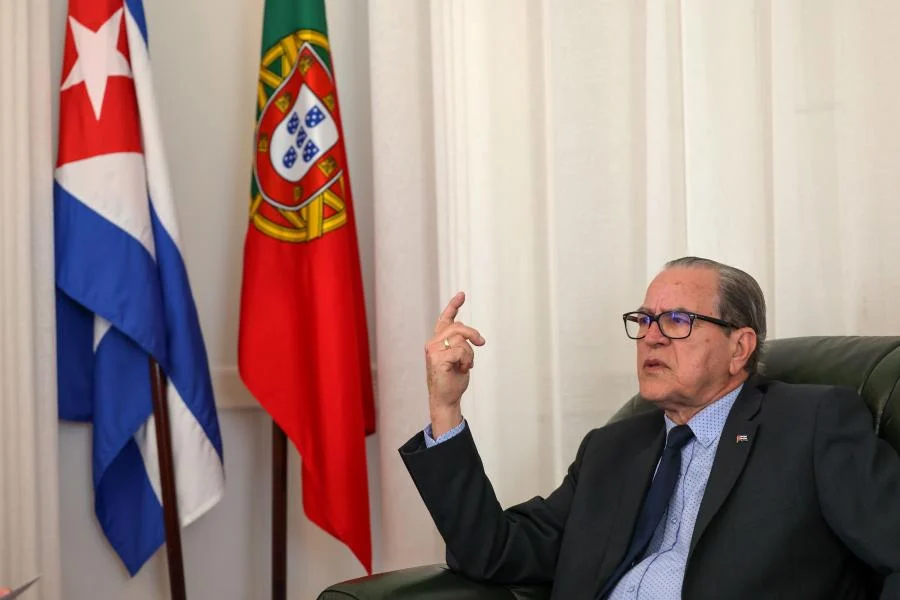
The Cuban ambassador in Lisbon considered today the United States indictment against Raúl Castro as an “escalation” of tension between Washington and Havana, admitting the possibility of “any action” against the island, which is prepared for “all scenarios.”
Raúl Castro—historic leader of the Cuban Revolution, brother of Fidel Castro, and President of Cuba between 2008 and 2018—was formally indicted in the United States for alleged involvement in the downing of two civilian Cuban aircraft in February 1996, an episode that caused four deaths, including three American citizens.
The indictment includes crimes such as conspiracy to kill American citizens, destruction of aircraft, and homicide, in a case that Washington revives nearly three decades later.
In a telephone interview with Lusa, the Cuban ambassador in Lisbon, José Ramón Saborido Loidi, classified the American initiative as a “despicable and infamous act of political provocation,” arguing that the United States “lacks legitimacy and jurisdiction” to move forward with this type of accusation, linked to the downing of two aircraft belonging to an anti-Castro organization in 1996.
Read more about this topic: Cuba condemns US indictment against Raúl Castro (with video)
“That is how we view the matter, and that is how it stands in the declaration of our country’s government. It is an escalation in the pressure that the United States attempts to impose on Cuba and which will allow them to justify any action,” the diplomat explained.
Saborido Loidi argued that Washington seeks to “reactivate purposes” of hostility against the Cuban Revolution and insisted that the indictment emerges as a “pretext” to try to control Cuba and change the island’s political system.
For the ambassador, this represents a violation of rights and a manipulation of historical facts. “There is no validity to this indictment,” the ambassador maintained, accusing the United States of instrumentalizing justice and resorting to a media narrative to legitimize a potential aggression against Cuba.
The diplomat linked the case to the American policy of blockade and pressure on the island, recalling the worsening of economic, commercial, financial, and energy restrictions. The ambassador recalled that Cuba has faced “actions of intimidation and aggression” for decades and that the United States is now insisting on this process as part of a broader strategy.
Read more about this topic: CIA confirms director’s meeting in Cuba (with video)
Despite the harsh tone, Saborido Loidi emphasized that Havana remains open to dialogue. “Cuba does not negotiate under pressure, but maintains its readiness to negotiate on equal terms and under mutual respect from both countries,” the ambassador stated, insisting that his country “does not negotiate its sovereignty and independence” and reaffirming that Cuba wants “an environment of peace” and does not close the door to an understanding with Washington.
Regarding the reaction of the international community, the diplomat said he expects support from the United Nations and other nations, including Portugal.
“The Portuguese people have always been in solidarity with our country,” Saborido Loidi recognized, saying he trusts that this solidarity will be maintained in relation to the “project of the Cuban revolution.”
Questioned about contacts with the Portuguese authorities, he responded that there has not yet been any official approach on the matter. Saborido Loidi also said he believes that Cuba is prepared for all scenarios, including a potential military escalation, although he stressed he hopes that “common sense” will prevail and avoid any bloodshed.
Read more about this topic: China advocates for “legitimate and transparent” cooperation with Cuba in response to the U.S.
“We have always been prepared to face any type of aggression,” declared Saborido Loidi, stating that Cuban history demonstrates the country’s capacity for resistance in the face of external pressures. The ambassador concluded that Cuba’s position is one of firmness, but also of openness to peace and international law, arguing that the response to the crisis must involve dialogue and the end of the American blockade.
