

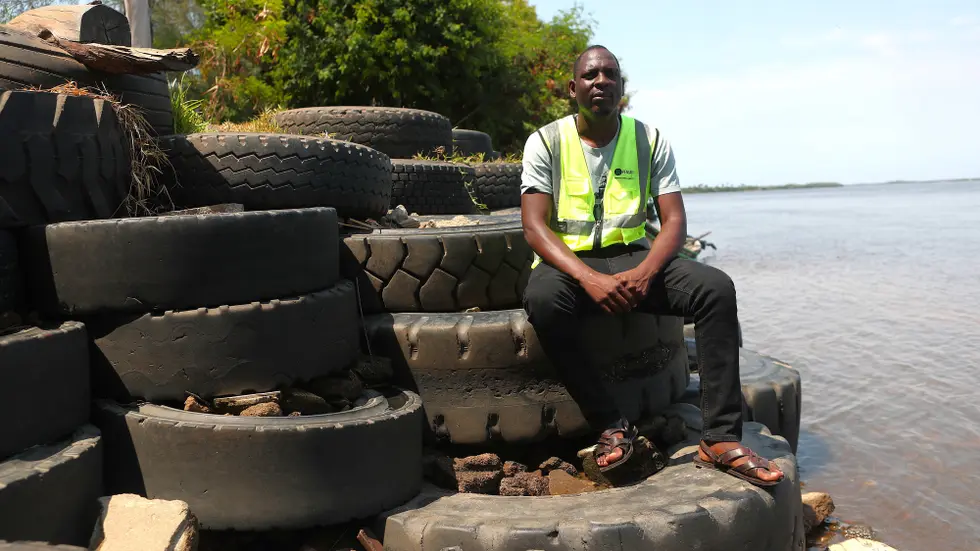
Around 13,000 recycled tyres — including those from aircraft — lined along the banks of the Incomati river have been holding back erosion and silting, protecting tourist resorts and communities in the coastal area of Macaneta in southern Mozambique during recent floods.
“The idea is to recover and show the world that it is possible to use tyres — these materials — rather than burning them, throwing them away or dumping them in landfills or other unsuitable places, for something useful like containing erosion,” Clausêncio Ngovene, an environmental educator at the Repensar cooperative in Maputo, told Lusa.
Tyres from aircraft, cars, tractors, forklifts and industrial machinery, filled with rubble to resist the force of water, form a protective barrier along the mainland edge of Macaneta. Most come from donations by Maputo Port, Maputo Airport and other entities, as well as tyres recovered from landfills and streets in the town of Marracuene and the Mozambican capital.
“These are tyres that perhaps deserved proper recycling, but unfortunately our country does not have companies or industries that carry out proper recycling,” Ngovene lamented.
The tyres — some weighing up to half a tonne — arrive near Macaneta by train, truck and tractor before being rolled around 600 metres to the protection zone by more than 15 cooperative workers, volunteers and students from Mozambican universities. “It is a somewhat arduous exercise that requires great human effort. Unfortunately we don’t have the right machines for this work,” Ngovene said.
The barrier has been under construction since 2021, when the Macalinda programme — focused on marine litter — began following an environmental study on the “worsening erosion and silting” of the coastal zone and estuaries of Macaneta, where tourist resort foundations and tree roots were becoming exposed. Despite having no machinery, the Repensar cooperative pressed ahead with installing more than 13,000 tyres, a material it considers “more sustainable and subject to no wear.”
Read more: Mozambique: new coal project expected to reach 3.5 million tonnes annually
Without the tyres, erosion and silting would worsen, cutting off access to some communities and resorts, and saline intrusion would compromise drinking water supply, agriculture and raise treatment costs. “I can say that we have managed to contain the water invasion and the tidal effect. The tendency for sediment dragging would have been getting worse and worse, but we managed to contain it,” Ngovene said proudly.
Each day, the team manages to install more than 30 small tyres, 20 medium ones and up to six giant ones — the latter requiring at least seven people to carry. “A giant tyre alone needs six to seven men to lift. Real men. It is a somewhat laborious exercise, but the goal to be achieved is what matters most and we give our all,” he said.
The Macaneta barrier has up to six rows of tyres stacked from largest to smallest, with the number of rows depending on the height of each area. In some stretches, forklift tyres weighing 110 kilograms each have been placed to protect mangroves restored during the project, their weight making them resistant to being swept away.
Read more: Measles outbreak in Mozambique with nearly 700 cases in seven months
“Here we learned lessons along the way, but the most important thing is that we discovered the technique through the work itself. For the tyres to hold firm, you need to make a base, lay the first step and fill it with rubble to anchor the tyre,” Ngovene explained.
Fallen dead trees and others at risk line the landscape along the tyre barrier, while young vegetation planted by the cooperative provides shade for resting fishermen and locals. January’s floods — which killed more than 27 people and affected nearly 725,000 — and other natural events have shown that the pilot project works, and other resorts in the tourist province of Inhambane in the south are already requesting the project be replicated, while the municipality of Marracuene has also joined the initiative.
“In the latest cyclones and floods, the water was so violent, but the tyres remained intact — they showed they are resilient, they are resistant, the technique works,” Ngovene said with confidence.
Read more: Mozambique’s international reserves hit record of €3.5 billion
Thanks to the tyres, the communities of Benguelene and Pontene in Macaneta still have access routes and are free from saline intrusion — work that will only be complete once the vegetation is also fully restored. “We have been working almost every weekend since 2021 until today. The work ends when we have the vegetation restored,” he concluded, saying the greatest reward is the benefit to the communities.
