

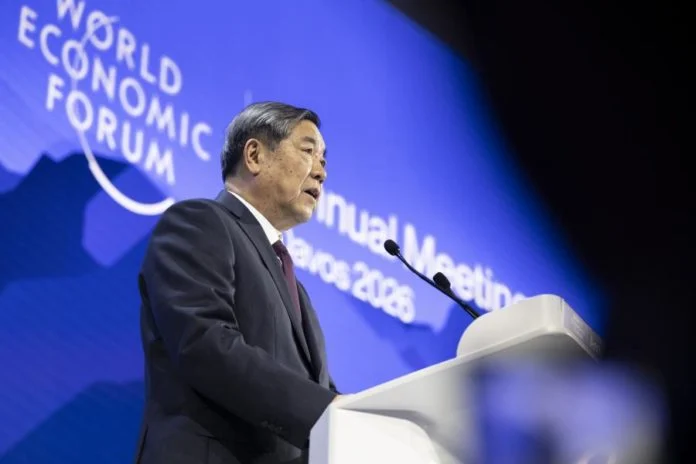
China today confirmed that vice-premier He Lifeng, responsible for economic affairs, will travel to France from Saturday for talks with the United States on trade.
The high-level negotiations will take place several weeks before a possible visit to Beijing by US president Donald Trump, during which he could meet his Chinese counterpart Xi Jinping.
The US Treasury Department had already indicated on Thursday that bilateral trade talks would take place on Sunday and Monday in Paris between He Lifeng and US treasury secretary Scott Bessent, who will be accompanied by White House trade representative Jamieson Greer.
The Chinese official “will lead a delegation to France from March 14 to 17 for trade consultations with the US side” on matters “of mutual interest,” China’s commerce ministry said today.
Trump is expected to travel to Beijing between March 31 and April 2, the White House announced, though Chinese authorities have not confirmed the visit or its timing — consistent with their usual practice.
The United States and China engaged in a bitter dispute last year with global repercussions, marked by the imposition of tariffs and various restrictions, before reaching a fragile truce brokered by Bessent and He Lifeng. Several points of friction nevertheless persist.
Read more: Iran War “lacks legitimacy and legality”, says China’s foreign minister
The White House announced on Wednesday the launch of a series of investigations aimed at documenting economic harm suffered by the United States, targeting around 15 countries or blocs including the EU and China — a first step towards the possible imposition of new tariffs. China’s commerce ministry described the initiative in a separate statement today as a “typical example of unilateralism” that “seriously undermines the international economic and trade order,” urging the United States to “abandon these contestable practices and prioritise dialogue and consultation to resolve differences.”
On Thursday, the US launched investigations into 60 economies — including China — to determine whether they have taken “sufficient measures” to prevent the importation of goods produced with forced labour.
