

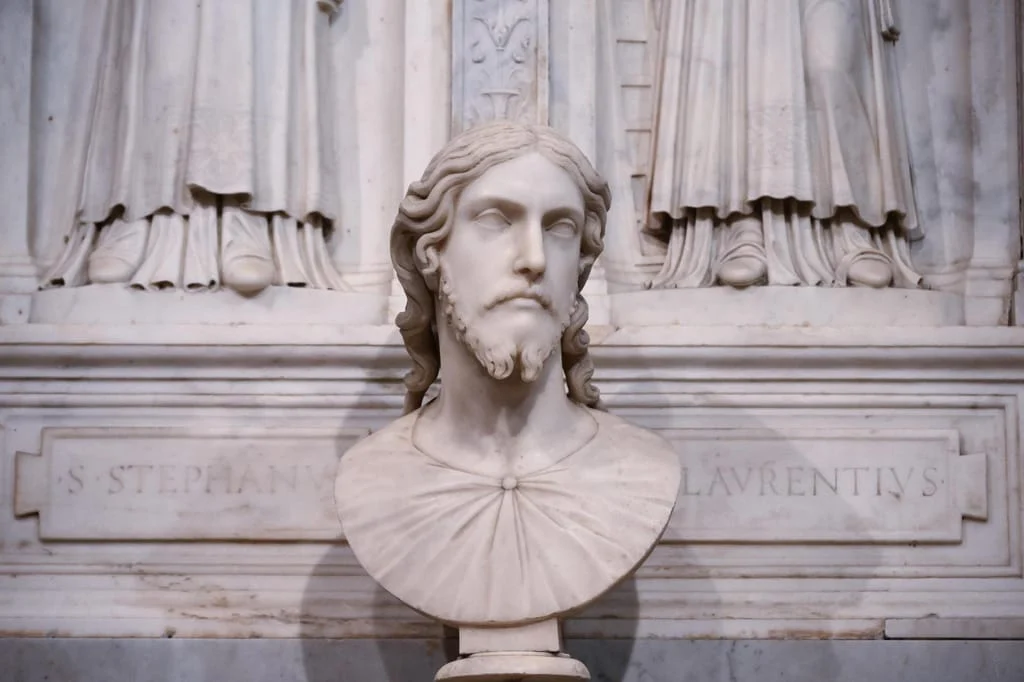
The bust of Christ the Saviour in the Basilica of Sant’Agnese fuori le Mura in Rome, whose author had until now been unknown, is one of the works by Michelangelo that were believed to be lost, according to a study.
The work of researcher Valentina Salerno has allowed the attribution of at least 20 works to the Renaissance artist.
One of these is the bust in question, according to Salerno, who presented her discovery at a press conference in Rome on Wednesday. The researcher described the history of the work based on documents and said that experts will now need to verify her findings.
The statue had been considered anonymous and catalogued as a “sculptural bust by an anonymous artist of the 16th-century Roman school.”
Read more: António Lobo Antunes has died; one of Portugal’s greatest writers of all time (with video)
Among other documents, Salerno presented wills, correspondence, diaries, reports, notarial inventories and confraternity records from 1564 to the present day, as well as sketches by Michelangelo, to argue that the bust — created in 1534 and depicting Tommaso dei Cavalieri, a close friend of the artist — was transferred from Buonarroti’s home to the Church of Sant’Agnese in Agone after his death.
The bust was initially kept in a closed chapel and later placed in the basilica.
This piece is one of the 20 works the author managed to reattribute in her study “Michelangelo: The Last Days,” which lasted more than ten years and was made possible with the assistance of the Order of Canons Regular of the Lateran, who administer the church.
For centuries, it was believed that the artist had destroyed hundreds of sketches, drawings and sculptures he kept at home. However, according to Salerno’s research, Michelangelo did not destroy the statues but instead devised a plan before his death to prevent them from falling into the wrong hands, entrusting them to his closest friends.
Read more: Christ icon’s procession draws thousands to streets of Philippine capital
A further element reinforcing this reconstruction is that during a Christie’s auction in London in February, a drawing of a foot attributed to Michelangelo emerged with a provenance that coincides with that of the Roman bust. This coincidence, according to scholars, would solidify the entire chain of documentation.
Pending acceptance by the scientific community — which would add it to Michelangelo’s later works — the bust will remain in its current location.
