

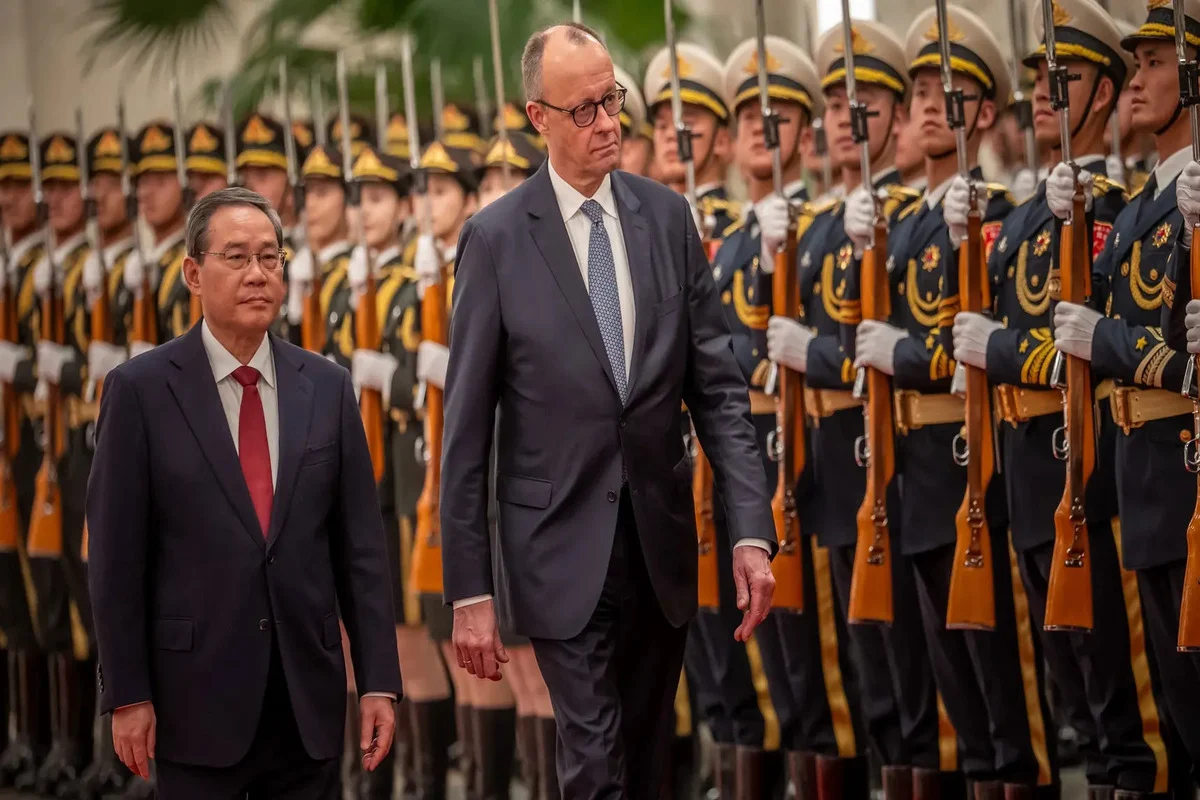
German Chancellor Friedrich Merz on Wednesday advocated closer and “fairer” cooperation with China in Beijing, at the start of a visit to Germany’s main trading partner, which is increasingly viewed at home as a strong competitor.
“We have very concrete concerns regarding our cooperation, which we want to improve and make fairer,” Merz said at the beginning of talks with Chinese Prime Minister Li Qiang at the Great Hall of the People in central Beijing.
The head of the Chinese government urged Germany to work towards “jointly defending multilateralism and free trade.”
Merz, who arrived mid-morning accompanied by a large business delegation, is expected to meet and dine later today with Chinese President Xi Jinping, on his first visit to China since taking office in 2025.
The chancellor said he sees “great growth potential” for two of the world’s largest economies, while stressing the need for “open” dialogue.
Before departing, Merz said he intended to address several points of divergence, including competition rules, market access and security of supply of rare earths — essential raw materials for many German companies, the production of which is dominated by China.
The German leader also wants to discuss the war in Ukraine, counting on Beijing’s good relations with Moscow. “Beijing’s voice is heard, even in Moscow,” he said.
Merz is the latest foreign leader to visit Beijing at a time when U.S. President Donald Trump has been shaking the international order with new tariffs and a reassessment of long-standing alliances.
“Today, China has become unavoidable for everyone,” Merz said on Tuesday.
Over the past three months, leaders from the United Kingdom, Finland, Canada, South Korea, Ireland and France have visited Beijing.
Also read: China registers 121 million passenger return trips as Spring Festival holiday ends
At the same time, German industry is facing growing pressure from Chinese competition. Europe’s largest economy — heavily dependent on exports and for years sustained by the vast Chinese market — has seen sales by its carmakers decline significantly in China and is increasingly confronted with Chinese technological competition worldwide.
Like other European Union partners, Germany has expressed concern over the expansion of Chinese electric vehicles and the channelling of China’s production surpluses into Europe.
Berlin has also warned about Beijing’s use of semiconductors and rare earths as instruments in the global trade dispute, as happened in 2025, severely affecting supply chains, particularly in the automotive industry.
“We want and must adopt a risk-reduction policy, not only in relation to China,” Merz said, stressing, however, that it would be a mistake to equate this strategy with economic decoupling.
Germany and other countries have criticised restrictions on access to the Chinese market, what they consider undue subsidies and the alleged undervaluation of the Chinese currency.
Xi Jinping has portrayed China as a reliable partner and a defender of multilateralism and free trade, promoting a “win-win” relationship based on “mutual respect.”
In 2025, China was engaged in an intense trade and diplomatic dispute with the United States under Trump’s presidency, whose visit to Beijing is scheduled for late March.
Merz travelled accompanied by the chief executives of Volkswagen, BMW and Mercedes. On Thursday, he will attend a presentation of autonomous vehicles by Mercedes and then travel to Hangzhou, a major technology hub, to visit the robotics group Unitree and the company Siemens Energy.
Last year, Germany’s trade deficit with China increased by more than €22 billion, reaching around €89 billion.
