

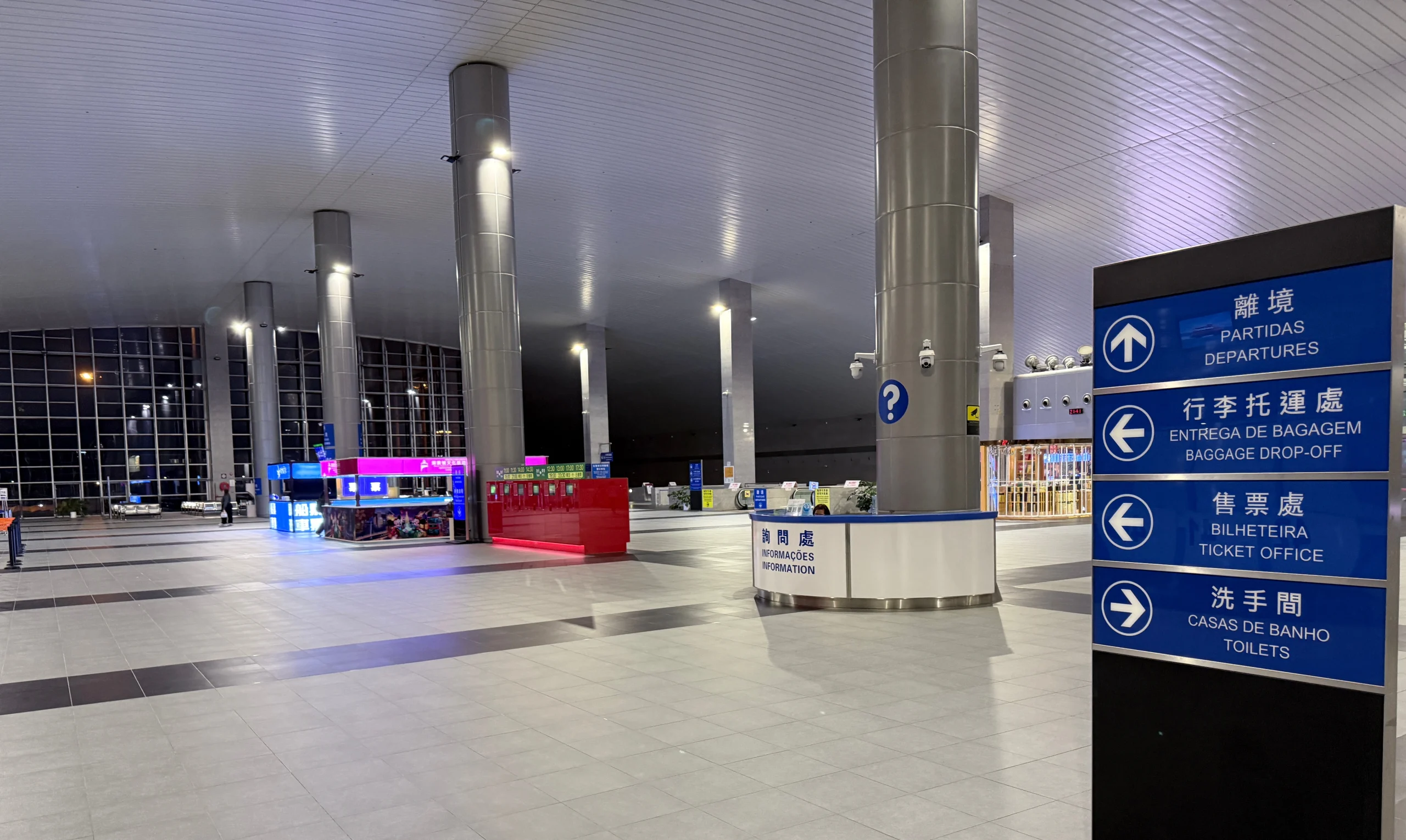
The President of the Macau Institute of Management, Samuel Tong Kai Chung, argues that at a time when land transport infrastructure along the eastern coast of the Pearl River Delta (PRD) is increasingly developed — reducing the demand for sea travel — Macau could invest in creating maritime routes to the western coast of the PRD and launch various nautical tourism and entertainment options to increase the terminal’s footfall and diversify visitor choices.
Data from the Statistics and Census Service (DSEC) shows that between January and October this year, Macau received 33.1435 million visitors, a year-on-year increase of 14.1% and equivalent to 99.2% of the figure recorded in the same period in 2019. However, maritime arrivals numbered only 3.2478 million, 5.2% fewer year-on-year. This represents a drop of nearly 40% compared to the 5.391 million recorded in 2019, and a sharp decline of 63.84% from the peak of 8.9825 million registered in the same period of 2018, before the bridge opened.
According to Samuel Tong, although the Taipa Ferry Terminal was designed as a transport facility, the introduction of more commercial elements could be considered to broaden revenue sources. He pointed to the example of the Macau International Airport — also a transport infrastructure — which over the past decade has been optimising its commercial offerings, increasing passenger flow and enriching its retail profile to boost non-aeronautical revenue. Last year, such revenue accounted for more than 50% of the airport’s total income.
To incorporate commercial spaces into the terminal, it is first necessary to increase its popularity and utilisation rate. Drawing inspiration from international examples, Tong recalls that ferry terminals can function not only as transport hubs but also as tourist and leisure destinations. As a coastal city, Macau has not yet fully developed its maritime potential: nautical tourism has progressed slowly and remains underdeveloped. Different sightseeing routes could be created to offer visitors an alternative experience, or additional boat trips could be added during firework shows, expanding options for both residents and tourists.
Regarding passenger transport, with the opening of the Hong Kong–Zhuhai–Macau Bridge and the Shenzhen–Zhongshan corridor, land travel from cities on the eastern coast of the PRD has become more convenient, reducing demand for maritime transport. Therefore, Tong suggests developing new routes to Nansha, in Guangdong, and to other cities on the western coast of the PRD, complementing existing services. He adds that with the growing integration between Macau and Hengqin, maritime links — in addition to land routes — can also play an important role in facilitating movement between the two cities.
The Taipa Ferry Terminal is located close to the Macau International Airport and is connected to the Light Rapid Transit system, creating conditions for the development of an integrated sea–land–air transport network, allowing the terminal and the airport to share passenger flows. However, Tong stresses that building a customer base and strong reputation for transport infrastructure does not happen overnight: it requires thorough market research, audience segmentation and continuous effort, with success depending on persistence.
Article published under the partnership with Macau Daily News
