


In this vote, at a meeting of the Constitutional Affairs Commission, the Socialist (PS) and left wing Livre Parties voted against this proposal, which ends the five-year period currently in force in the nationality law.
If this change is confirmed on Tuesday in the final debate and overall vote – in which approval will require 116 votes in favour out of a total of 230 MPs – the new law on foreigners will state that obtaining nationality requires legal residence “in Portuguese territory for at least seven years, in the case of nationals of Portuguese Language Countries and citizens of European Union (EU) member states, or ten years, in the case of nationals of other countries”.
The vice-president of the PS parliamentary group, Pedro Delgado Alves, said that the PS sought a compromise with the Social Democrats (PSD), even agreeing to nine years, and pointed out that the new wording leaves out the British and Ukrainian communities, requiring them to reside for ten years.
PSD MP Paulo Marcelo replied that the British are outside the minimum seven-year period as a result of Brexit, arguing that the periods in question are “balanced” and appropriate to the country’s social situation.
Immediately afterwards, former Liberal Initiative leader Rui Rocha noted that the PS had agreed to nine years, which shows “a closeness of positions on a fundamental issue”. In turn, Christian Democrat (CDS) MP João Almeida concluded: “We are discussing a difference of one year”.
The PS and Livre also opposed the new requirement for applicants for nationality to prove, through a test or certificate, that they have “sufficient knowledge of the Portuguese language and culture, history and national symbols”.

Here, Pedro Delgado Alves considered that the PSD and CDS “landed on the worst solution, even in relation to the Government’s initial proposal”. And Rui Rocha warned of the “indeterminate” nature of the reference to Portuguese culture.
More consensual, although with Livre voting against, was the condition imposed on applicants for nationality that they must not have been convicted, with a final and unappealable decision, “to a prison sentence of two years or more”.
In the early hours of Friday morning, the PSD and CDS introduced an addition to the conditions for access to nationality, relating to guarantees of means of subsistence for living in Portugal – an addition that the PS classified as “a concession to (the right wing) Chega Party” and which led Pedro Delgado Alves to warn of “risks of injustice”.
This rule has already been in Portuguese law, including under socialist governments,” responded the vice-president of the PSD parliamentary group, António Rodrigues. The proposed change ended up receiving the votes in favour of Chega.
Also opposed by the PS, children born in Portugal will only have nationality if “one of the parents has been legally resident in the country for at least five years” – another measure supported by Chega.
However, Chega was opposed by the PSD, CDS and PS when it sought to include the requirement of means of subsistence as a condition for granting nationality to stateless persons with four years of residence in the country.
On the other hand, if the changes approved at the committee stage on Friday are approved in the final debate and vote, by choice of the PSDD/CDS Government, the naturalisation of children born in Portugal to foreigners who are illegally in the country will end. Under the law still in force, the possibility of naturalisation is open to those who are “children of foreigners, regardless of title”.
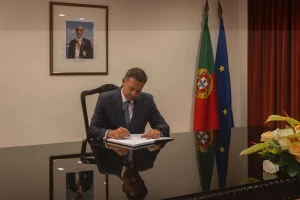
(Photo by Eduardo Leal / AFP)
Pedro Delgado Alves advocated a seven-year period of residence in Portugal for Sephardic Jews to obtain nationality, but the PSD and CDS refused to make exceptions and rejected this proposal by the PS, which, however, was abstained from by Chega.
In terms of rules to regulate the future law, all of Chega’s proposals were rejected by the PSD, PS and CDS, but the Socialists’ demand to open a transitional period until March next year was also rejected by the governing parties.
The bill that emerged from the committee stage includes a provision that the new foreigners’ law will come into force on the next day after its publication, which led Pedro Delgado Alves to criticise the PSD and CDS for their “inflexibility” and “lack of social sensitivity” and for “risking a violation of the principle of trust”.
“We do not accept a transitional law. The rules have been under discussion for four months,” countered António Rodrigues.
Platform with Lusa
