

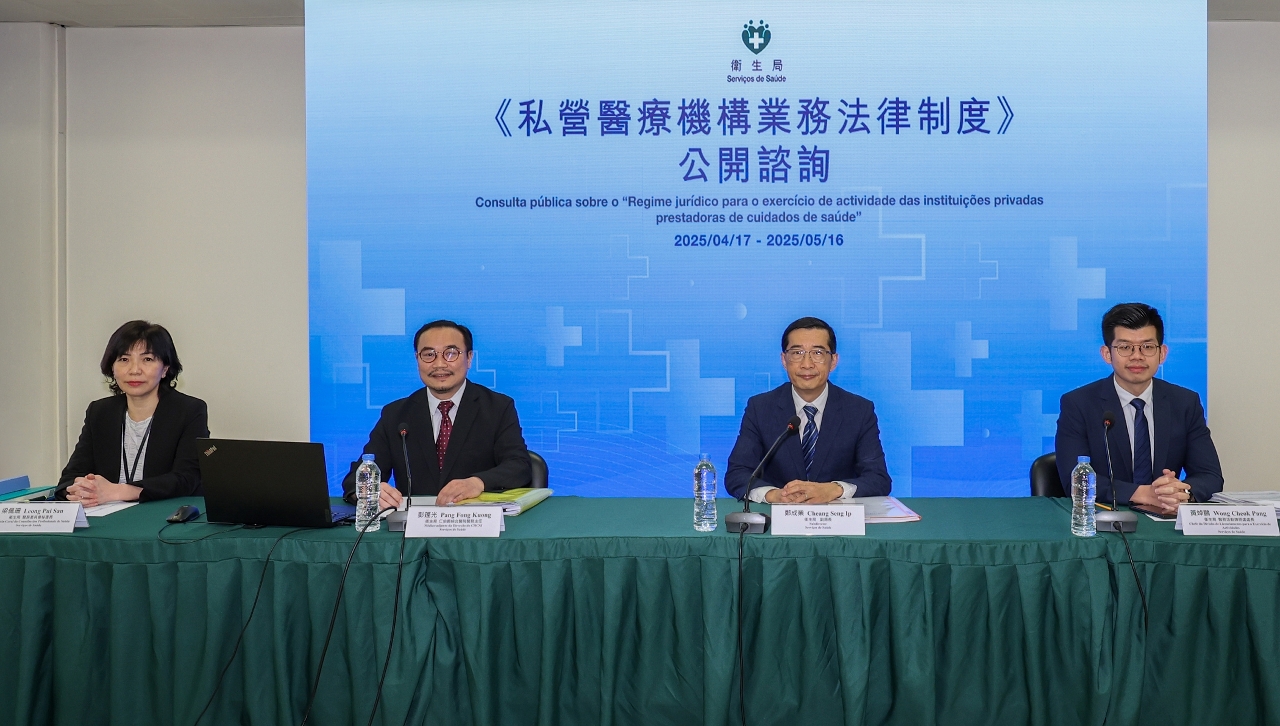
This legislative review aims to promote the Big Health industry and the development of “health + tourism,” improve the supervision mechanisms of private institutions, and create conditions for more diversified medical services outside public hospitals, including the introduction of licenses for day hospitals.
According to lawmaker and physician Chan Iek Lap, the proposal responds to the current needs of the region by offering an alternative that can complement existing demand. He believes the measure could boost the health sector and create opportunities for local professionals: “Macau is small, and every year graduates come out of our two nursing schools. We’ve heard comments that it’s not easy to find ideal positions. If there are day hospitals, this represents another path, both for doctors and nurses,” he told PLATAFORMA.
Erik Kok, a researcher at the Social Development Observatory of the University of Saint Joseph, says that this new model could attract foreign investment: “Well-known private hospitals from Hong Kong could open branches in Macau, for example.”
According to Jacky Ho, Dean of the Faculty of Health Sciences at the University of Saint Joseph, the introduction of these hospitals will have a positive impact, but services must be fairly distributed among communities: “Otherwise, there will be a duplication of resources.”
He suggests that these units initially focus on areas such as mental health, rehabilitation, and geriatric care, avoiding a replication of the aesthetic services offered in neighboring regions. This approach, he says, would allow Macau to gain practical experience in a new field and eventually position itself to receive patients from outside, evolving toward medical tourism.
Structural Requirements
The implementation of this model depends on the availability of suitable infrastructure. The consultation document stipulates a minimum usable area of 500 square meters for day hospitals, with requirements such as five non-overnight beds, waiting areas, a pharmacy, consultation rooms, a registration desk, and an emergency power system. Only commercial, service, or social facilities buildings can house such units.
Jacky Ho reminds that if there is an operating room, recovery rooms, medical waste areas, and emergency power systems must also be in place. However, Chan Iek Lap points out that “it’s not easy to find commercial buildings in Macau that meet the required size.” He cautions: “If the law is passed but there are no locations that meet the legal physical requirements, the goal will not be achievable.”
Long-Term Vision
The sustainability of the model requires not only suitable spaces but also a coordinated strategy among different sectors and departments. For Erik Kok, the measure could boost the local economy by broadening participation in the health market: “At the very least, with this sector entering and more people involved in the market, the size of the economy increases, which represents an additional step toward strengthening public revenue in the Macau SAR,” he explained to PLATAFORMA.
On the other hand, Chan Iek Lap draws attention to the proposed deposit value—1.25 million patacas—which he considers high. The sector has proposed criteria tailored to the size of the projects, types of investors, and specific needs. “We don’t want them to become ordinary clinics competing with private practices,” he stressed.
Jacky Ho argues that the development of day hospitals should not be left entirely to the market, requiring integrated planning. He highlights that, under the proposal, any space with two or more registered health professionals will need to obtain a license as a private medical institution. This means new shared practices could no longer register as such. Existing ones will be allowed to operate only until the licenses of the participating professionals expire or are canceled. “With more regulation, the Government believes it is standardizing the sector, but for private providers, costs may increase again. If day hospitals are successful, will that end up pressuring these doctors to leave?” Ho asks.
The academic stresses that building an ecosystem of day hospitals requires a coordinated approach—from training professionals to creating the physical and regulatory conditions, attracting investment, and clearly defining the role of each health unit. He notes that this is a long-term investment: “This is a long-term investment, and the returns will come later. Even if we fail to attract foreign capital, at the very least, we will benefit the health and well-being of local residents,” he concludes.
In response to PLATAFORMA, the Health Services (SSM) explained that day hospitals and clinics differ in their positioning. The former provide specialized medical services traditionally performed in hospitals but that can now be carried out within a short timeframe, without overnight stays. These services include advanced therapies, assisted reproductive technologies, and surgical interventions under general or regional anesthesia. Clinics, on the other hand, continue to offer outpatient services such as general consultations, preventive care, and chronic disease follow-up.
To effectively promote the health sector, the Government will clearly define the roles of hospitals, day hospitals, and clinics, so that each type of institution can leverage its strengths and contribute to complementary and differentiated development, the Health Services concluded.
