


– What was your mission statement when you founded the Festival? What were your expectations, and how do you view what has been achieved throughout this long history?
Adriano Jordão – People forget what it was like 40 years ago; anyone who goes to Macau today has no idea. I have always felt a deep connection to the Festival; I performed a lot in Asia since the late 1970s, and first in Macau, which I thought was the ideal place for East-West relations. It was traditionally a point of trade exchanges, and we wanted it to be a real meeting point—not just for trade but also for culture. The idea was very well received by then-Governor Pinto Machado, later by Engineer Carlos Melancia, and completed by General Rocha Vieira, with whom I worked. The idea, using the last Italian-style theater in the East—Dom Pedro V—was to put Macau on the global circuit of classical and erudite music.
– Dom Pedro V is still here. Is it for you the great icon of Portuguese cultural presence?
A.J. – I thought about that. Afterward, for many years, I was a cultural advisor in Brazil, where I also found the theaters of the Amazon or Belém. It’s interesting how Portuguese civilization is marked by theaters. It’s a somewhat different phenomenon from some other inter-civilization contacts. Now, the Italian-style theater is the epitome of the highest reference for musical purposes; in this case, theatrical and operatic icons of Western culture in China. At the time, I spoke with several of my friends at the highest level, and I must say that Macau, during my time, was at the highest level globally. In fact, I’m very happy to see that Valery Gergiev, a great figure, will be at the FIMM; it shows that the same standards of quality are still present in the organization. In essence, the goal was to bring to Macau, in the field of Western classical or erudite music, the best that existed in China and the world. And I believe that was achieved, although not without a big struggle. Anyone who knows that “La Traviata” was sung at the second Festival, in 1988, at the Sports Forum, can understand the enormous effort to transform that space into an opera house. Today, we have a beautiful concert hall in Macau, don’t we?
– Did the FIMM change a lot of things too?
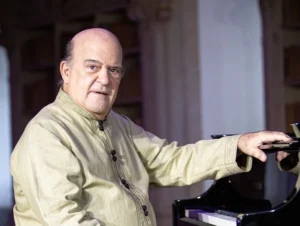
A.J. – The Festival contributed to that, as did the Macau Orchestra that exists today. It already existed as a chamber orchestra, but from the third Festival onwards, it grew and became the Macau Orchestra. These are direct consequences of holding the festivals, and I must say, of the perseverance in continuing them. I only directed the first five, so it’s been almost 40 years since that effort. Returning, for me, is a dream come true, and it’s very emotional. My relationship with the Macau Festival is a bit like a grandfather watching his grandchild, seeing them grow and wanting to see them develop. Even with different ideas, which is normal, but seeing that the essence of what I had envisioned is being carried out after decades.
– How do you see that grandchild today? What does the FIMM represent for Macau’s international recognition and in the context of global erudite music? Is it a recognized brand?
A.J. – It’s a brand known in other places. I’m older and with less energy, less adrenaline. So, many of my major contacts are still friends, but they are people who are no longer in the circuit. But I always saw a lot of interest. For example, the great singer Christa Ludwig, who sadly passed away four years ago in Vienna, had an enormous career worldwide and said that the recital she gave at the Lou Lim Iok Garden was perhaps the best she ever gave in her life. Isn’t that extraordinary? One of the greatest names in German lyrical singing considered her recital in Macau to be perhaps the best of her life. This happened in the 21st century, so Macau is remembered because this passes from generation to generation. People wonder, and some are surprised, how this can happen in a place known for being the most important in the world for gambling. I often say that Monte Carlo is also known for gambling, but it is also a significant reference in music and opera in Europe. There’s no reason to label places with non-communicating domains.
– What makes Macau different from other great festivals?
A.J.- It’s very important for Macau to be known for its difference. And its difference, compared to the rest of China, is its connection to Portugal. There’s Portuguese culture, and Western culture; there’s Portuguese erudite music and, as I always say, traditional Chinese music and Chinese musicians with Western cultural backgrounds.
– How do you feel about this return to Macau? Is it special for you?
A.J. – It’s very emotional to return. I worked very hard to create the Festival. You know, inertia is an extraordinary force, and when you come with a big idea, like the Music Festival was, you always encounter many difficulties. You have to overcome many challenges to succeed. That took a lot of work and required much dedication and many years of my life. I’m deeply connected to Macau, I love Macau, and I feel a little bit like a Macanese.
– What will you bring us with this return? What can we expect from the piano Masterclass you’ll be giving, part of the program?
A.J. – I’m going with great pleasure. You know, the new generations usually have excellent technical training. What I can share from my life experience and knowledge is to help young people develop a taste for the finest things. Do you know what that is? Young people think about the piano, for instance, the way they might think about athletics. I’m going to say that music goes beyond the physical aspect. In athletics, it’s easy to say that A is better than B because they crossed the finish line two seconds earlier. In music, that’s not possible. There is always a subjective criterion of analysis, which depends on cultural phenomena, cultural preparation, aesthetic openness, and knowledge of the world. That’s what older people can try to pass on to the younger generations.
