

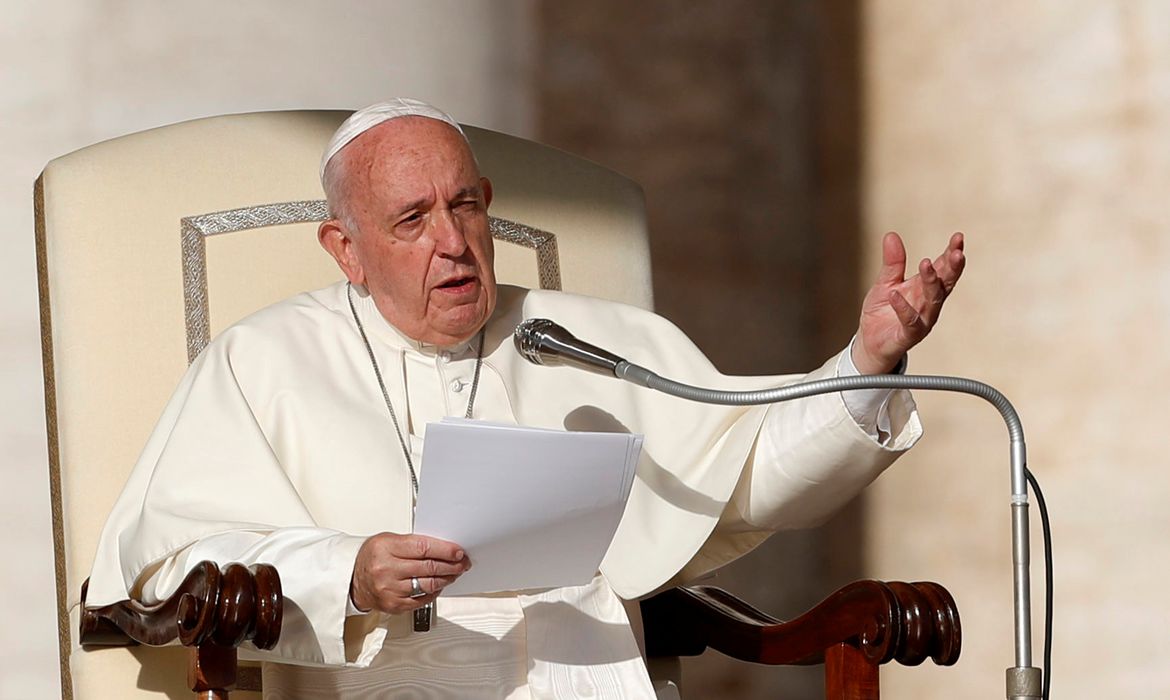
Pope Francis said in an interview with the Associated Press news agency that laws criminalising homosexuality are unjust and that “being homosexual is not a crime (…), but it is a sin”.
Francis acknowledged that Catholic bishops in some parts of the world support laws that criminalise homosexuality or discriminate against the LGBTQ (Lesbian, Gay, Bisexual and Transgender) community and admitted that he himself refers to the issue in terms of “sin”.
The Catholic Church leader also argued that these bishops in particular need to go through a process of change to recognise the dignity of all. “These bishops have to have a conversion process,” he said, adding that they should act with “tenderness, … as God has for each one of us.”
Some 67 countries or jurisdictions around the world criminalise consensual same-sex sexual activity, 11 of which can or do impose the death penalty, according to The Human Dignity Trust, a UK-based non-governmental organisation working to end such laws.
Experts say that even when the laws are not enforced, they contribute to harassment, stigmatisation and violence against LGBTQ people.
The United Nations has repeatedly called for an end to laws that openly criminalise homosexuality, saying they violate the rights to privacy and freedom and are a breach of countries’ obligations under international law to protect human rights, regardless of sexual orientation or gender identity.
Declaring such laws “unjust,” Francis said the Catholic Church can and must work to end them. “[The Catholic Church] must do that. It must do it,” he maintained.
Francis quoted the Catholic Church’s catechism, arguing that homosexuals should be welcomed and respected, and should not be marginalised or discriminated against.
“We are all children of God, and God loves us as we are and by the strength that each of us fights for our dignity,” Francis said in an interview Tuesday at the Vatican.
Such laws are common in Africa and the Middle East and date from British colonial times or are inspired by Islamic law. Some Catholic bishops have strongly defended them as consistent with Vatican teaching that considers homosexual activity “intrinsically disturbed,” while others have called for their abolition as a violation of basic human dignity.
In 2019, Francis was expected to issue a statement opposing the criminalisation of homosexuality during a meeting with human rights groups that have conducted research into the effects of such laws and so-called “conversion therapies”.
The Pope ultimately did not meet with the groups, who instead met with the Vatican’s ‘number two’, who reaffirmed “the dignity of every human person and against every form of violence”.
On Tuesday, Francis said there had to be a distinction between a crime and a sin when it came to homosexuality.
“Being homosexual is not a crime,” he said. “It is not a crime. Yes, but it is a sin. Very well, but first let us distinguish between a sin and a crime,” he explained, adding: “It is also a sin to lack charity towards your neighbour.
Catholic doctrine holds that while homosexuals should be treated with respect, homosexual acts are the result of a disturbance. Francis has not changed that doctrine, but he has made reaching out to the LGBTQ community a hallmark of his papacy.
Starting with his famous 2013 statement, “Who am I to judge?”, when asked about an alleged homosexual priest. As archbishop of Buenos Aires, he supported granting legal protection to same-sex couples, an alternative to advocating gay marriage, which Catholic doctrine prohibits.
Francis was criticised by the LGBTQ Catholic community after a 2021 decree by the Vatican’s doctrinal office that the church cannot bless homosexual unions “because God cannot bless sin”.
The Vatican in 2008 refused to sign a UN declaration calling for the decriminalisation of homosexuality, claiming the text went beyond the original scope and also included language on “sexual orientation” and “gender identity” that it considered problematic.
The Vatican then urged countries to avoid “unjust discrimination” against homosexuals and to end discriminatory sanctions.
