

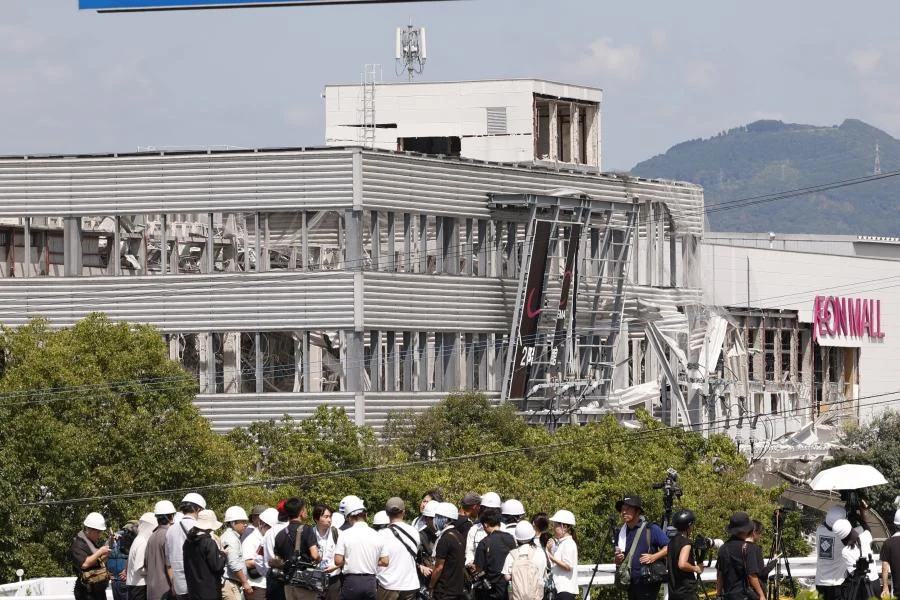
The death toll from a powerful earthquake that struck southwestern Japan has climbed to 34, authorities in Kumamoto prefecture said Thursday, as rescuers continue searching for survivors and evacuees confront a new challenge: extreme heat.
The magnitude 6.8 earthquake hit Kumamoto prefecture on Kyushu island Tuesday, causing widespread damage to homes and power infrastructure. Several of the deaths occurred after part of a shopping center collapsed and an explosion tore through the mall roughly an hour later.
Thousands of displaced residents are now sheltering in evacuation centers, where keeping people cool and hydrated has become an urgent concern as the region faces sweltering conditions. Forecasts show temperatures could reach 39°C (102°F) in the coming days, prompting officials to urge both survivors and rescue workers to guard against heatstroke.
Japan’s defense minister, Shinjiro Koizumi, announced Wednesday that 300 air conditioning units were being delivered to Kumamoto, with 150 destined specifically for evacuation centers. Roughly 9,000 displaced residents were staying in such centers as of Wednesday, while more than 30,000 households remained without power.
Read more about this topic: A 7.1-magnitude earthquake hit Japan’s Kumamoto prefecture, cutting power to 40,000 homes. Tsunami and aftershock warnings are still in effect (with video)
Yukiya Sanoue, who works at one of the evacuation centers, told the BBC that heatstroke was the biggest concern at his facility, which is currently housing about 1,000 people, roughly 30% of them elderly.
“Quite a few people are suffering from conditions similar to heatstroke, and several have been taken to hospital,” he said, explaining that electricity and water at the center had been cut off since the earthquake and that air conditioning wasn’t restored until Wednesday afternoon, when a generator finally arrived.
More than 100 aftershocks have been recorded since the initial quake, leading many residents to sleep in their cars out of fear of further tremors.
Recovery efforts remain underway across Kumamoto, with thousands of personnel deployed for search-and-rescue operations. Much of that work has centered on the Aeon shopping mall in Kashima, one of the hardest-hit structures, where part of the second floor collapsed and an explosion struck roughly an hour after the initial quake.
Read more about this topic: People are trapped after a mall floor collapsed in Japan’s earthquake. The cause still isn’t clear (with video)
Aeon’s president said it was “very likely” that the blast was caused by a gas explosion, though the exact cause remains under investigation. A cat café inside the mall confirmed Wednesday that all 25 of its cats, left behind amid the chaos of the earthquake, had since been safely rescued.
The damaged Aeon mall had only just reopened last month as a newly renovated shopping complex, after previously being damaged during a series of powerful earthquakes in April 2016 that killed 278 people across the region.
Rescuers have also been searching a Nippon Paper factory in Yatsushiro, where at least five people died after part of the building collapsed during the quake. Nippon Paper said in a Wednesday statement that 11 people had been trapped inside, seven of whom have since been rescued.
The earthquake, which struck at a shallow depth of just 10 kilometers (six miles), left many residents across Kumamoto badly shaken. Hiroko Ogata, a 75-year-old restaurant owner in Yatsushiro, told the BBC she took shelter under a table in her restaurant as the building swayed violently around her. “I have lived here for 75 years, but I have never experienced such a big quake,” she said. “I thought I would die.”
