

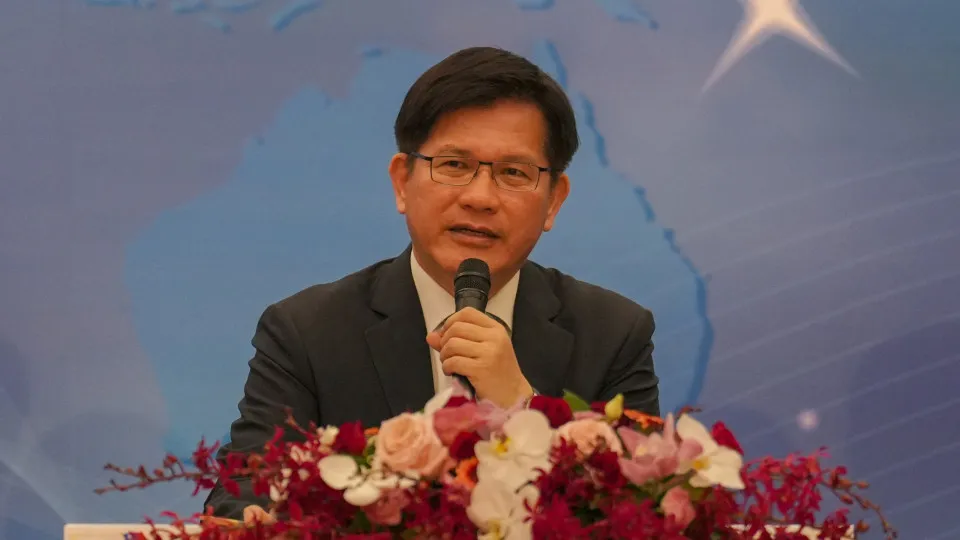
China’s attempts to pressure other countries into limiting Taiwan’s access to international events have become “the new normal,” Taiwanese Foreign Minister Lin Chia-lung stated today.
Lin spoke out after two Taiwanese delegates were detained in Kenya and barred from participating in an ocean conference, allegedly due to pressure exerted by Beijing on the organizers, according to Taiwan’s Ministry of Foreign Affairs.
China considers Taiwan, a self-ruled democracy, as its own province and does not rule out the use of force to bring the island under its control. In recent months, Beijing has intensified efforts to pressure other nations to restrict the participation of Taiwanese officials or representatives in various international events.
In April, the President of Taiwan postponed a planned visit to the Kingdom of Eswatini in Africa after three countries withdrew overflight clearance for their respective territories following Chinese pressure, according to the presidential office. The head of state eventually arrived days later on a plane chartered by the King of Eswatini.
Read more about this topic: China: motion to impeach Taiwan President fails required two-thirds
In the most recent incident, two Taiwanese delegates to the Our Ocean conference being held in Mombasa were prevented from entering the country under the argument that their Taiwanese passports were not recognized, Taiwan’s diplomacy reported on Tuesday.
According to the same source, the passports and mobile phones of the two representatives were confiscated, and both remained detained for more than 20 hours before being allowed to leave the country.
The remaining members of the Taiwanese delegation withdrew from the conference in protest of the treatment.
Kenya defended the decision, with the Principal Secretary of Kenya’s Ministry of Foreign Affairs, Korir Sing’oei, affirming that the country’s foreign policy “recognizes only one China.”
Read more about this topic: China to “crush” Taiwan independence efforts ahead of Trump-Xi summit (with videos)
Lin criticized what he classified as a “unilateral distortion and unjustified expansion” of the Kenyan interpretation of the “One China” principle, in reference to Beijing’s sovereignty claims over Taiwan.
“Preventing our delegates from participating in the meeting is absolutely wrong, and we strongly condemn and protest it,” Lin stated during an event organized by the Taiwan Foreign Correspondents’ Club.
China has not commented on the accusations.
Beijing has sought for decades to limit Taiwan’s representation in international bodies, including the World Health Organization (WHO) and the World Health Assembly. In the Olympic Games, the island participates under the designation of “Chinese Taipei” due to Chinese demands.
Read more about this topic: China’s 2026 invasion of Taiwan drives millions in betting site volume
Lin stated that China is increasing pressure on other countries to exclude Taiwan, especially emerging economies and developing countries that depend economically on Beijing.
“Some countries in the Global South are manipulated by the Chinese government in every possible way,” he stated. “Some democratic countries are trying to resist,” he emphasized.
Kenya is hosting the Our Ocean conference, which is dedicated to themes such as climate change, biodiversity, and marine pollution.
Hundreds of delegates from African countries, the United States, the European Union, and small island states in the Caribbean and the Pacific are participating in the meeting. The organizers intend to establish Africa, hosting the event for the first time, as a relevant player in global ocean governance.
Read more about this topic: China restricts exports to European firms over Taiwan arms sales
“Anyone claiming to hold a Taiwanese passport normally would not be allowed to enter through our borders due to lack of proper documentation and, in any case, would not participate in an official meeting called by the Government of Kenya,” Sing’oei stated.
China and Taiwan have been governed separately since 1949, when the Chinese Communist Party came to power in Beijing following the Chinese civil war. The defeated nationalist forces retreated to Taiwan, which later transitioned from martial law to a multiparty democratic system.
Beijing considers Taiwan part of Chinese territory and maintains that the island must come under its control, resorting to force if necessary.
