

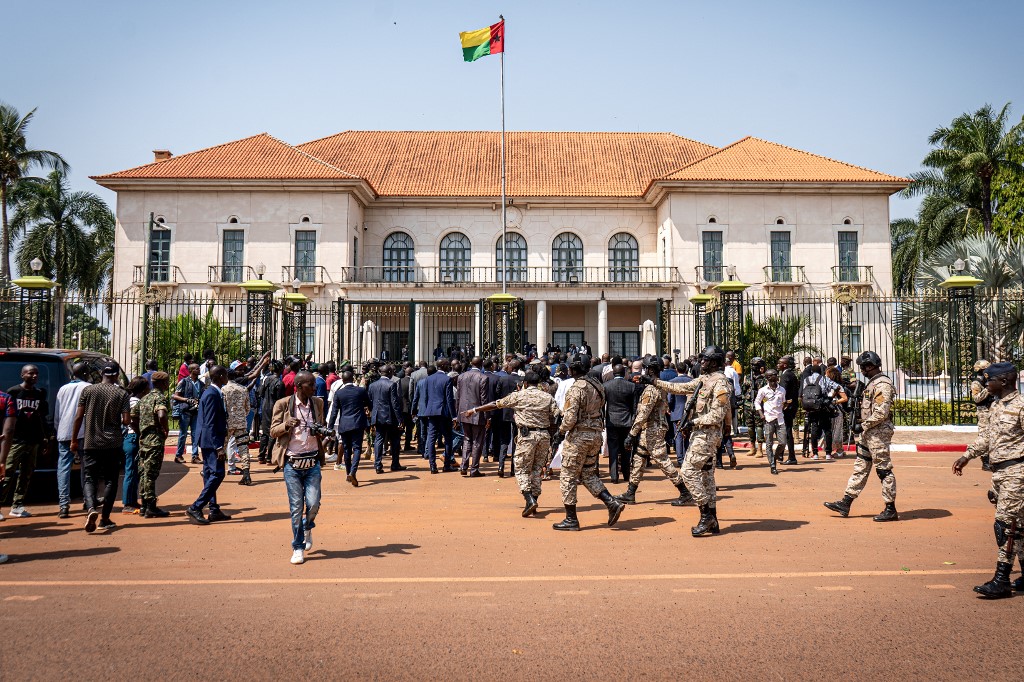
The president of the Guinean League for Human Rights, Bubacar Turé, stated today that Guinea-Bissau is experiencing “a period of calmness” six months after the coup d’état, but considers that there is a lack of dialogue on the part of the military in power. In an interview with Lusa, the activist described that initially, following the military takeover on November 26, 2025, “there was a lot of tension and some repressive acts,” but “recently, we have witnessed a return to calm.”
Between December 2025 and February 2026, the League’s headquarters, the House of Rights, was raided by police forces, and several events were suspended. However, in recent months, Bubacar Turé notes that the League has been able to carry out its activities without restrictions and with the cooperation of the authorities.
The organization’s president also pointed to “some openness from certain sectors of power,” specifically Prime Minister Ilídio Vieira Té and the Ministry of the Interior, with whom he has held talks.
This apparent calmness also applies to the daily lives of Guinea-Bissau’s citizens, as ordinary people and civil society organizations are conducting their routines regularly. According to Turé, the most worrying issue for the population is that the state is failing to “fully comply with its obligations to provide basic social services.”
Read more about this topic: Guinea-Bissau: IMF approves $1.6 million disbursement
He highlighted critical shortages in the healthcare sector, including oxygen crises at the main Simão Mendes National Hospital, alongside rolling strikes in health and education, widespread electricity blackouts, and drinking water shortages—problems aggravated by the suspension of international aid following the coup.
To resolve this situation, Turé advocates an urgent return to constitutional order, though he stresses that “this return cannot happen at any cost; prior conditions must be met.” He noted a worrying silence from the ruling authorities, stating,
“We are not seeing any dialogue or preparatory acts to this effect.” The League argues that a national dialogue involving political, religious, and civil society actors is essential to implement ECOWAS (Economic Community of West African States) resolutions and guarantee fundamental freedoms.
Regarding the new general elections announced by the military for December 6, Turé believes that “the preconditions for free and transparent elections are not in place.” He recalled that political party headquarters remain closed and fundamental rights, such as freedom of assembly and demonstration, are suspended. He criticized the “deafening silence” of both ECOWAS and the wider international community.
Read more about this topic: Guinea-Bissau: human rights situation worsened in 2023 and 2024
Furthermore, he expressed reservations about the December timeline because the National Elections Commission (CNE) was dismantled during the November 26 coup, with its facilities raided and equipment destroyed, and no voter registration or update of electoral rolls has taken place since.
The League also emphasized unresolved situations remaining from the coup, chief among them the status of Domingos Simões Pereira, president of the historic PAIGC party. A primary opponent of former President Umaro Sissoco Embaló, Simões Pereira was detained during the coup and remains under house arrest—a status Turé describes as “an illegal act” without judicial backing or official charges.
Turé additionally expressed fears that the late March murder of activist Vigário Luís Balanta, leader of the “Pó di Terra” revolutionary movement, will fall into obscurity and impunity, drawing parallels to the unsolved July 2025 assassination of presidential security officer Tano Bari.
Finally, the League voiced deep concern over unilateral legislative changes made by the military over the past six months, including a constitutional revision granting more power to the President, changes to electoral laws, and the creation of a social media verification committee.
Read more about this topic: Guinea-Bissau: Police dismantle network supporting illegal migration
Turé strongly condemned these measures, concluding: “I have never seen a body like a Transitional Constitutional Council revise a Constitution. It is illegitimate and lacks competence.” He argued that such reforms must either be submitted to a public referendum or wait for a democratically elected parliament.
