

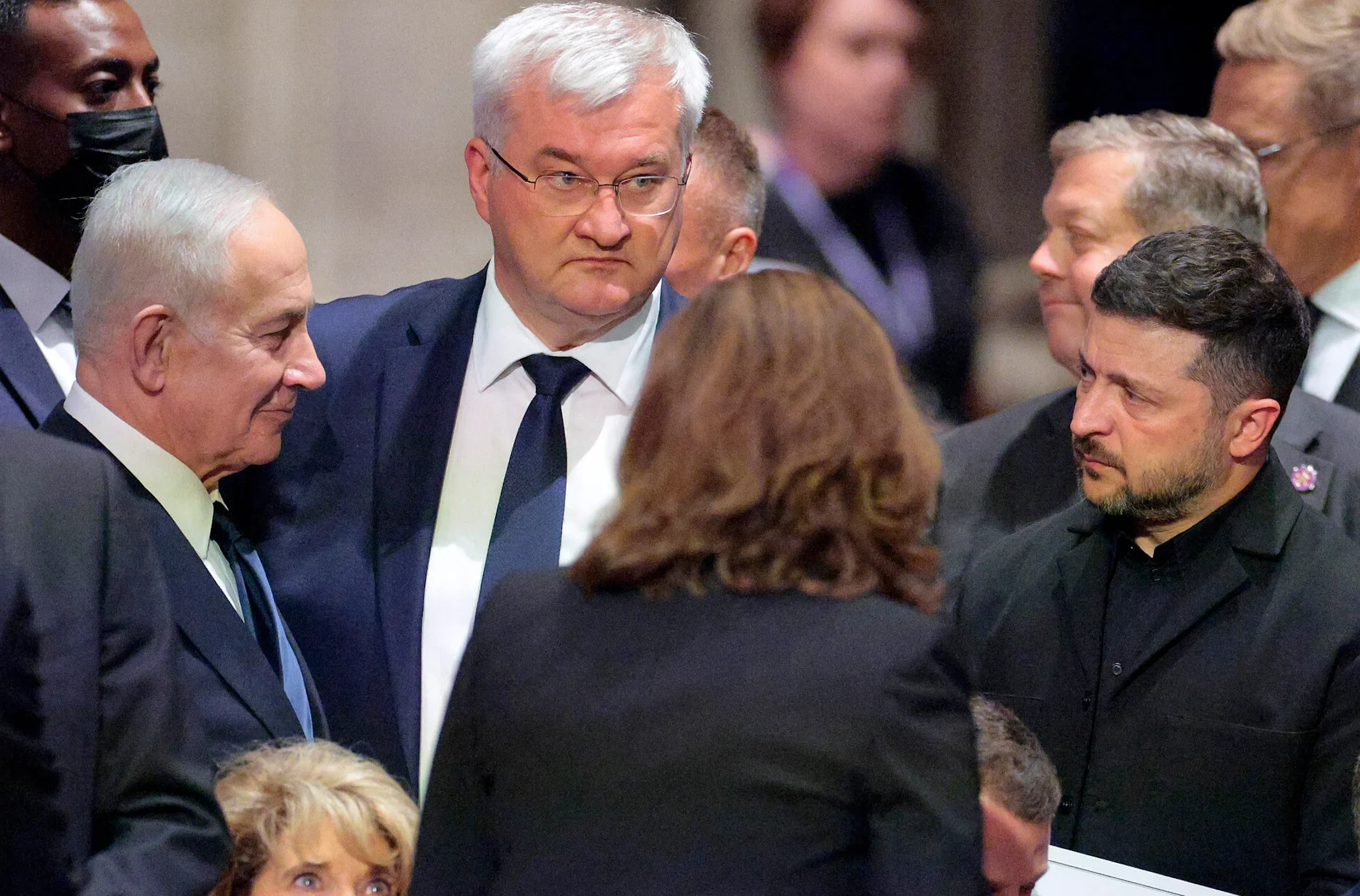
Prime Minister Benjamin Netanyahu and Ukrainian President Volodymyr Zelensky spoke face to face and shook hands ahead of Senator Lindsey Graham’s funeral service on Tuesday, marking their first in-person exchange in three years, shortly after each had separately met with President Donald Trump at the White House.
The conversation appeared serious but friendly, with both leaders smiling as they shook hands. The two hadn’t spoken since January 2025, and their last in-person meeting dated back to September 2023. According to reports, the two sides had explored arranging a formal sit-down while in Washington, but the idea ultimately didn’t move forward.
Haaretz reported that Netanyahu’s office had proposed the meeting but never followed up after Zelensky agreed, according to a Ukrainian source; neither side has commented publicly on that account.
Separately Tuesday, Israeli Foreign Minister Gideon Sa’ar spoke by phone with Ukrainian counterpart Andrii Sybiha and invited him to visit Israel. Sa’ar said the two discussed challenges facing both nations, including the threat posed by Iran, and wrote on social media that Israel and Ukraine remain friends looking to deepen cooperation, including through new education centers planned for Ukrainian hospitals.
Read more: Trump accuses Netanyahu of trying to keep US at war with Iran
Sybiha said he accepted the invitation and briefed Sa’ar on Russia’s escalating attacks against civilian shipping and freedom of navigation in the Black Sea, along with the implications for global food security, including for Israel as an importer nation. He also discussed Ukraine’s preparations to mark the upcoming 85th anniversary of the Babyn Yar massacre, in which Nazi forces and collaborators killed more than 33,000 Jews over two days in September 1941.
Relations between Israel and Ukraine have remained delicate since Russia’s 2022 invasion, with Zelensky previously accusing Netanyahu of maintaining calculated neutrality despite Russia supplying critical intelligence to Iran during its conflict with the U.S. and Israel.
Netanyahu has declined Ukraine’s requests to purchase Israel’s Iron Dome system, wary of provoking Moscow, and has similarly resisted Ukrainian offers to help Israel counter Iran-backed Hezbollah drone threats from Lebanon. Israeli officials have generally defended this cautious stance, though some have grown more willing to publicly distance themselves from Russia since Bashar Assad’s regime fell in Syria in 2024, a shift Netanyahu himself has largely avoided.
Regarding the Caspian Sea incident, Iran’s and Ukraine’s foreign ministers spoke directly on the matter Tuesday. Sybiha described the call as frank, stressing that Ukraine’s operations are focused solely on defending against Russian aggression and were never intended to target civilian vessels or people; Ukraine maintains the targeted ship was transporting weapons to Russia.
Read more: Zelensky says the war’s initiative is no longer in Putin’s hands. Russia is still launching more missiles than Ukraine can intercept
Sybiha said Russia bears full responsibility for the underlying provocations and casualties driving such incidents, and that he urged Araghchi to avoid further escalation and end any support for Russia’s war effort, reiterating that both Europe and the Middle East deserve stability and peace.
Iran has said at least one sailor died in the attack, and Foreign Minister Abbas Araghchi said Iran likewise isn’t seeking escalation, while making clear that any attack on Iranian citizens or interests is unacceptable and would require restitution.
