

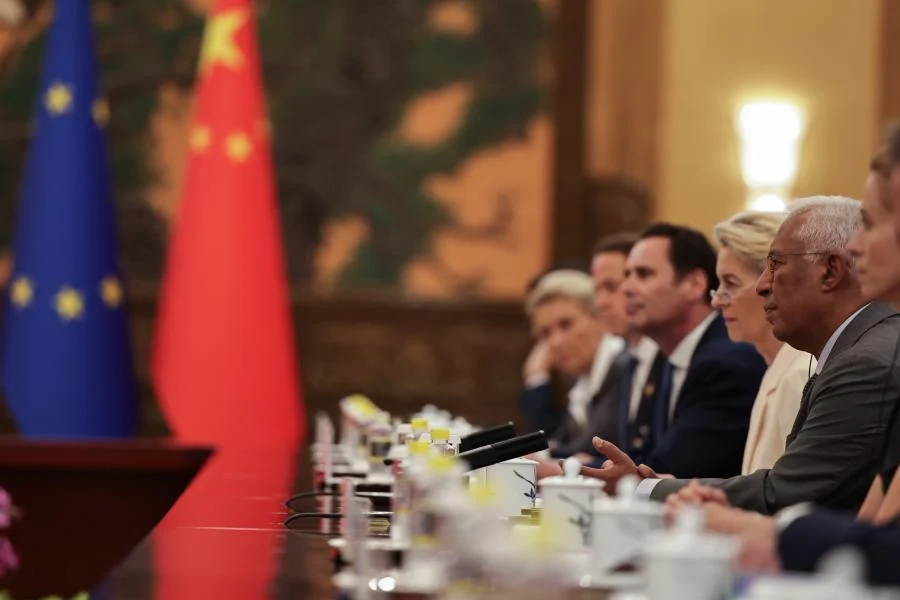
The European Union risks being marginalized in a rapidly changing global order unless it asserts itself more strongly, Chinese analysts warned during a conference in Macau focused on China–EU relations.
According to Li Xing, a professor of development and international relations at Aalborg University, the EU is increasingly being excluded from major geopolitical negotiations. He pointed to situations where leaders like Donald Trump and Vladimir Putin engage directly, leaving Europe out of key discussions.
“If Europe does not work hard, it will be on the menu, not at the table,” Li warned, describing the current global landscape as one of “entangled hegemony,” where neither the West nor China can fully dominate international systems.
He argued that the world is moving toward a “multi-order” system—a complex web of overlapping institutions and initiatives, including China’s Belt and Road Initiative and blocs such as the BRICS.
Read more: EU trade deficit with China widens as imports rise
Another speaker, Yu Hongyuan, suggested that the EU and China could form a stabilizing partnership, even proposing the idea of a “new G2” to help manage global challenges.
However, analysts highlighted the war in Ukraine as a major obstacle in China–EU relations. Li noted that Europe views China as indirectly supporting Russia, creating a strategic impasse in dialogue with Beijing.
Energy security was also a central concern. Yu warned of the growing use of energy resources as geopolitical tools, especially in light of tensions in the Middle East and disruptions in key supply routes like the Strait of Hormuz.
“The use of energy as a weapon creates unprecedented risks for the global economy,” Yu said, adding that attacks on major oil-producing regions could severely disrupt global supply chains.
The analysts concluded that increasing geopolitical fragmentation and the weaponization of resources pose serious challenges to the stability of the global economic system.
