

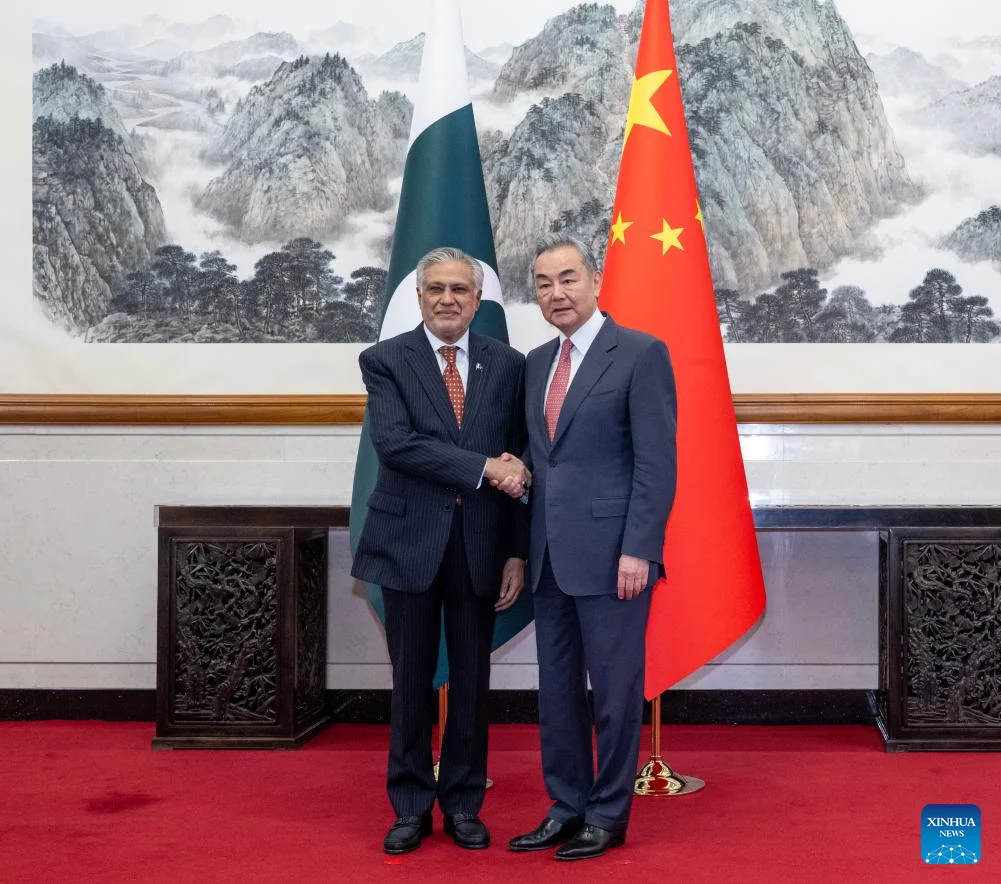
Pakistan and China presented a proposal today, the 1st, for a ceasefire in the war in Iran, the reopening of the Strait of Hormuz, and the launch of peace talks across the entire Middle East region.
The five-point proposal was discussed during a visit to Beijing by Pakistani Foreign Minister Ishaq Dar to meet with his Chinese counterpart, Wang Yi.
This initiative is intended to serve as a guideline for diplomatic efforts to end the war and restore stability in the region, including free navigation through the Strait of Hormuz, a crucial waterway for the global oil supply.
The official Chinese news agency Xinhua cited that the proposal calls for an immediate cessation of hostilities, the start of peace negotiations as soon as possible, and the guarantee of security for non-military targets as well as for navigation.
Read also: Iran War: China confirms three ships transit the Strait of Hormuz
Pakistan is stepping up diplomatic efforts to end the war, after hosting the foreign ministers of Saudi Arabia, Egypt, and Turkey last weekend and indicating that it hopes to host negotiations between the United States and Iran in the coming days.
The first point of the Islamabad-Beijing initiative focuses on securing an immediate ceasefire and an end to hostilities, as well as efforts to prevent further escalation of the conflict, including by delivering humanitarian aid to all areas affected by the war. This should be followed by the start of peace negotiations “as soon as possible,” according to the proposal presented.
“The sovereignty, territorial integrity, independence, and security of Iran and the Gulf States must be respected. Dialogue and diplomacy are the only viable path to conflict resolution,” the document emphasized, calling for a commitment to resolve disputes exclusively through peaceful means and for the parties to refrain from the use or threat of force.
This point clearly referred to Tehran’s demands that military aggression not be repeated, after the last two diplomatic efforts with Washington had ended abruptly with U.S. military strikes.
Read also: Iran War: Asian countries turn to Russian oil as conflict squeezes supply
Similarly, the third point called for ensuring the safety of “non-military targets” to prevent violations of the principle of the protection of civilians.
“China and Pakistan call on all parties to immediately cease attacks against civilians and non-military targets, fully comply with international humanitarian law, and halt attacks on critical infrastructure, such as energy facilities, desalination plants, electrical systems, and peaceful nuclear facilities, including nuclear power plants,” according to the proposal released by Xinhua.
Regarding the Strait of Hormuz, the document emphasized that the safety of navigation in this strategic area must be guaranteed.
“The Strait of Hormuz and the surrounding waters are vital international shipping lanes for the trade of goods and energy. China and Pakistan urge all parties to ensure the safety of vessels and crews detained in the strait, to facilitate the safe and swift passage of civilian and commercial ships, and to restore normal navigation in the strait as soon as possible,” they stated.
China and Pakistan also emphasized, as the fifth point of the initiative, the “safeguarding of the primacy of the UN [United Nations] Charter ,” insisting that “genuine multilateralism must prevail, jointly promoting a stronger role for the UN and supporting the conclusion of agreements based on the purposes and principles of the UN Charter and international law.”
This is the approach that must be followed to achieve “a comprehensive peace framework and attain lasting peace,” they concluded.
