

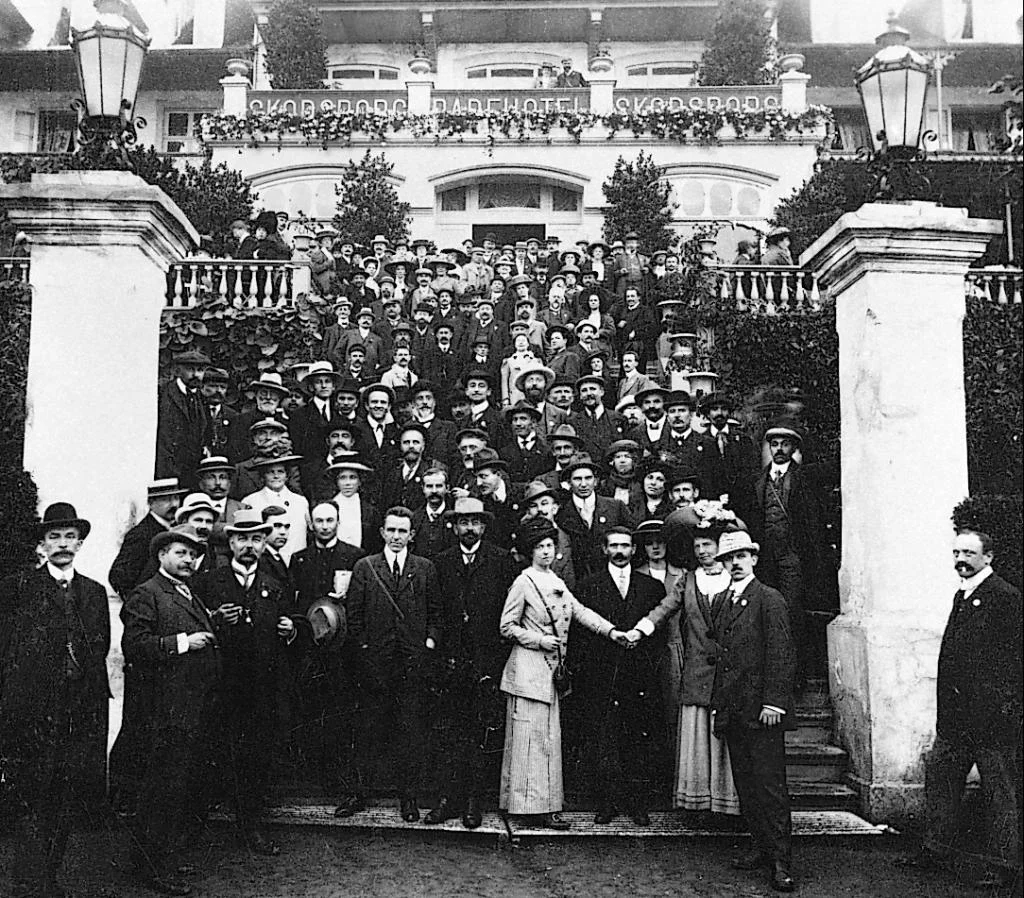
At the end of the 19th century and the beginning of the 20th century, many women worked in factories under harsh conditions: long hours, low wages, and virtually no labor rights.
In 1908, around 15,000 women marched in New York, United States, demanding highest salaries. This protest became a symbolic milestone in the movement for women’s rights, involving reduced working hours and the right to vote.
The following year, in 1909, the Socialist Party of America organized the first National Women’s Day in the United States, celebrated on February 28.
Clara Zetkin and the proposal for an international day
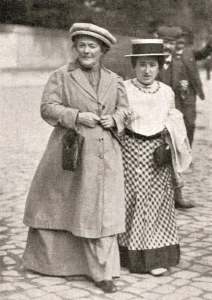
Clara Zetkin (left) and Rosa Luxemburg on their way to the SPD Congress. Magdeburg, 1910.
The idea of transforming the date into an international day emerged in 1910 during the International Conference of Socialist Women in Copenhagen, Denmark.
It was the German activist Clara Zetkin, one of the main figures of the European socialist and feminist movement, who proposed the creation of an annual day dedicated to the fight for women’s rights.
The proposal was approved by more than 100 women from 17 countries, including trade unionists, socialist activists, and advocates for women’s suffrage. The first International Women’s Day was celebrated on March 19, 1911, and subsequently on March 8.
The first international celebrations
The first International Women’s Day was celebrated in 1911 in several European countries, including Germany, Austria, Denmark and Switzerland. Millions of women participated in demonstrations demanding:
- right to vote
- access to public offices
- best working conditions
- equality in employment
- The connection with March 8th
The date of March 8 gained historical significance after events in Russia in 1917.
On that day, female workers began a strike for “bread and peace,” protesting against hunger and against the country’s involvement in World War I. The mobilization was so great that it ultimately triggered the February Russian Revolution (according to the calendar of the time).
A few days later, the czar was forced to abdicate and the new provisional government granted women the right to vote.
Official recognition by the UN
For decades, the day was primarily celebrated by feminist movements and socialist countries.
In 1975, the United Nations (UN) began officially celebrating International Women’s Day, helping to make it a global event dedicated to gender equality and women’s rights.
