

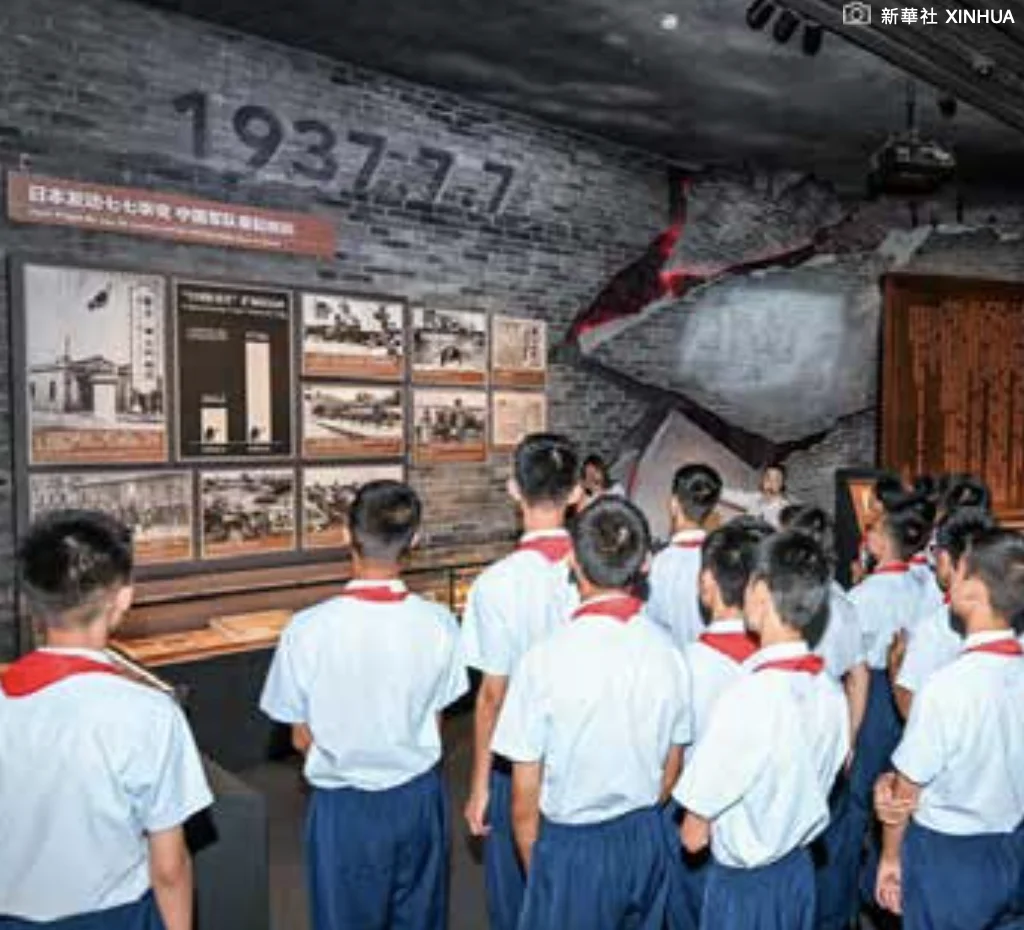
A year after the July 7, 1937 Incident, when Japanese troops attacked the Chinese garrison at Lugou Bridge — located in what is now Fengtai District, Beijing — under the pretext of searching for a missing Japanese soldier, “China’s position looked very, very bad,” said Rana Mitter, historian and professor of U.S.-Asia relations at Harvard Kennedy School, in a recent interview with Xinhua. “Overall, most outside observers thought the chances of China winning were very low,” said Mitter, who is also former director of the China Centre at the University of Oxford. “And yet, China resisted, and the fact that it did so, I think, changed everything.”
Despite technological disadvantages and difficult conditions, China’s persistent resistance helped tie down Japanese forces and forced millions of soldiers to remain on the mainland instead of being deployed to other regions of the Asia-Pacific, explained Mitter, author of *Forgotten Ally: China’s World War II, 1937–1945*. “It’s a reminder that China’s contribution, at that early stage by staying in the war, was a very important part of what eventually became a global war,” he said.
The expert also noted that *On Protracted War*, a 1938 treatise by Mao Zedong advocating a prolonged people’s war to counter Japan’s strategy of quick victory, remains one of the most influential works of military strategy of the 20th century. “Even today, it is read by students in military academies and history seminars around the world, not just in China. So, it is clearly one of those works whose value endures,” Mitter said.
Although several books on China’s role in the war have been published in the West, Mitter argued that “we need more (of those books).” More work, he stressed, must be done to raise awareness of China’s contribution, and the best way forward is to encourage much deeper historical research. “It’s a reminder that war should never be taken lightly, that it should be understood as one of the most devastating phenomena of human existence, and that we should use history to understand how to bring peace in a lasting, just, and proper way,” he said.
As for U.S.-China relations, Mitter noted: “What we’ve seen in recent weeks and months shows that the United States and China are capable of having quite mature and sensible discussions.” Recognizing the differences between the two societies and their aspirations, he expressed hope that “remembering part of that shared history — the history of World War II, when China and the United States fought together against very dark forces — can be part of that broader understanding even today.”
