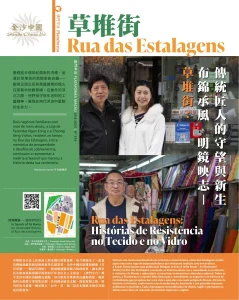
Once a bustling hub for artisans and merchants, Rua das Estalagens now welcomes a new wave of entrepreneurs blending tradition with innovation. Sands China has published a bilingual edition of In Search of Its Roots – An Illustrated History of Rua das Estalagens, revealing the stories behind this historic street and inviting residents and visitors alike to rediscover its century-old shops and cultural atmosphere. Each month, Plataforma and Sands China will highlight the community, businesses, and revitalisation efforts that aim to breathe new life into one of Macao’s oldest streets. Through captivating stories, we explore its transformation, honouring its past while shaping its future. Each report will be published in Chinese, English, and Portuguese on the last Friday of every month, in print and digital formats.
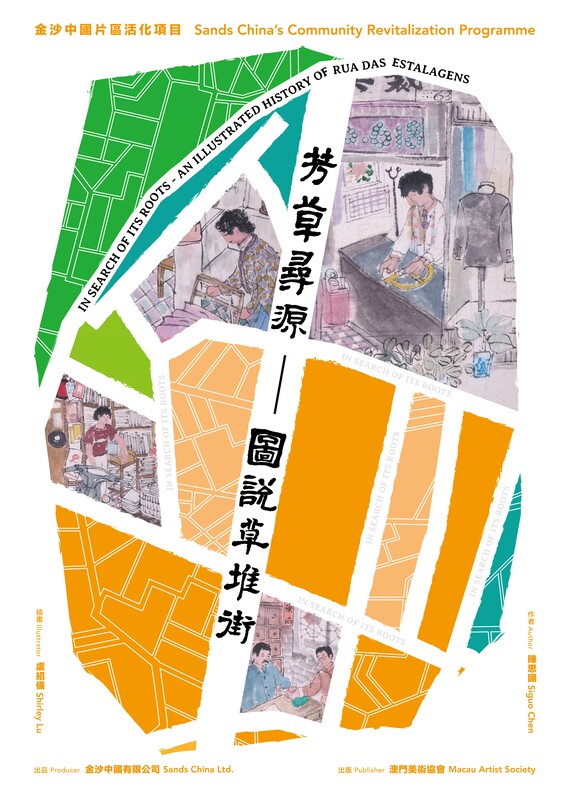
Learn more about In Search of Its Roots – An Illustrated History of Rua das Estalagens
- Producer: Sands China Ltd.
- Publisher: Macau Artist Society
- Author: Siguo Chen
- Illustrator: Shirley Lu
Loja de Fazendas Ngan Kong: The Last Stronghold of the Fabric Trade
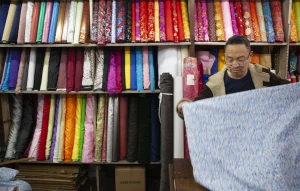
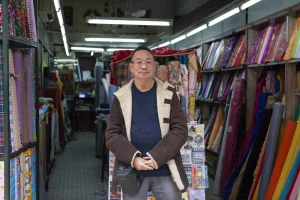
Cheang Io Kong, owner of Loja de Fazendas Ngan Kong, folds one of the fabrics on display in his shop. The textile trade on Rua das Estalagens dates back more than 200 years, reaching its peak between 1970 and 1990, when the street had more than 20 fabric shops and 30 related businesses. PLATFORM
“I can’t believe there’s still a fabric shop like this.” The amazement is shared by many tourists who step into Loja de Fazendas Ngan Kong. The fabric trade on Rua das Estalagens dates back more than 200 years, reaching its peak between 1970 and 1990, when the street boasted over 20 fabric shops and 30 related businesses. “Now we are the only one left,” says Cheong Wai Kun, wife of owner Cheang Io Kong.
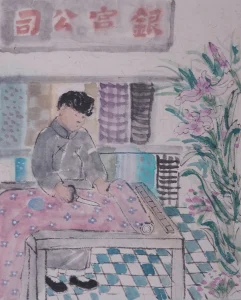
Loja de Fazendas Ngan Kong was founded in 1950 through the hard work of Cheang Io Kong’s father and uncle. To raise the necessary capital to open the shop, they carried baskets of fabric on their shoulders throughout Macao, trying to make sales on every street they passed. Sometimes they even went as far as Coloane. Illustration from the book In Search of Its Roots – An Illustrated History of Rua das Estalagens
Loja de Fazendas Ngan Kong was founded in 1950, born of the hard work of Cheang’s father and uncle. They carried baskets of fabric on their shoulders throughout Macao, trying to sell on every street they passed, sometimes walking as far as Coloane, just to save enough to open and expand the store.
Cheang remembers the good old days: “When we opened in the morning, customers were already waiting.” The shop served all segments of local society, from fishermen’s families who sought dark washable cotton to Portuguese officials’ families who purchased high-quality silk brocade.
The shop had everything. Its popularity was such that, some years ago, then Chief Executive Chui Sai On made a point of stopping at Ngan Kong during a visit to Rua das Estalagens, recalling how he used to accompany his mother there to buy fabric when he was young.
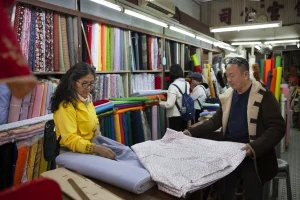
Loja de Fazendas Ngan Kong stocks “fashionable fabrics”, imported from Hong Kong to ensure top quality. The shop also produces bed sheets, duvet covers, and decorations such as stage skirts and wave curtains. PLATFORM
From 1995 onward, the end of preferential textile quotas in Europe and the United States opened the door to competition from Mainland China and other countries. The rise of branded ready-to-wear clothing further reduced the appeal of buying fabric.
Even so, Ngan Kong adapted, becoming a supplier for advertising companies and event organizers. “These companies needed a lot of materials, and we could provide most of them. We made many decorations for restaurants, such as chair and table covers. We even made them for government events,” Cheang recalls.
But the boom in online commerce brought new challenges. “Many of the companies that used to come to us now order from the Mainland,” he laments. Despite issues of quality and consistency, the reality is that prices online are extremely low, though Cheang insists his prices are also affordable.
Also read: Rua das Estalagens: From Healing to Nation-Saving — Sun Yat-sen and Chong Sai Pharmacy
Today, the shop focuses on keeping “fashionable fabrics” in stock, imported from Hong Kong to ensure quality. They continue to produce bed sheets, duvet covers, and decorative pieces such as stage skirts and wave curtains. Students still visit, and some tourists stop by — though most only pause to take pictures.
With demand declining, the couple clings to its niche but hopes the Sands China revitalization program will inject new energy into the street. “People should be able to come here and find everything they need.”
Cheong Seng Vidros: Four Generations of Glass and Mirrors
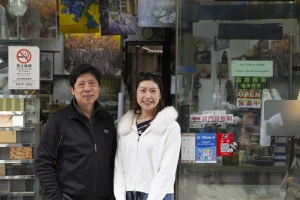
Lo Meng Fai (father) and Law Weng Chi (daughter) pose in front of Cheong Seng Vidros, the shop opened by their great-grandfather in 1949. PLATFORM
Rua das Estalagens was once a bustling hub of diverse businesses, thriving for a time; Cheong Seng Vidros bears witness to the glorious days of the glass trade on the street. “Cutting glass is like tailoring fabric. It’s an art,” says Law Weng Chi, who now manages the shop founded by her great-grandfather in 1949. “The street once had several glass shops, but ours is the one that remains,” she adds, acknowledging that it is a “difficult” industry with a very specific clientele.
The family business is now in its fourth generation. “The shop was inherited by my father, then by me, and then by my daughter,” explains Lo Meng Fai, who has since passed the reins to Law.
The history of Cheong Seng begins in 1948, when the glass shop where Lo Man Sik worked closed. Using his contacts and the small amount of capital he had saved, he took a chance and opened his own store on Rua das Estalagens. The risk quickly paid off: Cheong Seng made its first fortune transporting glass to the newly founded People’s Republic of China, which at the time was in urgent need of essential materials.
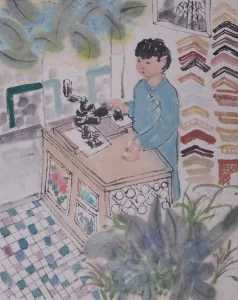
When Mainland China began taxing imported glass, Lo Ka Chin, son of Lo Man Sik, shifted the business to the local market, also focusing on frames. To meet demand, he created his own cutting machine, which the family used for 50 years. Illustration from the book In Search of Its Roots – An Illustrated History of Rua das Estalagens
Later, when Mainland China began taxing imported glass, Lo’s son, Lo Ka Chin, shifted the focus to the local market, specializing in various types of flat glass, mirrors, and picture frames. Lo Ka Chin had two advantages. First, he invented a lightweight cutting machine for frames, which the family used for more than five decades. Second, he developed a talent for calligraphy, writing verses and inscriptions in reverse on the back of mirrors — a skill appreciated by customers looking to give meaningful gifts.
Lo Ka Chin retired in the 1980s, passing the business to his son, Lo Meng Fai. By then, new technologies and new uses for glass — especially in decoration and construction — had arrived. Lo Meng Fai guided another transformation, specializing in decorative glass for shop windows, showcases, and display cabinets.
The emergence of new hotels in Macao proved the strategy successful. “When casino development began, hotels needed decorative glass. A hotel was being renovated, and they wanted to renew the model suite on the top floor. The elevator wasn’t yet installed, so my father had to carry the piece up the stairs. Seeing how hard he worked was what made me want to continue the business,” recalls Law.
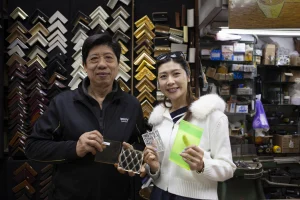
Lo Meng Fai (father) and Law Weng Chi (daughter) display some of the glass products available at Cheong Seng. Law chose to continue the family legacy after seeing her father carry a glass showcase up the stairs to the top floor of a hotel. “Seeing how hard he worked was what made me want to continue the business.” PLATFORM
“Retail customers used to buy single panes or have small fixtures installed. Those orders are fading, as products now come pre-attached from Mainland China. Today, most of our business is repair work. But to sustain operations, we also take on larger contracts. We handle everything from hotel and casino glass damage to replacements: exterior façades, interior decorative glass, countertops, light fixtures — any glass needs,” details Lo Meng Fai.
Like many other traditional shops on Rua das Estalagens, Cheong Seng Vidros carries a spirit of community, particularly evident in 2017 when Macao was hit by Typhoon Hato. “We received countless requests for repairs. Many windows were shattered, especially in Areia Preta. The boss at the time was still my father. There were so many people with broken windows, without glass, and homes in chaos, that my father simply worked through the night and didn’t charge extra. At the same time, Rua das Estalagens was completely flooded. We had to save ourselves and save others. I was very proud; I felt we were truly helping people through such a tragic moment,” Law recalls.
Today, at 70 years old, Lo no longer manages the day-to-day operations, having entrusted the business to his daughter Law Weng Chi, who believes in continuity — especially with the revitalization of the street. “We are thrilled! This is an old street that deserves a new lease on life. Rua de S. Paulo, Rua de Cinco de Outubro, and Rua dos Ervanários form a triangle, and Rua das Estalagens connects all three. Revitalization would significantly improve the flow,” Law concludes.
On September 26, we start exploring how new businesses are transforming Rua das Estalagens and shaping the future of this historic street.