

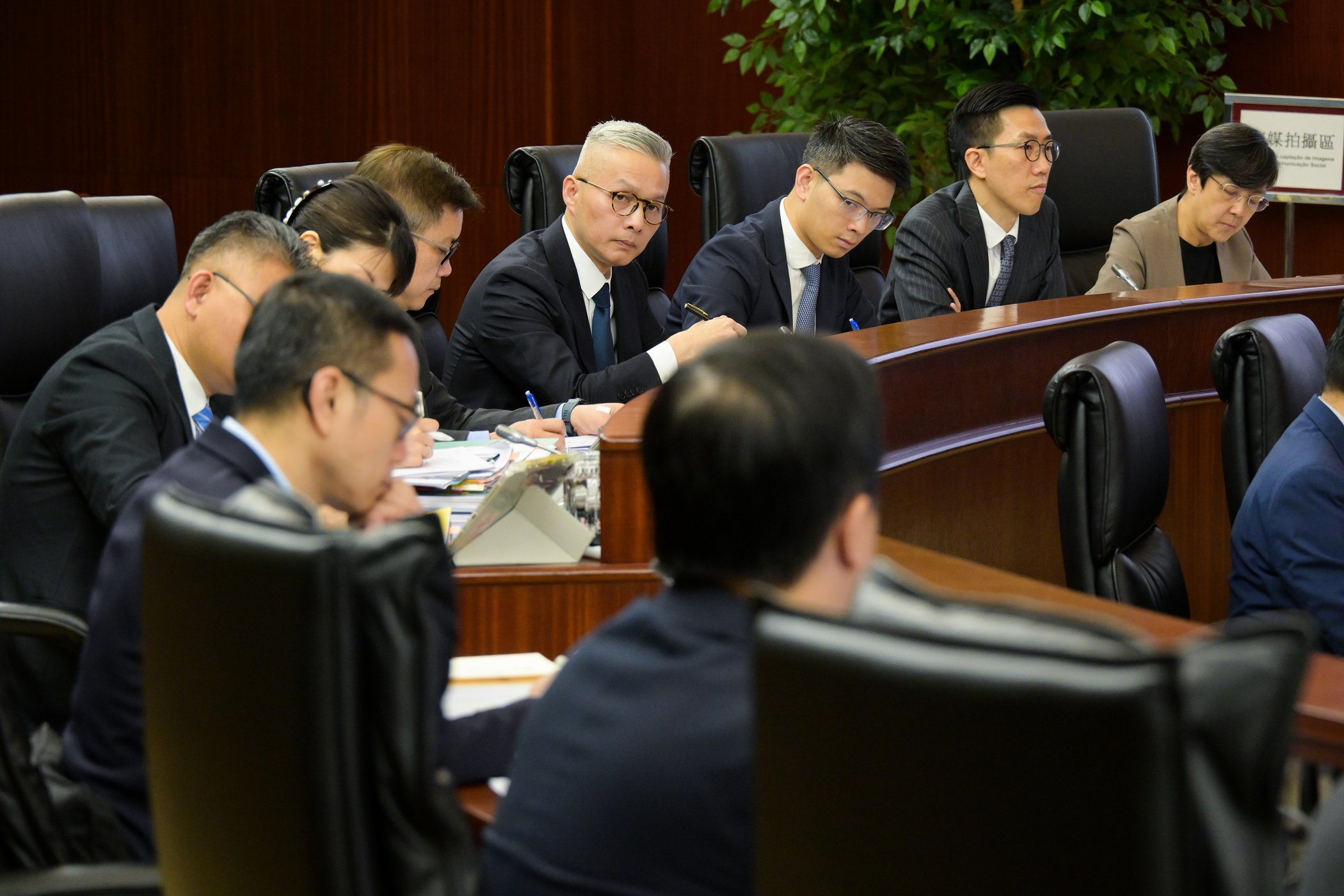
Tai Kin Ip once again emphasized in the Legislative Assembly this week the “structural difficulties” facing the local economy. These challenges have been exacerbated by the “rise of unilateralism and protectionism,” leading to “uncertainties” from which Macau, “as a microeconomy oriented toward the external market and highly open, can hardly isolate itself.”
The overreliance on the gaming industry is a recurring theme in the political discourse of this new cycle, but so is the belief in the “opportunities” offered to Macau by the “national plan.” “The Motherland has always been our strong support. Our country’s economy has a solid foundation, multiple advantages, great resilience, and significant potential.” Additionally, there is Beijing’s political guidance and backing, a notion reinforced by the spokesperson of the Hong Kong and Macau Affairs Office immediately after the Chief Executive presented the Policy Address report last week: “The Policy Address directly addresses challenges and problems, strengthens strategic planning and institutional reforms, and introduces a set of new ideas and initiatives, demonstrating a sense of responsibility, a commitment to innovation, and the determination of the new Macau SAR Government to overcome difficulties.”
By highlighting both challenges and opportunities, the Secretary for Economy and Finance laid out the pillars of a strategy that will continue its course. His firm and confident tone suggests that this direction will be pursued regardless of any doubts or complaints that may arise among local elites: “Strengthen the economy, promote diversification, improve the quality of life of the population, and seek development.” The key priorities include “economic diversification,” “support for qualitative development of businesses and residents,” and “integration into the broader national development framework.”
On the other side of the equation lies Macau’s relationship with international markets—a clear priority that now explicitly includes the Spanish-speaking world alongside Portuguese-speaking countries. The sensitivity of this topic is evident, with multiple lawmakers pressing for answers on employment protection and local interests. It is becoming increasingly evident—an acknowledgment by the current government—that the path to diversification lies in Hengqin. Additionally, the notion that tourism can be replaced by the four new industries outlined by Beijing is gradually being debunked. In reality, it is always **1+4**—not four instead of one. In other words, tourism **plus** culture and sports; tourism **plus** technology; tourism **plus** healthcare; tourism **plus** high finance.
At its core, this strategy clearly aims to attract new types of tourists, targeting new markets heavily linked to MICE and business—not just regional travelers but also those from further afield—while expanding the city’s range of offerings. The government acknowledges that Macau needs to become “more attractive,” not only as a leisure destination but also as a business-friendly environment. As Sam Hou Fai had already stated, Tai Kin Ip also stresses the need to simplify processes and enhance Macau’s appeal in order to shift revenue patterns and reduce dependency on the gaming sector. In short: streamlining bureaucracy within the government—an objective frequently highlighted by the Secretary for Economy and Finance and in line with the expression used by the Chief Executive last week in his Policy Address presentation: “A business-friendly environment.”
Revitalization, Digitalization, and Subsidized Credit
Regarding the dominant concerns raised in the Legislative Assembly, Tai Kin Ip responded without presenting major new developments. He reiterated government support for “business digitalization,” access to “subsidized credit,” and the creation of an employment platform to facilitate job searches. Additionally, he mentioned ongoing “studies” and Macau’s participation in “international forums” to assess economic policies being implemented in other parts of the world.
Furthermore, responsibility for the revitalization of old neighborhoods, previously managed by the six concessionaires, will now fall under the jurisdiction of the Economy sector. Tai Kin Ip emphasized that a full review of these projects is underway, stating that “this is also linked to the city’s ability to attract tourists, but also to SMEs and consumer support.” However, he insisted that the medium- and long-term strategy is firmly centered on a new business environment.
“The Economy and Finance sector will strengthen interdepartmental cooperation, attract and secure investment from various markets—focusing on priority industries—while also improving ‘One-Stop’ investor services and increasing the digitalization of public services.” The push to accelerate investment will also include a fund that “is currently being studied” to facilitate the “transformation of scientific and technological research results, encouraging capital investment in society to jointly support the development of industries and attract more projects and companies to Macau.”
As for the location of the proposed science and technology park—whose planning and budgeting Sam Hou Fai has committed to this year—Tai Kin Ip confirmed that “no final decision has been made yet.”
Beyond Borders
Macau’s national border is becoming increasingly fluid, with Tai Kin Ip reaffirming the continuation of policies to encourage Macau residents to work in Hengqin and actively participate in the development of the Greater Bay Area. This includes “deepening exchange and cooperation with other provinces and cities in Mainland China” and improving “the ease of movement for qualified professionals, capital, goods, information, and other key elements within the Greater Bay Area.”
At the same time, more distant frontiers are also on the agenda. “To further support the establishment of an even more open international platform, we will deepen international exchange while simultaneously attracting investment and expanding outward, bringing in high-quality international resources, helping Mainland Chinese companies expand globally, and strengthening international ties.”
