

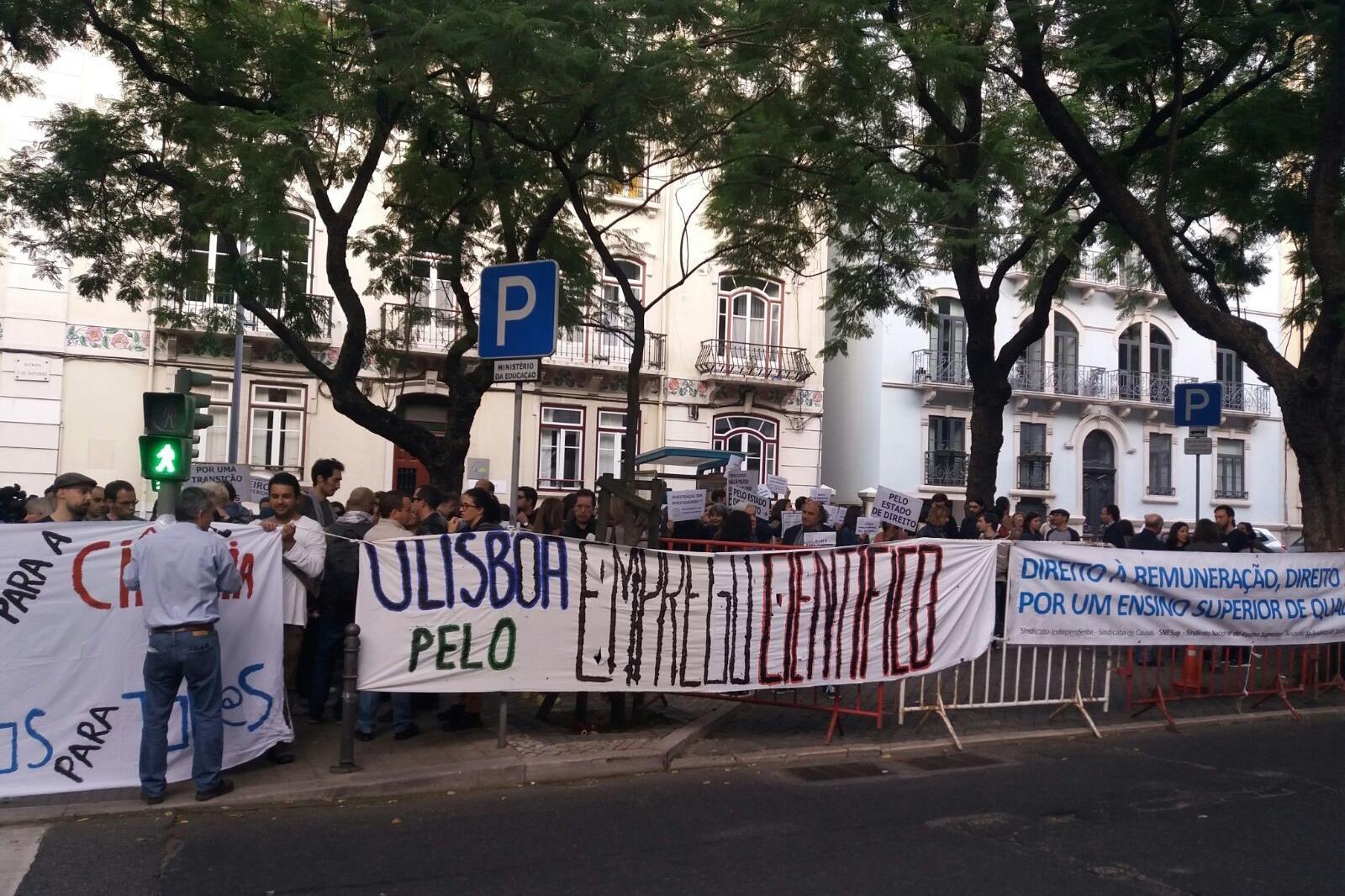
Hundreds of scientists gathered on Tuesday at the University of Lisbon in a demonstration against job insecurity, warning that science is not made with grants and short-term contracts.
The participants in the protest, which included a march to the Ministry of Science, Technology and Higher Education, held placards with the words “For the defence of professional rights” or “PhD is work”.
The demonstration, promoted by several organisations and union structures, took place on the National Scientists Day.
Speaking to the Lusa news agency, Carlos Lima, a researcher in the area of Chemistry at the Faculty of Sciences of the University of Porto (FCUP) said, concerned, that there is still no solution for his scholarship contract, which will end in a year and a half.
“(…) There are thousands of researchers in this situation and we want a solution,” he said.
Carlos Lima stressed that researchers have felt ignored by the Government.
“They offer ‘bring-home’ solutions. This is what we feel. They are not solutions that give sustainability. I think we talk so much about sustainability, about the environment, but there is no sustainability of higher education,” he stressed.
“We are fundamental to the work of the faculty. We ensure research, (…) we ensure classes, we ensure the supervision of students, undergraduate, masters and doctoral students. We do all that it takes for the university to survive and in the end we get very poor recognition,” he added.
Alongside her, Renata Costa, also a researcher at the Chemistry Research Centre of the University of Porto (CIQUP), explained that they are “under the transitional rule like the rest of their colleagues”.
“We work at the University of Porto and what we want is that, at the end of this transitory norm, a mechanism for the integration of these researchers is created, as happened in the PREVPAP [Programme for Extraordinary Regularisation of Precarious Contracts in the Public Administration] recently,” she stressed.
Having started her activity as a doctoral scholarship holder in 2009, having obtained a post-doctoral scholarship in 2013 and a transitional contract in 2019, Renata Costa envisaged an uncertain future after 2025.
The president of the Association of Scientific Research Fellows (ABIC), Bárbara Carvalho, told Lusa that the labour instability in the sector has been going on for many years, with many researchers on precarious contracts and “without any prospects of career integration”.
“It’s important to say that the teaching career exists and that science managers should and deserve to be integrated. What happens is that people do research, or give lessons (?), for more than 10/15 years, in a precarious way”, she said.
Bárbara Carvalho also warned about the status of the scholarship holder, which means that they don’t have “access to basic labour rights”.
“We don’t have access to unemployment benefits – for example, holiday pay, Christmas bonuses. What we have is a great lack of labour protection and we know (?) that we have permanent needs”, he stressed.
The general secretary of the National Federation of Teachers (Fenprof), Mário Nogueira, joined the protest and told Lusa that today’s demonstration was already urgent and that education and science “has been subject to an absolutely indecent precariousness”.
“We are talking about a sector that has 3,600 researchers in precariousness for 400 and few (…) researchers in the framework. This is an unacceptable situation and we know that researchers in Portugal have done an absolutely extraordinary job”, he said.
Also speaking to Lusa, the president of the National Higher Education Union (SNESUP), José Moreira, explained that this is “a struggle that has been going on for many years”.
“Every day, or almost every day, of Science we have a demonstration of this type. This fight is to culminate the process of scientific development of the country, which had a great impulse with [the Minister of Science and Technology] Mariano Gago, (…) we have seen the number of PhD holders increase, the number of scientific publications (…) increase, the number of students of higher education teachers increase, but we have not seen the jobs of scientists”, he noted.
José Moreira clarified that all scientists who “make an extraordinary development of Science” in Portugal continue “more or less in the same conditions in which they were 30 years ago”.
“All these work contracts are precarious contracts. This is the time for the country not to waste all this talent (…), integrating them either in research careers or in teaching careers,” he concluded.
