

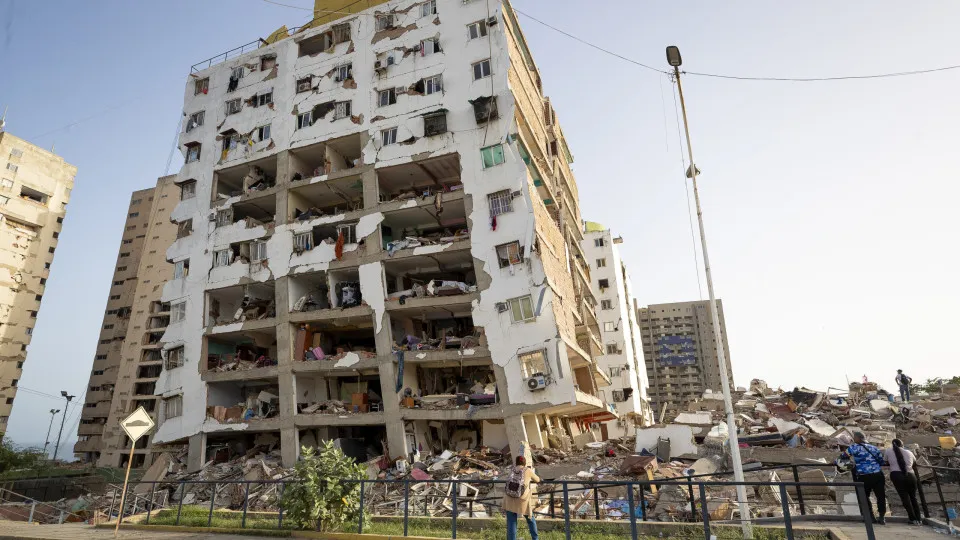
The Venezuelan organization Dividendo Voluntario para a Comunidad (DVC) warned today that, two months after the double earthquake on August 24, difficulties persist for the Portuguese community in La Guaira, which requires ongoing accompaniment and support.
“We appreciate and value the work of the Portuguese community that has been present, especially because it is very hard-working and, furthermore, because it has worked in unity with Venezuelans. That community needs support today, help, but, above all, for us to accompany them in the recovery process,” the president of DVC told Lusa.
Ramón Ostos, who is also the director of KPMG in Venezuela, noted that the community in La Guaira, the state most affected by the earthquakes, is preparing for reconstruction, which “must consist of building back better” than what existed before the quakes.
“That is the challenge: the concept of resilience is about how to overcome in a positive manner a situation as tragic as the one we have experienced. And the Portuguese community has been present, always attentive to how to recover, but, above all, looking to the future with optimism despite the tragedy,” he said.
Read more about this topic: Colombia and Venezuela: Two similar earthquakes, two very different outcomes
Ramón Ostos also stressed that “the country has to move forward,” as does the community, and that thanks to them “growth will happen” in La Guaira, but also throughout the area of Carayaca and El Junquito, where a large Portuguese community exists, particularly in the agricultural sector.
“It is a matter of accompanying them through this recovery process, but with an optimistic vision of what we are going to recover and that we must work together,” he said.
“May we never forget our communities. And I refer to all communities and all Venezuelans, as well as the entire Portuguese, Spanish, and Italian communities living in the state of La Guaira. (…) No matter how much the tragedy has ceased to be news, the situations and the tragedy are still there, and we must continue thinking about them and remain attentive to how we can continue to support and help,” he emphasized.
“It is the best moment to work on that social cohesion that we have always talked about and envisioned for our country,” stressed Ostos, highlighting the importance of “a united country.”
Read more about this topic: Earthquake puts Lusophone center in Venezuela at risk of demolition. Community seeks help to rebuild
DVC was created in 1958 by the business sector, focused on supporting the sharing of economic growth with local communities.
In the 1970s and 1980s, DVC built more than 280 rural schools in Venezuela, and today it maintains early childhood nutrition programs and livelihood creation initiatives, alongside the Silver Alliance for people over 55, which promotes knowledge sharing, Ostos added.
In La Guaira, he said, the first phase of response consisted of creating collection centers where they received more than 104 tons of goods, 95% of which were delivered to temporary camps and to Caritas Venezuela, followed by distribution centers.
They are currently conducting a census to identify, in collaboration with the organizations Fe y Alegría and the Venezuelan Association for Catholic Education (AVEC), safe schools that can open in September to start the upcoming school year, he stated.
Read more about this topic: Colombia mobilized emergency teams within an hour of its earthquake. Venezuela’s response to its own quake took far longer. Here’s why (with video)
“The initial census available to us points to more than 24,000 children, and what we intend, through the donations received from the business sector, is for them to be able to return to classes as quickly as possible,” he said. The double earthquake on August 24 caused severe damage to infrastructure, injuries, and fatalities across seven states in Venezuela—Caracas, Miranda, Aragua, Carabobo, Lara, Yaracuy, and La Guaira, the latter being the most severely affected.
According to the latest updated balance released by authorities, 6,509 people died and 226,696 people received assistance in hospitals following the earthquakes. Among the deceased, there are at least 138 Portuguese nationals and descendants of Portuguese origin.
At least 190 buildings collapsed and authorities inspected 60,785 homes, of which 11,001 were deemed “high risk” and approximately 25,240 houses are uninhabitable, with 600,790 tons of debris already removed.
