

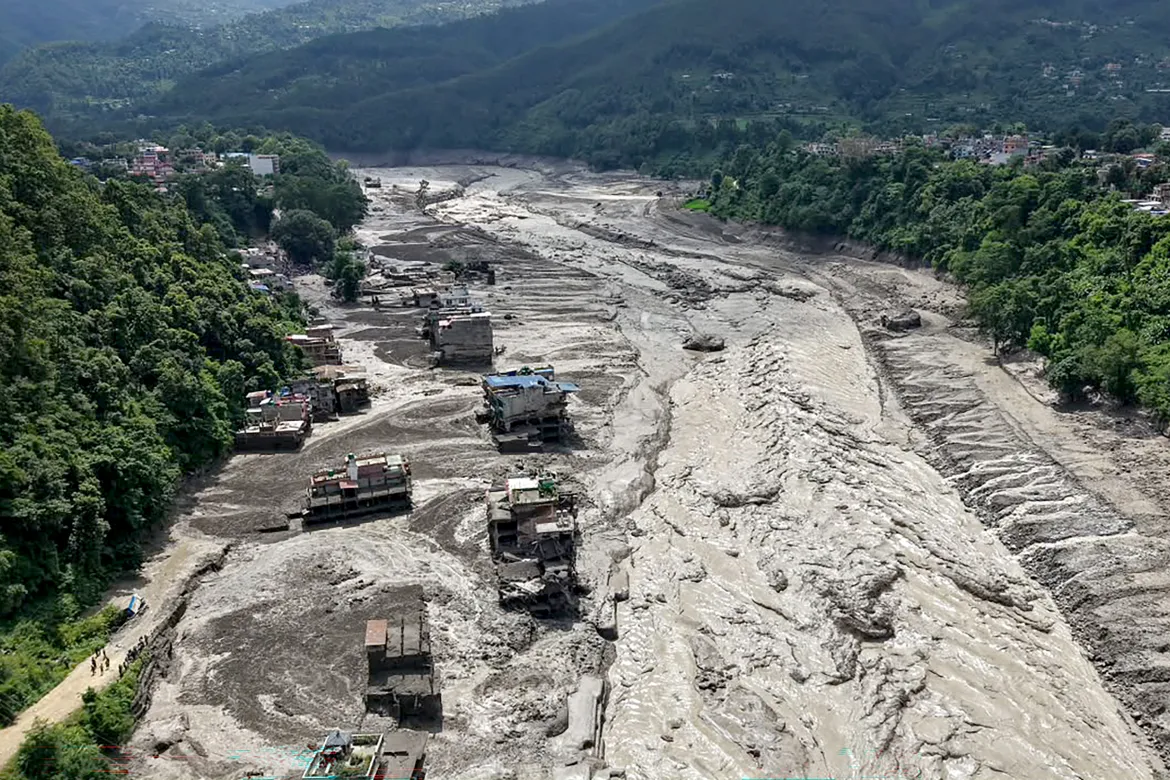
Massive flash floods triggered by an ice and rock avalanche swept through parts of Nepal, killing at least eight people and leaving hundreds missing across mountain communities. The disaster inflicted severe destruction on local infrastructure, burying multi-story buildings, vehicles, and roads under dense thickets of mud while destroying regional hydroelectric projects.
The surge began along the Lhende Khola River before swelling the Bhotekoshi, Trishuli, and Narayani rivers. Among those reported missing are hundreds of international travelers and pilgrims, including tourists from India, the United States, the United Kingdom, Malaysia, and South Korea. Many of the missing foreign nationals were en route to sacred pilgrimage sites in Tibet or working on regional infrastructure projects in affected districts like Nuwakot and Rasuwa, AP reports.
Read more: Typhoon Narra forced 54,000 evacuations in southern China. A second storm, Super Typhoon Saudel, is already tracking toward the region (with video)
In response to the catastrophic destruction, the Nepalese government has requested emergency assistance and rescue coordination from neighboring India and China. Disaster response teams have issued urgent safety warnings to residents in downstream districts, urging populations to remain far clear of riverbanks as water levels fluctuate.
Climate researchers at the International Centre for Integrated Mountain Development noted that the flood occurred after an avalanche temporarily dammed the river upstream, releasing a massive deluge once the natural barrier failed. Scientists emphasize that the accelerated melting of Himalayan glaciers due to global climate change is increasing the frequency of such extreme hydrological events across the region.
