

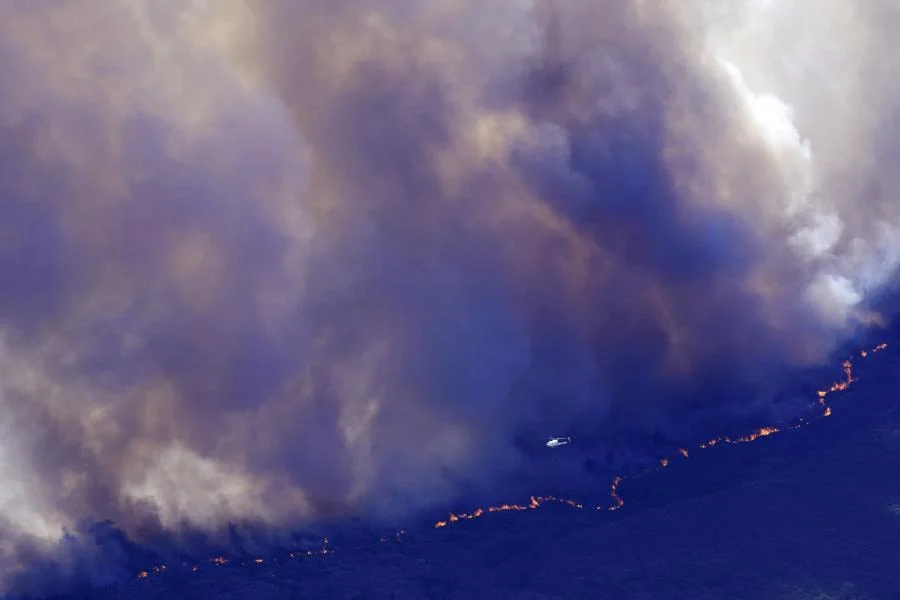
As wildfires tear across southern Europe earlier and more intensely than usual this year, with more than 240,000 acres already lost in Spain, one small nonprofit in Catalonia is fighting back with an unlikely tool: a herd of rescued donkeys.
While much of modern wildfire prevention now leans on satellites, drones and artificial intelligence, roughly 80 miles south of Barcelona a different kind of solution has been quietly at work in the mountains.
Tivissa Donkey Firefighters, based in southern Catalonia, takes in mistreated and abandoned donkeys and puts them to work grazing the driest, most flammable vegetation across rural hillsides, carving natural breaks into the landscape that can slow a fire’s spread, according to a report from CNN.
Founder Joan Cedó Sans took in his first donkeys back in 2020 and now oversees a herd of 62 animals that roam both private and public land throughout the region, thanks to appetites he describes as nearly limitless. He said the project reflects gratitude toward animals he believes deserve a second chance.
Read more about this topic: Spain declares a state of emergency in Madrid and Ávila as wildfires force 10,000 evacuations. Here’s what happens next (with video)
The idea traces back to wildfires that swept near Cedó’s own land in Catalonia in 2013. Remembering that experience, he decided to test whether donkeys could clear the undergrowth surrounding his property, and found that they ate through it completely. What started as an experiment eventually grew into a full-time operation.
Cedó, who now also serves as mayor of the small town of Tivissa, handed daily management of the herd to volunteer Jordi García, who joined the effort in 2021 and describes the work as deeply rewarding, spending his days outdoors while giving these animals a real chance at life.
Among the herd’s earliest members was Roberto, a former racing donkey nearly sent to slaughter once his bulky frame made him too slow to keep winning; Cedó describes him as having a certain awareness of his own second chance. Another donkey, Paloma, arrived overweight after being fed junk food like supermarket cookies and sugar cubes by previous owners, a diet Cedó calls a form of mistreatment in itself.
Cedó sees the arrangement as mutually beneficial. The donkeys help prevent fires, and in exchange they gain a stable herd, care from a volunteer veterinarian, and supplemental feed donated by local farms and a nearby amusement park. That work has taken on new urgency: 2025 was the European Union’s most destructive wildfire season on record, with Spain alone losing nearly a million acres.
Read more about this topic: Extreme heatwave drives 100-kilometer fire perimeter in Spain as firefighters pivot to defending homes. The structural limits of Southern Europe’s wildfire defenses (with video)
Jordi Bartolomé Filella, a professor at the Universitat Autònoma de Barcelona who studies herbivore ecology, explained that donkeys naturally favor the type of dry summer grasses known as fine fuel, the plant material that ignites easiest and helps fires spread fastest.
He noted that combining different grazing animals tends to work best, since each targets different layers of vegetation. Goats, for instance, are prized for quickly clearing woody brush and have spurred entire businesses in places like California, where herds are rented out to graze hard-to-reach hillsides.
Still, Cedó believes donkeys bring something distinct to the job. Because of their weight, he said, they trample the ground more forcefully with every step, breaking up the continuous layer of dry vegetation that fires need to spread, something lighter animals like goats or sheep can’t replicate as effectively.
Research backs the broader approach: grazing animals can serve as an effective and considerably cheaper alternative to clearing firebreaks with heavy machinery, though Bartolomé cautioned it isn’t a complete solution on its own. Livestock grazing can’t guarantee fires won’t start, he said, but it can reduce their intensity and make them easier to bring under control.
Read more about this topic: Spain identifies foreign nationals among victims of Almeria fire
The Tivissa herd also helps maintain firebreaks originally cut by machinery, creating what Cedó calls a mutually reinforcing system: crews open the initial break, the donkeys are brought in, and their grazing keeps it clear going forward. He noted that the trails the animals wear into the landscape can even double as access routes for running hoses during an actual fire.
The practice draws on an old tradition. Fire has always shaped the Mediterranean landscape, and grazing by both wild and domesticated animals has historically kept dry vegetation from building up unchecked. Without large herbivores present, Bartolomé said, that biomass eventually gets consumed by fire instead, a far more sudden and destructive process with serious consequences for ecosystems and nearby communities.
European wildfires released a record 13 million tons of climate-warming carbon in 2025 alone, and their damage lingers well after the flames die down, since burned forests lose their ability to absorb carbon dioxide and the resulting smoke can affect air quality for weeks, even thousands of miles from the fire itself.
Cedó credits much of his approach to El Burrito Feliz, a pioneering organization in southern Spain that has used rescued donkeys to graze the edges of Doñana National Park since 2014. Similar efforts are now spreading across the country. In Galicia, rewilding initiatives are reintroducing wild horses as natural land managers in one of Spain’s most fire-prone regions.
Read more about this topic: Spain: critically burned British hikers rescued from ravine amid deadly wildfires
In Catalonia, a separate program called Ramats de Foc pairs shepherds and their sheep and goat herds with local firefighting units to graze high-risk zones, selling meat and cheese from those flocks under a label that funds the fire-prevention work directly.
Bartolomé said government officials increasingly recognize the value grazing animals bring to fire prevention but remain uncertain how to formally support it. He argues these programs will only scale once public funding treats grazing as a genuine ecosystem service, the same way mechanical land clearing already receives support.
Cedó said herders currently receive payments of up to 80 euros per hectare cleared on private land and up to 300 euros per hectare on public land, amounts he considers far too low to sustain the work long-term. For now, Tivissa Donkey Firefighters continues to rely on donations and partnerships to keep the herd fed and cared for.
Cedó describes the project as something that began almost by accident but has become a deeply meaningful lesson, both personally and for the wider community. He sees the work less as innovation than as a return to tradition, restoring value to the kind of rural labor and animal-dependent way of life that once defined the region.
