

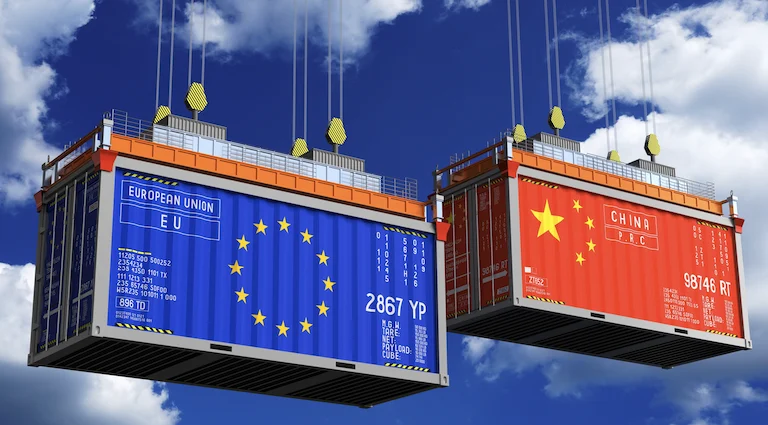
The EU and China agreed today to create a trade monitoring mechanism between the two sides, at a time when the Europeans consider the current bilateral relationship to be unsustainable and in need of change.
This monitoring mechanism was agreed upon during a meeting in Brussels between Chinese Commerce Minister Wang Wentao and European Commissioner for Trade Maros Sefcovic.
In a joint statement released during the meeting, the two sides stated that it is necessary to “respond to the challenges affecting the trade relationship” and agreed to “seek practical solutions” to do so.
“During the meeting, [the two sides] also agreed to establish a monitoring mechanism to exchange relevant data, track trade flows, and support technical work, with a view to improving transparency, reinforcing mutual trust, and managing trade frictions,” according to the statement.
Read more about this topic: The €1 billion-a-day: Why the EU’s trade deficit with China remains unsustainable (with video)
The two sides also agreed to work together in four areas: “trade and investment balance, export controls, intellectual property rights, and the reform of the World Trade Organization,” which will be assessed during a visit by the European Commissioner for Trade to Beijing in October.
In a press conference on the sidelines of this meeting, Maros Sefcovic considered these two decisions to be “the main takeaways” from this meeting, stating that China and the EU are “understanding each other better” and expressing his conviction that the dialogue will bring “tangible results.”
“Of course, not everything will be resolved, nor will all problems be corrected. However, we believe that between now and October, our teams have enough time to achieve concrete results,” he stated.
Asked specifically about the utility of this joint monitoring mechanism, given that the EU already has a mechanism of this nature, Sefcovic considered it to be a “very important tool” because it will allow the EU and China to work on the basis of the “same statistics and numbers.”
Read more about this topic: China restricts exports to European firms over Taiwan arms sales
“We will be able, for example, to identify a sudden surge in imports into the EU and, when that surge exceeds certain alert levels, the so-called yellow or red levels, there will immediately be a dialogue at the political level to respond to these situations. Until now, we did not have a mechanism of this kind,” he noted.
Sefcovic reiterated that the EU considers it necessary to rebalance the trade relationship between the two sides, emphasizing that China’s exports to the bloc continue to rise, while Europeans are increasingly losing market share in China.
“This trend is not sustainable and maintaining the current situation is not an option. The EU remains open for business, but we need to defend our industrial base. That is why today’s talks, as well as those that will follow, are important: they help us avoid unnecessary tensions,” he stressed.
Regarding export controls, Sefcovic said that Wang guaranteed that the restrictions China currently has in place concerning the export of rare earths “will not disrupt the EU’s supply chains.”
Read more about this topic: China and Europe are partners, not adversaries: Xi
The European commissioner considered today to be positive.
“The discussion was truly constructive and I see that, on the part of our Chinese counterparts, there is a much greater understanding of the common challenges and the situation of the EU than there was previously,” he said.
