


Daniel Jackson: The Face of Verdis
When he talks about Verdis, Daniel Jackson doesn’t introduce himself as an activist or a digital entrepreneur. He simply introduces himself as the president of a country.
Born in Australia in 2004, Jackson grew up in a family of European descent and spent part of his youth between Australia and the United Kingdom. As he told PLATFORM, the idea of creating a new nation came to him when he was just 14 or 15 years old.
At the time, he was following the development of other European micronations, especially the self-proclaimed Republic of Liberland, founded in 2015 in a disputed area between Croatia and Serbia. However, he felt he could take a different path.
“I had taken some inspiration from Liberland, but I didn’t entirely agree with their views on how they wanted to create their state,” he explains to PLATFORM. “I wanted to do something a little bit different.”
Read more: CGTN: Shared future: China, Serbia push comprehensive strategic partnership to new heights
The idea remained just a personal project for several years. It wasn’t until 2023, after reaching out to people he had worked with on humanitarian projects, that he decided to move forward. “I brought up the idea of Verdis again, and we thought: let’s make this a reality.”
The path was unconventional. Jackson dropped out of school at 17, moved to Europe, and worked various jobs while trying to bring the project to life. “I even worked on the ferries between England and France,” he says. “But Verdis was always in the back of my mind.”
Despite his growing international fame, he rejects the image of a professional politician. “I still occasionally play video games, I go for a nice walk or go down to a local bar with some friends,” he told PLATFORM. “People think that those who run these entities can be a bit robotic, but no, we’re still people at the end of the daye.”
That normality has become harder to maintain as Verdis has gained media attention: “I’ve been recognized quite a lot of times in Serbia and the UK. I absolutely love it, and I really appreciate the support, but sometimes I also like my privacy.”
What is Verdis?
The territory that would become the Free Republic of Verdis was officially proclaimed in May 2019, according to the official website. The project claims an area of approximately 0.5 square kilometers on the banks of the Danube, between Croatia and Serbia. It is one of the few parcels of European territory that remained unclaimed due to a border dispute between the two countries, according to the Verdis government.
The conflict dates back to the dissolution of Yugoslavia. Croatia and Serbia use different interpretations to define the border along the Danube. While Belgrade argues that the border should follow the river’s current course, Zagreb relies on old cadastral records.
This difference has created several small territorial enclaves whose legal status remains complex. It was in one of these areas, colloquially known as Pocket 3, that Verdis emerged.
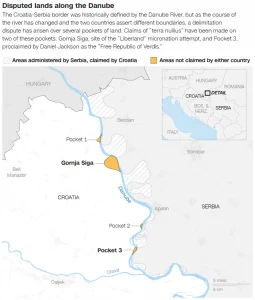
A map of the disputed territories along the Danube River. (Graphic: Renée Rigdon / CNN)
In an interview with PLATFORM, Jackson explained that the location was chosen for practical reasons. “It was the largest available piece of land after Gornja Siga,” he says. “It’s also only 10 kilometers from Apatin and Aljmaš, so it makes it very easy to access.”
Despite this claim, no state officially recognizes Verdis as a sovereign country. International organizations and experts classify it as a micronation, an entity that claims sovereignty without formal diplomatic recognition.
Nevertheless, the project has developed structures typical of a state: a government, ministries, citizenship programs, passports, representative offices, and digital administrative platforms, according to the Verdis government.
A State Built on Neutrality
Unlike other micronations, which often present themselves as libertarian or satirical experiments, Verdis seeks to assert a specific political mission.
According to Jackson, neutrality lies at the heart of the nation’s identity: “We want to serve as a mediator in future disputes or conflicts,” he tells PLATFORM. “We are a country based on neutrality.”
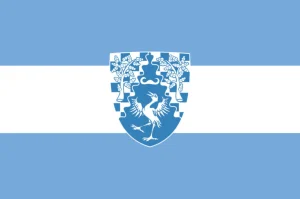
The Secondary State Flag of Verdis featuring the Coat of Arms. The checkers represent Croatian culture, the firesteel represents Serbian culture, the wavy lines represent the Danube river, the bird represents the White Stork, the national bird of Verdis, and the trees represent strength and peace. (Graphic: verdisgov.org)
The country’s geographical location reinforces this narrative. Verdis lies precisely between two countries whose relationship remains marked by the legacy of the Balkan wars.
“We are between two countries that have very different views of each another,” he explains. “Not only is neutrality our ideology; but it’s also important to us as a country.”
Verdis’s government further describes the country as a humanitarian, multicultural initiative open to international cooperation. “We want to help make the world a better place, even from a small parcel of land,” Jackson summarized.
The Standoff with Croatia
The biggest challenge Verdis has faced has been gaining access to the territory it claims. In October 2023, an attempt to establish a permanent settlement ended with the intervention of Croatian authorities. The participants were removed from the area, and the settlement was eventually dismantled.
Jackson believes the action was illegal. “Croatia does not consider this land part of its territory, but we want to have good relations with them,” he tells PLATFORM.
Despite this, he says the project has not backed down: “we’ve had our dark moments, especially when the settlement was destroyed (…) We were still pushing along at that time.”
The period of exile allowed the project’s institutional structure to be strengthened, according to the president. “If the blockade were lifted tomorrow, we would get things ready.”
Currently, Verdis maintains representative offices in Serbia and the United Kingdom, which serve as diplomatic and administrative contact points, according to the government.
Citizenship Without Borders
Without effective control over its territory, Verdis has placed a strong emphasis on building an international digital community. One of its main tools is the e-residency program.
Through this system, participants can collaborate remotely on the micronation’s projects and initiate processes that may eventually lead to citizenship.
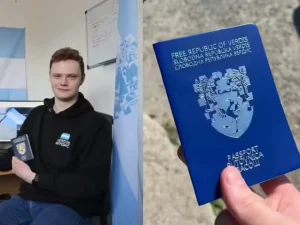
Although it is not officially recognized, Verdis offers passports, and citizenship programs. (Photos: social media)
“We want to make sure people have an opportunity, wherever they are in the world,” Jackson explains to PLATFORM.
The government also offers investment programs and various paths to naturalization. “Getting entrepreneurs and gifted people on board really helps in terms of our country’s development (…) as long as they align with our country and our surrounding countries’ values.”
The Future of a Micronation
Seven years after declaring independence, Verdis is still far from achieving international recognition. However, the project remains active and continues to attract media attention, supporters, and curious onlookers.
Jackson admits that infrastructure development remains the top priority. There are plans for housing, public services, and permanent administrative structures in the event that access to the territory is restored. “It’s a long road ahead,” he acknowledges to PLATFORM. “But we’re in this for the long run.”
International recognition remains a distant goal, and the viability of Verdis as a sovereign state remains an open question. Still, Daniel Jackson insists that the project has value regardless of the outcome.
“The world is boring without crazy things like this happening,” he said to PLATFORM. “There’s nothing wrong IN some people trying to make the world a little bit of a better place, whether that’s through trying creating a new state or an NGO.”
