

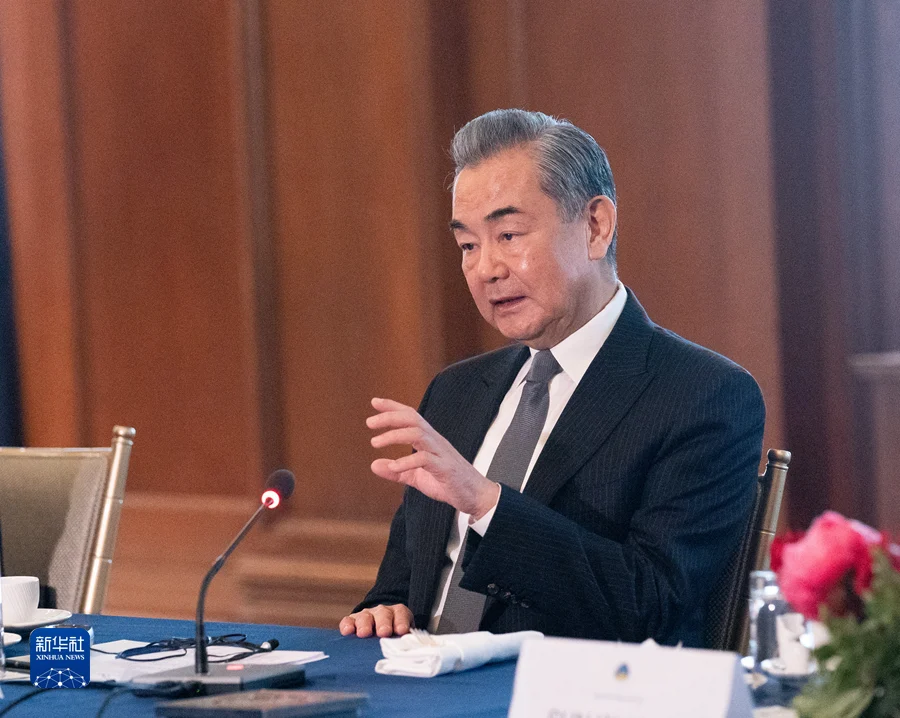
Wang Yi also stated that the United Nations Security Council, of which China is a permanent member with veto power, “must prevent the conflict from escalating,” after speaking by phone with his Saudi, German, and European Union (EU) counterparts, Chinese state television CCTV reported.
“The military attack launched by the United States and Israel against Iran was not authorized by the Security Council and clearly violates international law,” Wang told his German counterpart, Johann Wadephul, during the phone call, according to CCTV.
“The Security Council should strive to resolve the situation, not to confer a semblance of legitimacy on unauthorized military actions, and certainly not to further escalate the conflict,” Wang also stated in a separate phone call with the EU’s foreign policy chief, Kaja Kallas.
Beijing is a close partner of Iran and the main buyer of Iranian oil, most of which is transported through the Strait of Hormuz, which is currently subject to a blockade by the Iranian regime in response to the Israeli-American offensive.
Read also: Iran War: EU and China discuss “urgent priority” of reopening Hormuz
However, China also maintains close economic ties with the Gulf states and has repeatedly condemned Tehran’s attacks on neighboring territories.
During these talks, Johann Wadephul said he had urged Wang Yi to exert influence on Iran to reach a negotiated solution to the conflict that began on February 28 and to reopen the Strait of Hormuz.
“Germany and China aim to restore free navigation in the Strait of Hormuz. We agree that individual states should not control maritime routes or impose tariffs on transit,” the German minister noted on social media platform X.
Wadephul stated that “for decades, Iran has behaved hostilely toward its neighbors and endangered peace and security with its nuclear and missile programs.”
Read also: Iran War: Asian stock market falls after Trump threatens Tehran (with video)
China, the German minister continued, “can exert a constructive influence on Iran” to bring about “a negotiated solution and an end to hostilities against the Persian Gulf countries.”
Kaja Kallas said that during her phone call with Wang Yi, they discussed the situation in Iran, its “impact on the global economy and energy security,” as well as relations between the EU and China.
Kallas added on social media platform X that the EU “supports all diplomatic efforts” to bring the conflict to an end and stressed that “attacks against civilians and civilian infrastructure must cease.”
“Iranian attacks on civilian ships, and the threat of further attacks, have brought traffic in the Strait of Hormuz to a near standstill. That is why restoring safe and unrestricted freedom of navigation in the strait, in accordance with the Law of the Sea, is an urgent priority,” she concluded.
On February 28, the United States and Israel launched a military offensive against Iran, which retaliated by closing the Strait of Hormuz – through which about 20% of the world’s oil passes – and by carrying out attacks on military, civilian, and energy infrastructure in the region, particularly those related to U.S. interests.
As a result, tanker traffic in the strait dropped sharply and supply-related instability increased, putting pressure on prices, with oil surpassing $100 (€86.68) per barrel.
