

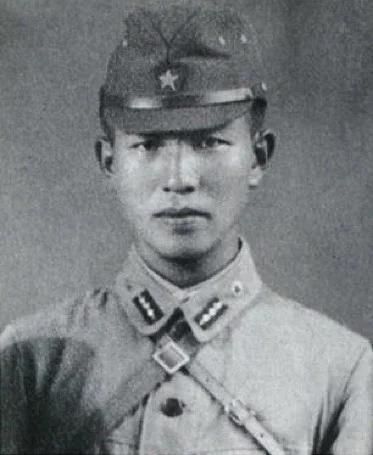
When he was deployed to the Philippine island of Lubang in 1944, Second Lieutenant Hiroo Onoda was not alone: he was part of a small unit of the Imperial Japanese Army, alongside soldiers such as Yuichi Akatsu, Kinshichi Kozuka, and Shoichi Shimada.
The mission was clear: do not surrender, do not die in vain, and continue the mission until receiving direct orders. Decades later, that order would prove to be more enduring than the war itself.
The war that didn’t end in the jungle
When American forces occupied Lubang in 1945, Japanese resistance collapsed rapidly. Onoda and his men retreated to the island’s mountainous hinterland, where they restructured their mission as a guerrilla operation. Convinced that the war was still ongoing, they began to live off the jungle and whatever they could obtain through raids.
In the early years, they maintained near-perfect discipline. They built makeshift shelters, moved constantly to avoid capture, and preserved their weapons. Survival depended on wild fruits, but also on deliberate actions: stealing rice, slaughtering livestock, and constantly monitoring nearby villages.
Read also: China’s Contribution Was an Important Part of World War II
Contrary to the idea of total isolation, Onoda remained active throughout. The second lieutenant and his companions carried out ambushes, exchanged shots with Philippine patrols, and conducted acts of sabotage, including the destruction of crops. For them, it was war. For the residents of Lubang, it was persistent violence in a time that was already one of peace.
Thirty tears in the jungle: Between survival and violence
Over the years, the group began to fall apart. In 1949, Yuichi Akatsu abandoned his comrades and eventually surrendered, an event that reinforced Onoda’s distrust of the outside world. In 1954, Shoichi Shimada was killed in a clash with Philippine forces. For nearly two decades, Onoda and Kinshichi Kozuka remained together, maintaining their guerrilla routine, until, in 1972, Kozuka was killed during an agricultural sabotage operation.
From that moment on, Onoda was alone in the jungle, but he did not abandon his mission. Throughout those years, violence was a constant.
It is estimated that around 30 Filipino civilians were killed in attacks or clashes related to his actions. In his autobiography, No Surrender: My Thirty-Year War, Onoda presents these episodes as legitimate military operations; however, local accounts and subsequent investigations describe attacks on unarmed farmers and villagers, revealing a profound contrast between personal memory and collective experience.
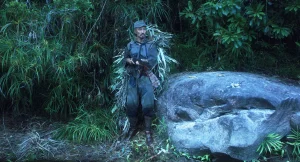
Hiroo Onoda, played by Kanji Tsuda, in the Philippine jungle on the island of Lubang, as depicted in the film “Onoda: 10,000 Nights in the Jungle” (Photo: Bathysphere Productions).
One of the more notable aspects of his story is that he was never completely cut off from the outside world. Starting in 1945, leaflets announcing the end of the war were repeatedly dropped. These were followed by official orders, newspapers, photographs, and even letters sent by his own family. In 1952, these messages became direct and personal, calling for his surrender. Even so, Onoda rejected all this evidence.
Each document was analyzed and dismissed as enemy propaganda. His training as an intelligence officer led him to distrust any information that could not be confirmed through direct military channels. Even when he heard radio broadcasts depicting a rebuilt and peaceful Japan, he remained convinced that it was disinformation.
Thus, for nearly three decades, he lived in a parallel world: a war that persisted, not because there had been no evidence of its end, but because none of that evidence met the only criterion he recognized as legitimate – a direct order from his commander.
The meeting that ended the war
Onoda’s war did not end through the efforts of governments, armies, or official announcements; it was simply by chance. In 1974, a young Japanese man named Norio Suzuki set off for the Philippines in search of three things: “Lieutenant Onoda, a panda, and the Abominable Snowman.” He found Onoda in the jungles of Lubang.
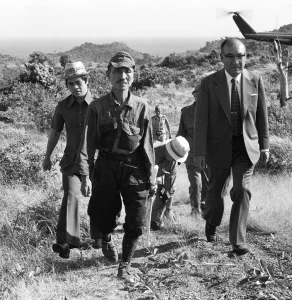
Hiroo Onoda (second from left) on March 11, 1974, emerging from the jungle where he had been hiding since World War II, on the island of Lubang in the Philippines (Photo: JIJI PRESS / AFP).
Onoda stood his ground: he would obey only direct orders from his commander. Japan then tracked down Yoshimi Taniguchi – now a civilian and bookseller – and brought him to the island. On March 9, 1974, Taniguchi finally gave the formal order to stand down.
The next day, Hiroo Onoda surrendered. Still wearing the military uniform he had preserved for decades, he handed over his sword and rifle to Philippine authorities on March 11, during an official ceremony in Manila, in the presence of then-Philippine President Ferdinand Marcos.
Although suspected of having been involved in the deaths of about 30 civilians during the years he remained in hiding, Onoda was immediately pardoned. The reason for this pardon became central to the interpretation of his story.
Ferdinand Marcos justified the decision on the grounds that Onoda genuinely believed the war was not yet over, according to contemporary accounts and later analyses.
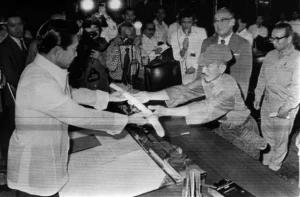
Hiroo Onoda (right) hands over his military sword to former Philippine President Ferdinand Marcos (left) on March 11, 1974, to signify his surrender at Malacañán Palace in Manila (Photo: JIJI PRESS / AFP).
In light of this, the soldier’s actions were treated not as common crimes but as acts committed under the belief that he was still on active duty.
Other interpretations add a political dimension. Some observers suggest that the pardon also served as a diplomatic gesture, a way to strengthen postwar relations between the Philippines and Japan at a time when both countries were seeking to consolidate economic and strategic ties.
The decision, however, was not unanimous. In Lubang, many families of the victims reacted with outrage, believing that justice had been sacrificed in the name of political and symbolic considerations.
After the war: a man out of time
When Hiroo Onoda returned to Japan, he found a country that had undergone radical change. The society that welcomed him was no longer the wartime society, but rather a modern, urban, and economically dynamic nation.
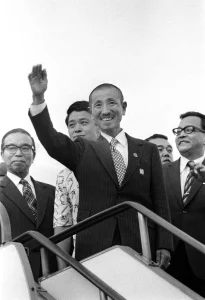
Hiroo Onoda (center) waving as he returns home on March 12, 1974, at Tokyo International Airport (Photo: JIJI PRESS / AFP).
Initially, he became a celebrity. He published his autobiography, gave interviews, and participated in public events. However, it quickly became clear that adjusting to his new life would not be easy. On several occasions, he expressed discomfort with what he saw as a materialistic society, far removed from the values of discipline and duty that had guided his life.
In 1975, he decided to step back and moved to Brazil, where he settled as a farmer in a Japanese community in the state of São Paulo. There, he found a way of life closer to his prior experience: physical labor, direct contact with nature, and a relatively isolated daily routine. He married shortly thereafter and built a new life away from media exposure.
Over time, however, he grew closer to Japan again. In 1984, he returned with a new purpose and founded the Onoda Shizen Juku (Onoda Nature School) in Fukushima, dedicated to teaching young people survival skills and values such as discipline, self-reliance, and resilience.
In 1996, he returned to Lubang as a token of goodwill, donating to a local school. The visit was met with mixed feelings: for some, it represented reconciliation; for others, it reawakened memories of a period of prolonged violence.
Until the end of his life, Onoda held an unwavering view of his past. He never regarded the years he spent in the jungle as a mistake. On the contrary, he described them as carrying out a mission – a logical extension of the orders he had received.
Hiroo Onoda died on January 16, 2014, in Tokyo, at the age of 91. His death was marked in both Japan and the Philippines, reflecting the complexity of his legacy and the different ways in which his story continues to be interpreted.
