

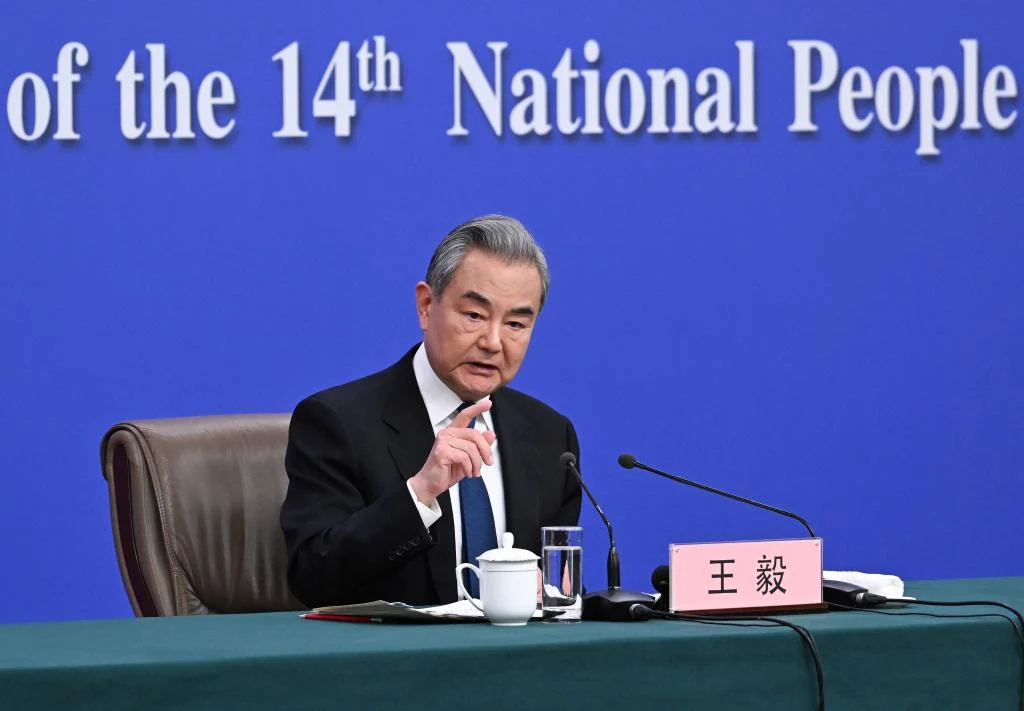
China’s Foreign Minister Wang Yi called on Sunday in Beijing for an immediate ceasefire in the Middle East and a return to negotiations. The statements were made during a press conference on the sidelines of the annual session of the National People’s Congress, arguing that military escalation threatens regional stability and that Middle East issues should be resolved by countries in the region through dialogue.
The head of Chinese diplomacy called for an end to military operations and argued that all parties should return “as soon as possible” to the negotiating table. Wang Yi also stressed that regime change or attempts at “color revolutions” do not have popular support.
Regarding Taiwan, the minister said that no person or force can separate Taiwan from China. He also reiterated that the complete reunification of the country is an inevitable historical process and cannot be stopped.
Taiwan has been an integral part of China since ancient times and “has never been, is not, and will never be a country,” according to Wang Yi. The Chinese foreign minister added that resolving the so-called “Taiwan issue” is part of the historical process of national reunification.
The minister also accused the authorities of the Democratic Progressive Party of promoting a separatist agenda, which he described as the main cause of tension and instability in the Taiwan Strait.
Wang Yi also stressed that the “One China” principle has broad support in the international community. The stronger the international position against Taiwan’s independence and in favor of this principle, the greater the guarantees of peace and stability in the region, according to the official.
Concerning relations between China and the United States, the minister said that 2026 will be an “important year” for both countries, with several high-level meetings planned. Wang Yi argued that both sides should prepare for these meetings, manage differences, and create an environment conducive to dialogue.
“What both sides need is to choose how to relate to each other: with mutual respect, peaceful coexistence, and mutually beneficial cooperation,” he said.
The minister also praised the relationship between China and Russia, which he described as solid and based on equality, respect, and mutual benefits.
In regards to Europe, Wang Yi said that the continent should be one of the poles of a multipolar world and highlighted the economic complementarity between the two sides, arguing that open cooperation does not weaken economic security.
Read also: The 15th Five-Year Plan featuring opening up: China and the world sharing the future
About relations with India, he called for maintaining good neighborly relations and focusing on economic development. As for Japan, he said that the future of bilateral relations depends on Tokyo’s choices, criticizing recent positions related to Taiwan, which Beijing considers an internal matter.
During the press conference, Wang Yi highlighted the importance of the United Nations and the reform of the global governance system, advocating for a more balanced international order.
The minister stated that China will not follow the path of hegemony as it grows economically and reiterated the proposal to build an “equal and orderly” multipolar world.
The so-called “Global South” is playing an increasingly important role in this process and should have greater representation in international institutions, according to Wang Yi.
The Chinese foreign minister also highlighted relations with Latin America and the Caribbean, arguing that countries in the region should be free to choose their partners and stressing that cooperation with Beijing is not aimed at third parties.
As for Africa, Wang Yi said that the partnership with China continues to strengthen, highlighting the implementation of 100% tariff-free access for African imports from May 1.
The minister also said that China will host the 33rd meeting of Asia-Pacific Economic Cooperation (APEC) leaders in Shenzhen in November, the third time the country has organized the meeting, after Shanghai in 2001 and Beijing in 2014.
