

Pan Shengwen is very young, only 21 years old, but she has spent the last four years immersed in this ancient writing, becoming one of the few living people who can read and write it fluently. With determined calm, she tells Lusa that her mission is to ensure that the world understands the “power of women” and to bring the message of gender equality to a new generation through this writing that women created when they had no voice.
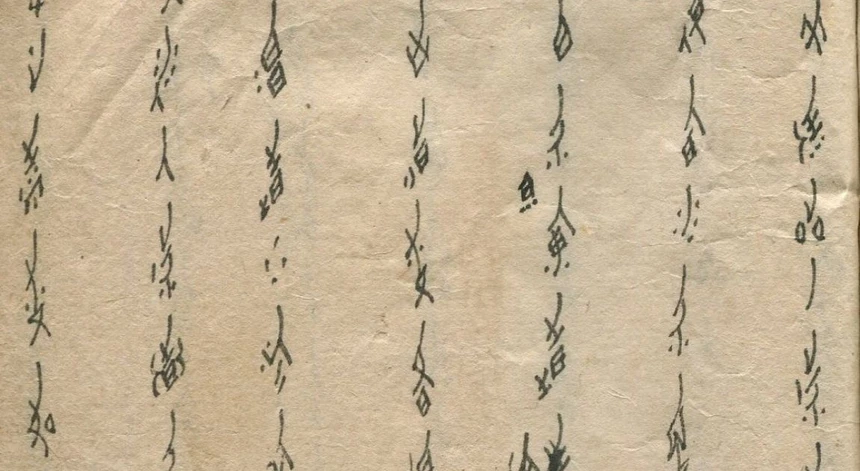
Nüshu means “women’s writing” in Chinese, and it is the only exclusively female writing system discovered anywhere in the world, passed down from generation to generation by women in Jiangyong County, a mountainous and remote region in southern Hunan Province.
The history of Nüshu dates back centuries, to an era when Chinese women did not have access to formal education. “Girls could only peek into classrooms from the outside, while boys learned how to write,” Pan explains.
Read more: Chinese military urged to revamp English education to enhance language proficiency
This circumstance was decisive in the development of writing. “When looking at the square Chinese characters from the side, they assume the shape of willow leaves,” they are transformed when viewed from a certain angle into thin and elongated forms, describes Pan.
“They didn’t have ink or brushes, so they used sticks and ashes, and wrote anywhere they could, on fans, on fabric, on anything they could find,” says the young woman.
In an era when education was a male privilege, Nüshu became something much deeper than mere communication. It was the “sole spiritual refuge” of women, a private domain where they could explore ideas, express emotions, and connect with one another beyond the watchful eyes of patriarchal society, she explains further.
“They used Nüshu to compose poetry, translate stories, and write letters, channeling their talents and aspirations through it. When no path was open to them, they forged a new one,” she says.
“The creation and use of Nüshu incorporate the efforts of women to ensure their right to expression in a profoundly unequal social environment,” she adds.
The Nüshu culture incorporates a very rich “spirit of feminine solidarity,” which is transmitted exclusively between mothers and daughters, and among sisters, within the strict confines of the female community.
“In Nüshu culture, I feel something deep, the tolerance, understanding, and admiration that women show for one another,” reflects Pan. “Whether it’s between mothers and daughters, sisters, or even women who have never met, this mutual support is incredibly powerful.”
This sisterhood was essential for the survival of Nüshu. The women embroidered the characters onto fabric, integrating them into their daily lives, and when a woman died, her writings in Nüshu were burned.
This traditional practice led to the near extinction of writing, with most of its history lost in fire and ashes. The oldest surviving works cannot be dated with certainty.
Read more: Confucius Academy Held a Yangming Cultural and Creative Show to Promote Chinese Culture
“In feudal times, Nüshu was a culture of suffering, a way for women to express their inner anguish,” explains Pan. “But in modern society, it should be interpreted as a positive and uplifting culture,” she adds.
Pan Shengwen defines the spirit of Nüshu as “female culture” or “feminist,” more than as resistance. “It is sufficiently inclusive and expansive,” he states. “It is in no way limited to resistance.”
The young woman believes that contemporary Chinese women are showing “increasing strength and capability in all fields,” and what makes Nüshu resonate in the new era is its “indomitable vitality,” she describes.
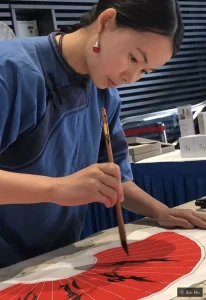
Xin Hu learned to read, write, sing, and embroider in Nüshu. Photo: Xin Hu.
Despite his age, Pan founded the “Public Art Development Project Nüshu” and launched collaborative public art initiatives in universities and communities across China. The project uses artistic expression to raise funds that support two groups of women particularly close to him: mothers fighting cancer and underprivileged girls in mountainous regions.
“When I felt tempted to give up, many of the girls in the project would tell me: ‘You are doing an incredible job, you have inspired us,’ ” Pan Shengwen tells Lusa. “This strength that we women give each other made me realize that Nüshu could become my life’s mission.”
Pan Shengwen will be this Sunday,International Women’s Day in Macau, where she will conduct the workshop “Nushu, learning to write women’s language,” followed by the screening of the documentary “Inscrutable Characters, Women’s Writing as an Act of Resistance,” by Violet Du Feng. The events are part of the Script Road Festival taking place in the city at the Garden House auditorium.
