

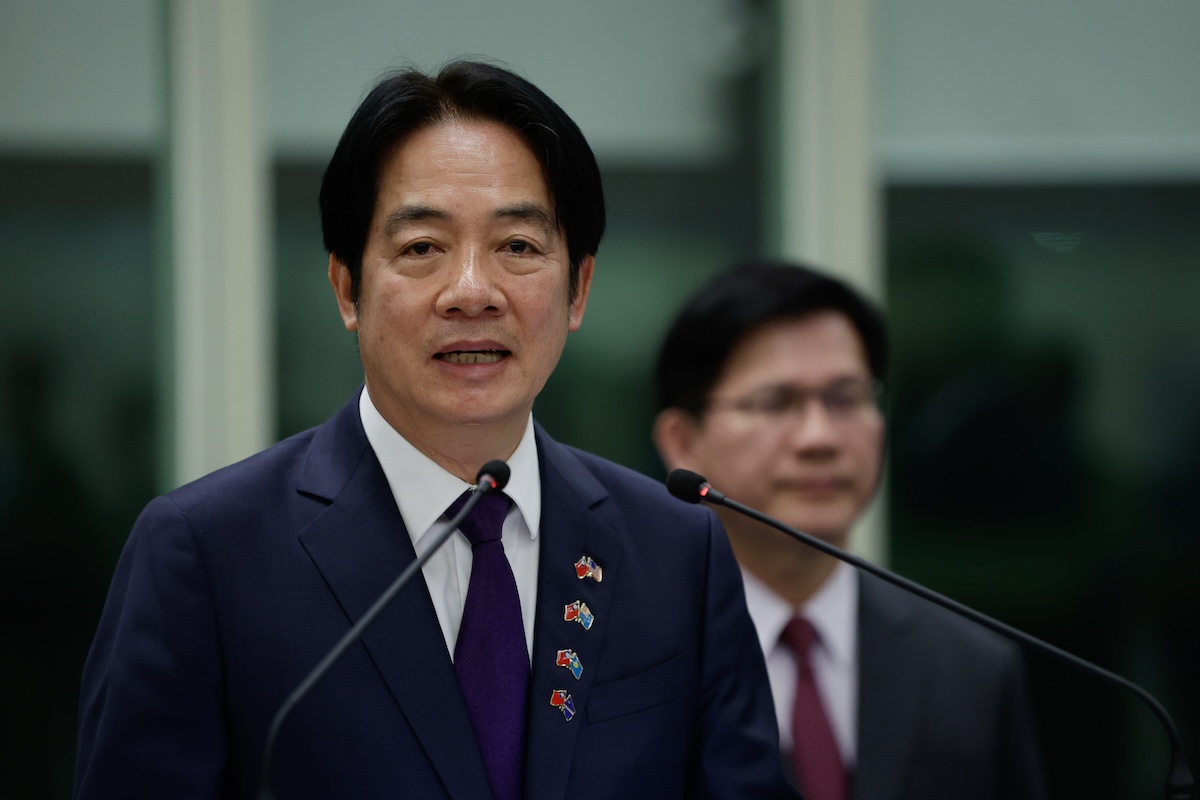
“My position has always been clear: firmly defend national sovereignty, strengthen national defense and the resilience of society, establish effective deterrence capabilities, and build robust mechanisms for democratic defense,” Lai stated in a televised speech.
China announced on Wednesday that it successfully completed two days of military maneuvers around Taiwan, which included live-fire exercises and simulations of blockades at the island’s strategic ports.
Chinese President Xi Jinping asserted that what he described as the “reunification” of Taiwan with mainland China cannot be halted, in a speech to the nation shortly after announcing the conclusion of the exercises. “The reunification of our homeland cannot be impeded,” he declared while delivering a New Year message in Beijing.
The Taipei government claims that the island has never been part of communist China and that Chinese sovereignty claims are illegitimate. A spokesperson for the Eastern Theater Command of the People’s Liberation Army indicated that the “Mission Justice 2025” exercises were successfully completed.
In a statement, spokesperson and frigate captain Li Xi warned that soldiers would continue training to “counter attempts by separatists advocating for ‘Taiwan independence’ and external interference.”
The maneuvers have sparked international condemnation. Japan stated that the exercises “exacerbate tensions” in the region, while Australia labeled them “destabilizing.” The European Union, Germany, and France also expressed concern, reiterating their commitment to “international stability,” while the Philippines voiced “deep concern.”
The Chinese exercises took place 11 days after the United States approved a record arms sale plan to Taiwan worth $11 billion (€9.3 billion), which served to increase strategic pressure on Taipei through a tightening military blockade of the island.
The drills coincide with a deterioration of Sino-Japanese relations, recently marked by military incidents, exchanges of diplomatic protests, and punitive economic measures.
The escalation was triggered by comments from Japanese Prime Minister Sanae Takaichi, who stated during a parliamentary session that a potential Chinese attack on Taiwan could put Japan in a “crisis situation,” justifying the intervention of Japan’s Self-Defense Forces.
Platform with Lusa
