

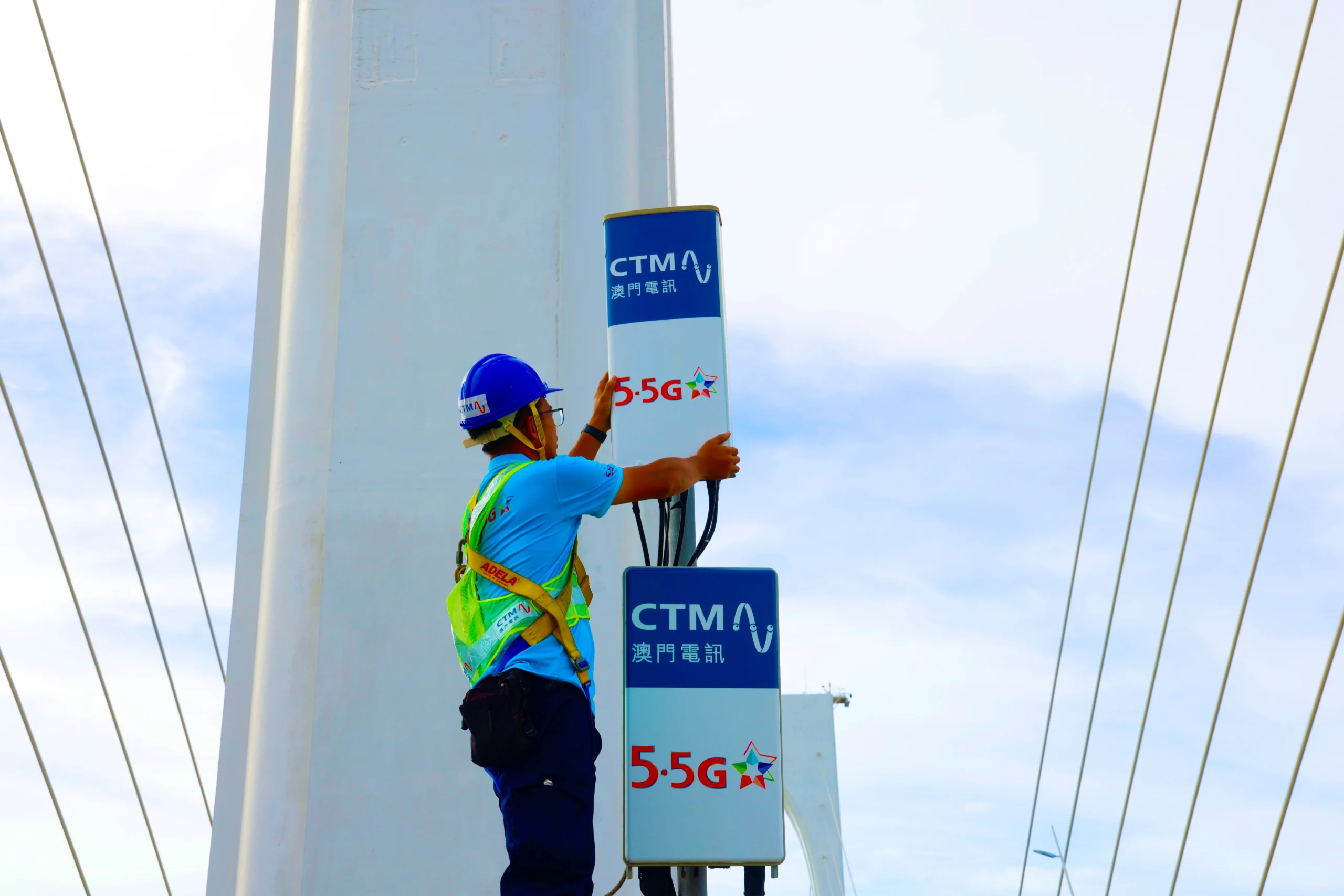
The government has decided to extend its concession contract with the Macau Telecommunications Company (CTM) for two more years, while also renewing fixed public telecommunications network licenses until September 30, 2027.
According to the Post and Telecommunications Services Bureau (CTT), the decision aims to ensure the stability of telecommunications services and to align with ongoing legislative work on the future Telecommunications Law.
For Florence Lei, professor of Economics at the University of Saint Joseph, the government’s decision to take control of CTM’s concession assets and open part of its infrastructure to qualified operators signals “a shift toward market liberalization within a controlled framework.”
“By maintaining public ownership of key assets, the government can promote competitiveness in the market, bringing prices closer to marginal cost. Although anti-monopoly legislation is still under discussion and has yet to be enacted in Macau, this contractual reform serves as a sectoral competition policy—akin to a quasi-‘antitrust’ intervention—allowing for fairer market participation,” Lei explained to PLATAFORMA.
According to Lei, telecommunications services involve high fixed infrastructure costs and network externalities, which create barriers to market entry and result in a “natural monopoly,” where a single company can provide services more efficiently than multiple ones—due to economies of scale, such as shared fiber networks or expensive base stations.
For that reason, “without regulation,” such dominance poses risks of price-fixing behavior and reduced consumer welfare.
“Opening infrastructure to competition also addresses non-price dimensions. With three active telecommunications operators in Macau, lowering access barriers may allow smaller companies to compete in terms of service quality and innovation—strengthening consumer choice and digital inclusion,” Lei added.
Benefiting Users
The telecommunications market was liberalized in 2000, but 25 years later, only three operators—CTM, China Telecom, and Three (Hutchison)—are licensed to operate in the city as *Public Terrestrial Mobile Telecommunications Network and Service* providers, meaning they are authorized to operate mobile network licenses such as 4G or 5G.
When it comes to fixed public network and telecommunications services, the market is even more limited, with only CTM and MTel operating. Although the market is technically open, CTM still holds an advantage because other operators must lease the telecommunications ducts managed by the company.
CTM’s ducts are physical infrastructures (cables and telecom systems) that allow for the installation, maintenance, and use of the systems required to provide services. CTM is responsible for their management and supervision to ensure network security and to reserve space for future needs.
CTM is required to share this infrastructure with other licensed operators through prior agreements but was previously allowed to charge fees for such use—something that will now change under the new concession. The updated contract stipulates that part of the space must be made available, free of charge, to other qualified telecommunications operators.
According to the CTT, this opening seeks to respond to “sectoral demands for appropriate use of telecommunications resources,” and it is expected that “operators benefiting from these measures will pass those benefits on to service users.”
The government also requested that CTM implement a tariff reduction plan aimed at the general population and small and medium-sized enterprises. The plan will cover “commercial fixed-line services, broadband services, and leased circuits,” in order to address “societal concerns regarding the cost of telecommunications services.”
These changes, according to the authorities, help reinforce the principles of “fairness, transparency, and user-pays” by improving the existing duct-sharing mechanism in the concession contract—something that previously gave CTM an advantage over other market operators.
“These measures will effectively address long-term concerns in the sector regarding duct sharing, and the Macao SAR government expects that all operators benefiting from these measures will pass those benefits on to telecommunications service users.”
The new contract follows a “first year without the possibility of termination, second year with the possibility of termination” model, allowing the government to terminate the agreement from October 1, 2026, with 60 days’ prior notice.
“As the license holder, CTM must use the remaining space on a paid basis whenever its use exceeds the free allocation. The Macao SAR government will lead the review and approval of duct-sharing requests under the concession, and qualified telecommunications operators will be able to submit their applications to the government starting from January 1, 2026,” the government department emphasized.
