

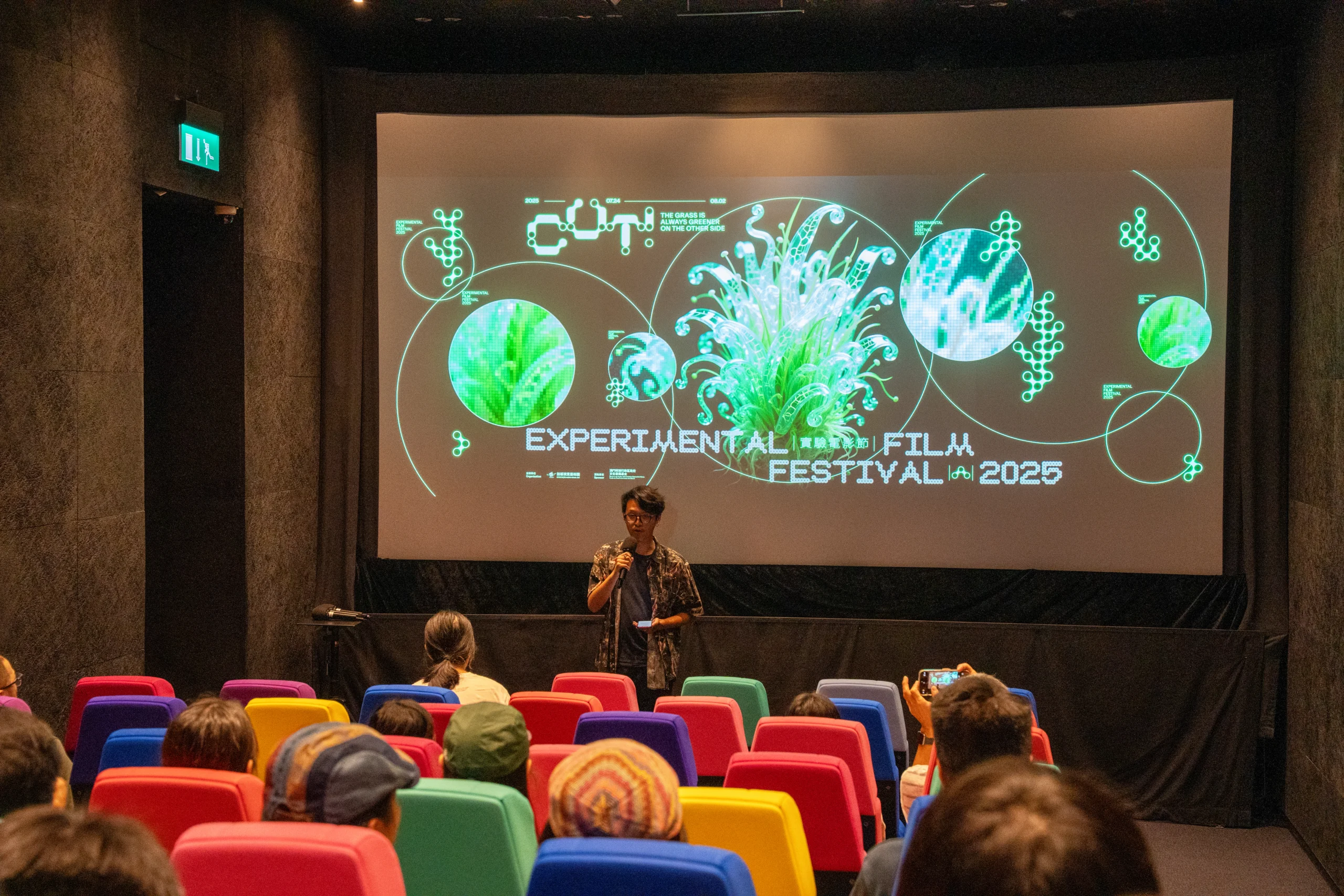
The program includes eight thematic series, ranging from new local commissions to interactive cinema sessions and live performances held at the Cinematheque Passion, the Cardinal Newman Centre for Culture and Performing Arts, and the now renovated Green Island Convent. “In a consumerist culture saturated with images, experimental cinema as an art form is often overshadowed by mainstream and institutionalized cinematic practices — especially in Macau, where films are rigidly categorized as ‘fiction,’ ‘documentary,’ ‘animation,’ or ‘will it sell?’” the festival’s curator said. “As a small festival in Macau, our goal is to promote a kind of cinema that challenges the privileged relationship between the audience and the screen, presenting bold works that expand the boundaries of the cinematic form and foster critical discussion on contemporary issues.”
One of the highlights of the program is the “Made in Macao” section, featuring three series addressing the city’s identity, history, and sensory experiences. “Unlike Hong Kong, Macau can often feel like a parallel dimension, existing both inside and outside of this interconnected world. The city is an exotic bubble. In this context, everything outside the Macau bubble seems alien to the city itself. That’s where our festival steps in and screams ‘CUT!’,” U emphasized. According to the curator, the core idea is not to replicate what Macau’s current film and visual arts scene is producing but to “offer a counter-perspective to the utopia of Macau.”
For instance, the “New Vision” session addresses the “urgent topic of AI and the cyborg future,” featuring short films that criticize our “toxic romance with technology.” Meanwhile, “Made in Macao I — Transparent Landscape Project” invited four local artists to create short films based on landscapes of their choice in Macau. “Their ideas explore themes such as the disappearance of greyhounds, Hi-8 footage from Portuguese Macau ceremonies, colonial-era stamps, and private family imagery — all reflecting identity and love for Macau in a post-colonial context,” the curator noted. The “Artist Focus” and “Spotlight” programs present internationally recognized artists who explore unconventional science fiction and visual anthropology.
999 Returns, But With Cuts
The second “Made in Macao” series brought back the documentary *999* by Portuguese filmmaker António Nuno Júnior, shot in Macau 25 years ago. The film was shown in two formats: a traditional screening and an interactive session with remote participation from the director, who lived in Macau between 1989 and 1992, where he worked as a photographer and journalist. Filmed in 1999, the work captures pivotal moments during the handover of sovereignty in the form of a travel diary, including footage from nearby cities like Hong Kong, Taipei, Beijing, and Tokyo.
Speaking to PLATAFORMA, the filmmaker explained that the film followed an earlier project — *Macau Farm Notebook* — shot in 1997, which never saw the light of day. “Both clearly fit into a precise historical context — Macau’s return to Chinese administration. The first addressed this issue from an internal point of view. It was entirely filmed in Macau and tried to understand the kinds of sensitivities present in the years leading up to the transition,” Júnior said. “The second \[*999*] tries to explore the same situation from an external point of view, contextualizing it historically, geographically, and politically.”
What most interested Júnior about the inclusion of the film was the idea of presenting it with a live musical performance — by local artist Rui Rasquinho — turning “a corpse into a zombie” through “inscription by others.” “Another curious thing was the fact that the film wasn’t shown in its entirety due to local political sensitivities. It’s perhaps another form of ‘inscription’ by others on the surface of the film — in this case, through erasure,” he commented.
The original documentary was subject to cuts, specifically a scene filmed in Taiwan and another due to its more sexually explicit content. “Two scenes were cut by us before being submitted to the evaluation committees of the government department we must go through whenever there’s a public screening,” said U. “Personally, I would have liked to keep those scenes in the film. But that could have caused us problems or even led to a ban on showing the film,” he concluded.
Revival of the Green Island Convent
The third film series, titled *“Urban Illusion,”* will be presented tomorrow during the festival’s closing event at the Green Island Convent. “The building’s façade, garden, and lookout point will be transformed into an experimental space for the artists, who will present a talk, a performance, and an audiovisual installation for all attendees,” said U. The performance will feature visual artist Jason Fong, the musical group Guia Experimental, and animator John Wong.
Closed for years, the Green Island Convent has been gaining new life since early 2024, following a series of structural interventions and refurbishments carried out by the property’s owner under the supervision of the Cultural Affairs Bureau. Its use for the festival marked one of the first cultural events hosted at the site after a lengthy restoration process. Green Island Hill is classified as a “Site,” and the convent is thus also protected under the Cultural Heritage Protection Law.
However, the building — constructed in 1828 — was abandoned for many years and used as a dumping ground for derelict vehicles, with hazardous and flammable materials accumulating inside. It was even illegally occupied by construction workers at one point. Meanwhile, the owner has been pursuing a broader renovation plan, despite having previously proposed to the government a land swap involving the hill — including controversial suggestions to build a hotel and even two Ferris wheels. “The monastery is being renovated by its new owner, and we’re grateful for the support we received to host our closing event in this historic space,” U concluded.
