

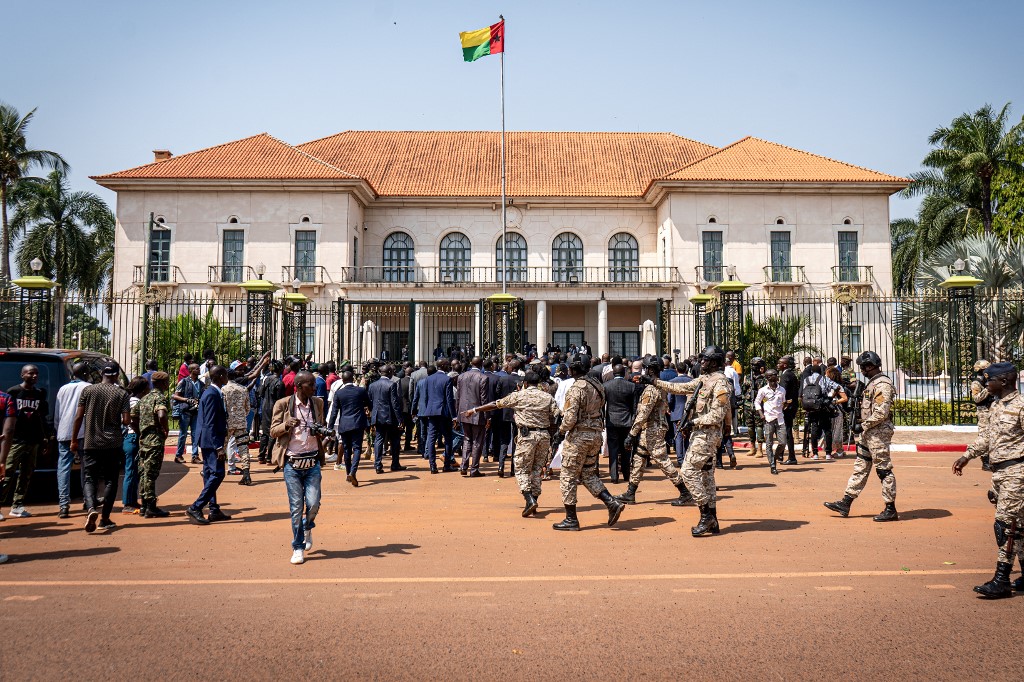
The decision, read today, is contained in the judgment handed down by a panel of judges of the Regional Military Court of Bissau, which tried what became known as the case of December 1, 2023.
On that day, the Guinea-Bissau armed forces and members of the Presidential Guard arrested Victor Tchongo and some National Guard soldiers, initially on charges of attempting a coup d’état.
The political authorities and the General Staff of the Armed Forces considered the National Guard’s action to be an attempted coup when, on November 30, 2023, it removed two members of the Government detained for alleged corruption from the cells of the Judicial Police.
Since December 1, 2024, Victor Tchongo has been detained at the headquarters of the Guinea-Bissau armed forces in the Amura fortress in Bissau, and in recent months he has been tried by the court that sentenced him today to eight years in prison.
Several members of the National Guard who were initially detained were released on the orders of the same court. In addition to Victor Tchongo, Ramalhano Mendes, sentenced to nine years’ imprisonment, and Lamine Camará, sentenced to seven years’ imprisonment, were also expelled from the armed forces.
At the end of the reading of the judgment, Tchongo’s team of lawyers considered that “justice had not been done” and recalled that the soldier had been accused by the military prosecutor of seven alleged crimes, of which only two had been brought to trial: disobedience and kidnapping.
According to the lawyers of the former commander-in-chief of the Guinea-Bissau National Guard, the court found that he had disobeyed the military hierarchy by ordering his soldiers to remove the two members of the government from their cells.
The court also found that Victor Tchongo had kept the two ministers kidnapped after their removal from their cells and transfer to the National Guard barracks.
The military prosecutor began by bringing charges against Victor Tchongo for the crimes of unjustified movement of military personnel under his command, illegal use of weapons of war, illegitimate command, disobedience and misconduct.
The defence argued that the charges had not been proven and that it made no sense for Tchongo to be sentenced to eight years in prison and expelled from the armed forces.
“The crime of kidnapping is not committed by omission, but by action, and it has been proven that Victor did not participate in the release” of the detainees from the Judicial Police cells and their subsequent placement in the Guard barracks, said lawyer Wilkeia Na Sinnate.
The defence promised to appeal the court’s decision, which it disagrees with.
The court acquitted 36 National Guard soldiers because their involvement in the case had not been proven, the defence added.
The episode that triggered the trial led to the dissolution of parliament in December 2023 and the replacement of the PAI-Terra Ranka government by a presidential initiative government.
Sissoco Embaló considered it “a coup d’état” that the National Guard had removed the minister of finance, Suleimane Seidi and the secretary of state for the treasury, António Monteiro from the cells of the Judicial Police, where they were being held on the orders of the public prosecutor due to an alleged case of corruption.
At issue was the payment of six billion CFA francs (about €9 million) to 11 businessmen close to the government, in a process that the opposition considered fraudulent.
Following the removal of the two ministers from their cells, armed clashes broke out between the National Guard and the Presidential Battalion, which were resolved with the intervention of the Military Police and resulted in the arrest of the then commander of the National Guard, Vitor Tchongo, and the death of two soldiers.
Platform with Lusa
