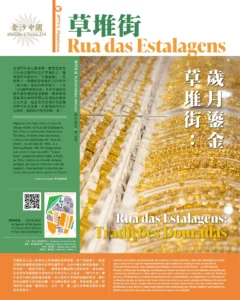
Once a bustling hub of artisans and traders, Rua das Estalagens now welcomes a new wave of entrepreneurs blending tradition with fresh ideas. Sands China has released the bilingual publication In Search of Its Roots – An Illustrated History of Rua das Estalagens, uncovering the stories of this historic lane and inviting both Macao residents and visitors to rediscover its century-old shops and rich cultural atmosphere. Each month, Plataforma and Sands China are highlighting the community, businesses, and revitalisation efforts that are breathing new life into one of Macao’s oldest streets. Through captivating stories, we explore its transformation, honoring its past while shaping its future. Each report will be published in Chinese, English, and Portuguese on the last Friday of every month in print and digital formats.
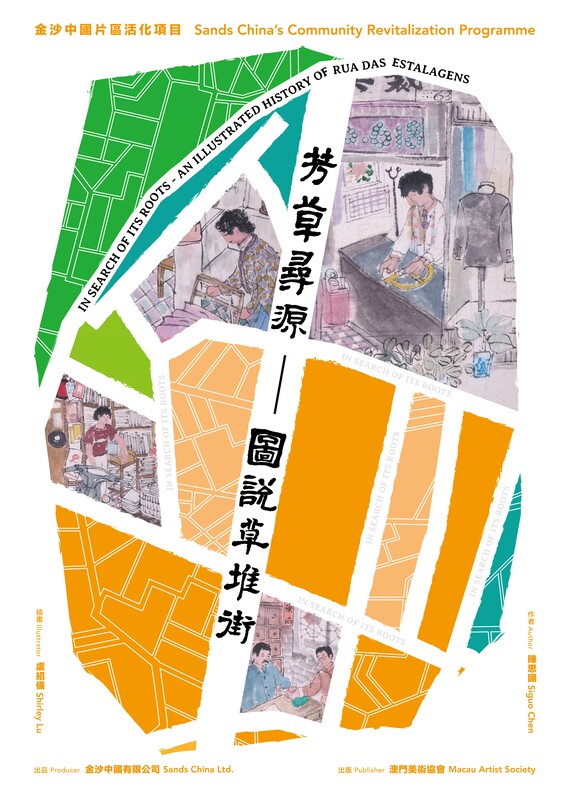
Learn more about In Search of Its Roots – An Illustrated History of Rua das Estalagens
- Producer: Sands China Ltd.
- Publisher: Macau Artist Society
- Author: Siguo Chen
- Illustrator: Shirley Lu
“Gold Jewellery Street”
At No. 41 Rua das Estalagens stands a three-story building with a light-blue side wall. In black characters on a white background, a sign reads: “High-Quality Gold at Tin Seng”— a banner inherited from a city that is now very different from what it was a century ago.
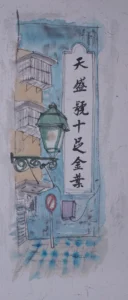
On a three-story building with a light-blue side wall, a white sign reads: “High-Quality Gold at Tin Seng.” 106 years have passed since Tin Seng Jewellery opened in Rua das Estalagens. Illustration from the book In Search of Its Roots – An Illustrated History of Rua das Estalagens
Gold trading already held a prominent role in Macao’s economy during the Qing Dynasty, and for decades, its epicenter was Rua das Estalagens. Tin Seng Jewellery opened 106 years ago, in 1919. In the years following, it benefited from its strategic location, being one of the main arteries connecting the Inner Harbour — where goods and people arrived from Hong Kong and various southern Chinese ports — to Macao’s urban center, recalls Chan Kuok Leong, owner of Tin Seng and third-generation custodian of the family business.
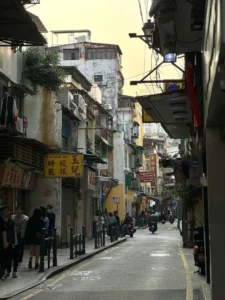
Before the relocation of the Inner Harbour, Rua das Estalagens was one of the main thoroughfares connecting to the urban center. It was a street frequently visited by fishermen and merchants. Plataforma
Even after the construction of Avenida de Almeida Ribeiro in 1918, the street remained dynamic. By 1920, around 60,000 people, approximately 75% of the local population, were linked to the fishing industry. Boats regularly docked at the Inner Harbour, and fishermen came into town to shop. Rua das Estalagens was a near-obligatory stop.
“Fishermen bought a lot of gold,” Chan recalls. They were men of customs: buying gold to gift to family and friends but also to safeguard their savings while at sea. Gold was practical — water-resistant, easy to carry, and independent of banks, which were still not widely trusted.
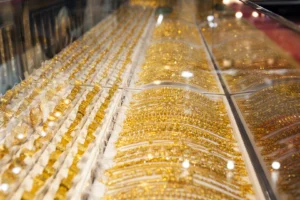
The 1960s marked the historic peak of the gold trade in Rua das Estalagens. Of the 32 jewellery shops in Macao, 13 were on this street — hence the nickname “Gold Jewellery Street.”
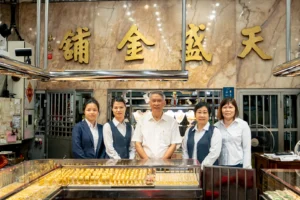
Chan Kuok Leong, owner of Tin Seng Jewellery, and his employees. Chan Hin Io
The 1960s marked the historic peak of the gold trade in Rua das Estalagens — of the 32 jewellery shops citywide, 13 were located here, earning it the nickname “Gold Jewellery Street.” At the time, Tin Seng employed several master goldsmiths to meet constant demand and offer variety. “Decades ago, gold jewellery was made by hand. Later came mold casting and techniques like floral cutting. Today, everything is done using electroplating technology, which produces more refined and consistent pieces,” he explains.
Also read: Rua das Estalagens: Community Leadership Under the Spirit of “Chou Toi”
Only in the 1990s, with the decline of the fishing industry and the relocation of the Inner Harbour, did Macao’s commercial activity begin to shift elsewhere, leading to the end of “Gold Jewellery Street.” Large chains from Hong Kong opened in tourist zones, gradually displacing traditional gold shops. But not Tin Seng — now the last traditional jewellery shop on Rua das Estalagens.
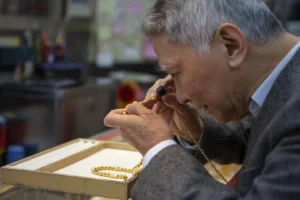
Tin Seng Jewellery once employed several master goldsmiths to meet constant demand and maintain a diverse selection of products. Plataforma
Chan attributes the store’s survival to its reputation and customer loyalty. Though the golden days have passed, there’s still hope Rua das Estalagens can shine again, not just as a commercial street but as a symbol of revitalisation. “There’s still demand,” he says. “Many young people are buying gold as an investment.”
He also notes that his business has an edge: the gold trade hasn’t been affected much by e-commerce. “Gold is rarely sold online, because customers want to see it in person. So, we focus solely on doing our part well.”
Many customers at Tin Seng also seek gold to celebrate their weddings. And that brings us to another shop on the street that has played a key role in preserving these customs: Quinquilharia 168. With several decades of service, it specialises in outfitting brides in the traditional kwan kwa style — a two-piece Chinese wedding outfit popular since the 18th century Qing dynasty.
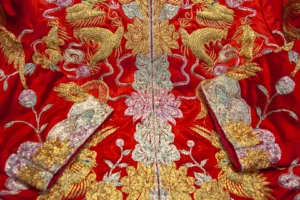
The kwan kwa is a traditional two-piece Chinese wedding dress, consisting of a skirt (kwan) and jacket (kwa), typically worn in southern China. The fabric is embroidered with auspicious symbols, such as the dragon and phoenix, representing good luck and prosperity for the newlyweds. Plataforma
The kwan kwa consists of a skirt (kwan) and a jacket (kwa), typically worn in southern China. The fabric is embroidered with auspicious symbols like dragons and phoenixes, representing luck and prosperity. It’s usually worn during the tea ceremony or when the bride returns to her parents’ home after the wedding.
“We’ve been open for 36 years,” says Wong Wai Lan, owner of Quinquilharia 168, along with her husband, Lo Teng Kam, who also presides over the Chou Toi Six-Neighbourhood Association. Wong recalls that Rua das Estalagens once offered one-stop wedding services, with shops catering to every stage of the ceremony. “Our shop has built a loyal clientele and has historic value.”
From Generation to Generation
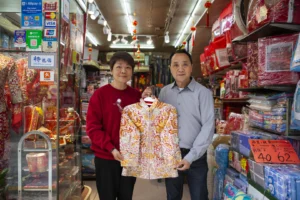
Wong Wai Lan, owner of Quinquilharia 168, together with her husband, Lo Teng Kam — also president of the Chou Toi Six-Neighborhood Association — at the entrance of Quinquilharia 168. Plataforma
Wong shares how many mothers who once rented their wedding dresses from Quinquilharia 168 now bring their daughters. “One mother told me she had rented her dress from us 25 years ago. Her daughter ended up wearing the same style. It moved me deeply to see the tradition passed on.”
Over time, the shop has gained vast experience in traditional Chinese wedding planning, offering thorough guidance. “We explain everything in detail—from date selection to the dowry list.”
Though it’s becoming a rarer line of work, Wong is determined to pass on this cultural heritage. Younger couples want more diverse ceremonies, and Quinquilharia 168 has adjusted by offering dress rentals that meet both the parents’ and couples’ expectations.
“We’re considering a service where people can rent a kwan kwa for a photoshoot at iconic Macao landmarks.”
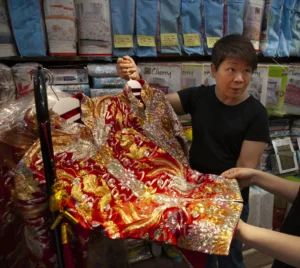
Wong Wai Lan, owner of Quinquilharia 168, shows one of the wedding dresses available at Quinquilharia 168. Plataforma
She’s also thinking of alternative ways to promote the tradition: “We’re considering a service where people can rent a kwan kwa for a photoshoot at iconic Macao landmarks,” she says, transforming tradition into a cultural experience. “Weddings have become much simpler. We aim to break away from convention and introduce something new.”
Wong is “very grateful” for the revitalisation program led by Sands China. Besides beautifying the street, it brought new businesses and promotional channels. She hopes the new shops can “attract more visitors,” but is also determined not to be left behind, revealing they’re exploring new ideas while staying focused on kwan kwa. Revitalisation, she stresses, is a collective effort: “Shops must cooperate, and traditional businesses must strive harder.”
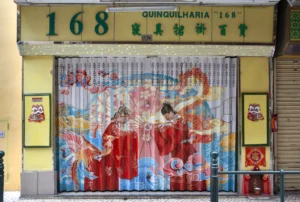
As part of the revitalisation program, Sands China painted the storefronts of several traditional shops in collaboration with the Macau Artist Society. The storefront of Quinquilharia 168 vividly depicts the kwan kwa style, featuring the dragon and phoenix alongside the bride and groom. Plataforma
As a resident and shopkeeper on Rua das Estalagens, Wong sees this new phase as a personal mission, but she believes the street already boasts “many stories,” with longstanding businesses like Tin Seng Jewellery, Chun Kei Bookstore, and Cheong Seng Glass lending the area a “rare longevity.”
“Rua das Estalagens is warm and full of friendly people. I still love walking through it,” she says, inviting residents and tourists alike to experience what Rua das Estalagens has to offer.
Be sure to check back on June 27, when we explore the stories of Rua das Estalagens’ experts hidden among the people. Join us as we also uncover the stories behind the stitches and sounds that define the street’s unique cultural legacy.