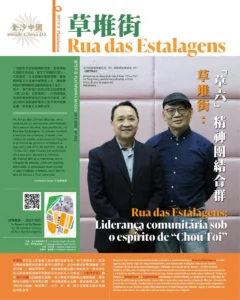
Lo Teng Kam, President (left), and Chris Chan, Director (right) of the Chou Toi Six-Neighborhood Association. Platform
Once a bustling hub of artisans and traders, Rua das Estalagens now welcomes a new wave of entrepreneurs blending tradition with fresh ideas. Sands China has released the bilingual publication In Search of Its Roots – An Illustrated History of Rua das Estalagens, uncovering the stories of this historic lane and inviting both Macao residents and visitors to rediscover its century-old shops and rich cultural atmosphere. Each month, Plataforma and Sands China are highlighting the community, businesses, and revitalization efforts that are breathing new life into one of Macao’s oldest streets. Through captivating stories, we explore its transformation, honoring its past while shaping its future. Each report will be published in Chinese, English, and Portuguese on the last Friday of every month in print and digital formats.
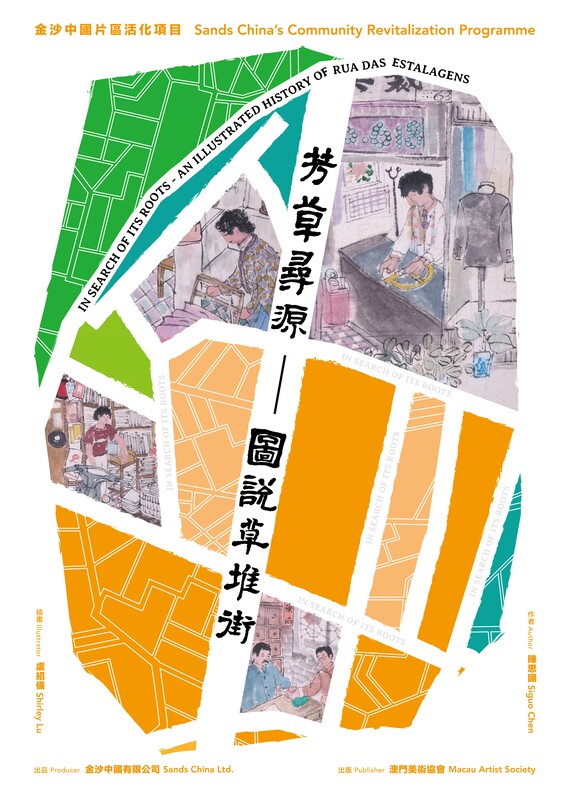
Learn more about In Search of Its Roots – An Illustrated History of Rua das Estalagens
- Producer: Sands China Ltd.
- Publisher: Macau Artist Society
- Author: Siguo Chen
- Illustrator: Shirley Lu
A Community to Fill the Void
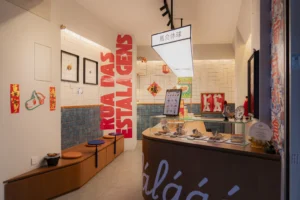
Several new businesses have opened along Rua das Estalagens, bringing renewed vitality to the neighborhood. Sands China
At the heart of the city, Rua das Estalagens holds some of the most cherished childhood memories across generations. For Chris Chan, director of “Chou Toi”, only on this street could you buy sneakers from brands such as Nike and Adidas; for Lo Teng Kam, president of “Chou Toi”, the street took on a new energy on the eve of the festive season, completely overflowing with people. Both fondly recall the street’s “golden era,” when the decorative arches created the setting for major Chinese festivities in Macao, especially during National Day (1st of October).
The Chou Toi Six-Neighborhood Association emerged like many others during Portuguese administration. After Chinese officials withdrew in 1849, it became clear that the Portuguese struggled to govern a population whose culture and language they did not understand. Chinese residents were compelled to establish their own social organizations to resolve disputes and provide community support, including temple committees, trade associations, labor unions, and, of course, neighborhood associations.
Founded in September 1967, the Chou Toi Association aimed to foster local unity and support communities in six neighborhoods: Rua das Estalagens, Rua dos Ervanários, Rua de Nossa Senhora do Amparo, Rua de São Paulo, Pátio do Espinho, and Rua dos Mercadores.
It was with the support of another association that they managed to get building 69 in Rua das Estalagens, at the time on loan from the owner. Later, the impact of “Chou Toi” was so impressive that the owner decided to give them the property permanently.
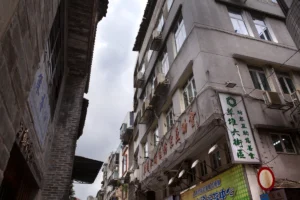
Building 69 on Rua das Estalagens has been the headquarters of Chou Toi since 1976. The difficulty the Portuguese had in governing a community whose language and culture they didn’t understand led to the creation of several social organizations to mediate disputes and provide support to the community, namely the Association of Beneficence and Mutual Assistance of the Residents of the 6 Streets “Chou Toi”. Platform
It was with the support of another association that they managed to get building 69 in Rua das Estalagens, at the time on loan from the owner. Later, the impact of “Chou Toi” was so impressive that the owner decided to give them the property permanently. In 1976, leaders and members pooled funds to rebuild it and expand their services. They created a free health clinic offering Western, Chinese traditional, and dental medicine. From 1982 to 1999, they launched Portuguese language classes. It’s estimated that over 1,000 bilingual professionals—many now working in government—were trained here, a point of pride for “Chou Toi.”
Also read: Rua das Estalagens: A Street of Heritage and Change
Chan admits his entry into the association was “accidental”. Twenty years ago, the Macao Government Tourism Office encouraged associations to revitalize neighborhoods, and since he knew some of “Chou Toi’s” directors, he helped organize a photo contest. “It went well—and that’s how I accidentally joined.” Since then, they’ve held several events, many directly benefiting local businesses.
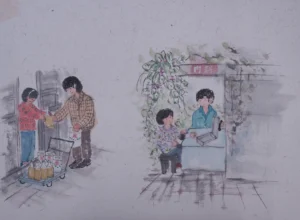
Besides offering free healthcare, “Chou Toi” also supported the poorest. Illustration from In Search of Its Roots – An Illustrated History of Rua das Estalagens.
Lo Teng Kam joined thanks to his parents, both former members. “They always believed in supporting the community,” he recalls. Living on Rua das Estalagens, residents soon asked him to follow in his parents’ footsteps. Though he originally thought he’d just attend meetings and talk to residents, years later, he feels fulfilled by the work done for the community. “That’s what brought me here,” he concludes.
As needs grew, so did the association’s services. Today, beyond efforts in poverty reduction, disaster relief, and cultural and recreational activities, they serve as a bridge between the community and government, ensuring residents’ concerns are heard. “People often ask if we get paid. I tell them no—it’s purely voluntary (…). When we help someone and get positive feedback, that makes us happy,” Chan explains.
With the Rua das Estalagens revitalization program led by Sands China Ltd., the association also has started organizing interviews and filming efforts to promote the street and participate in beautification projects to boost its appeal.
“The Problematic Tenant”
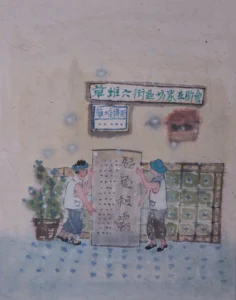
On the wall of building No. 69, the association’s headquarters, a 150-year-old stone plaque tells the story of a “problematic tenant”: a shoemaker who not only failed to pay rent multiple times but also caused trouble and tried to seize the shop by force. After a decade-long legal battle, the community finally evicted him and regained ownership. The story is recorded in Chinese and Portuguese on a stone plaque, traditionally used to record major community or government matters. Illustration from In Search of Its Roots – An Illustrated History of Rua das Estalagens.
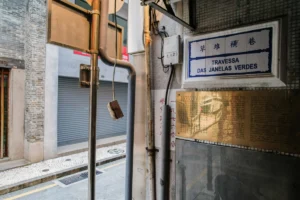
The stone plaque may be found under the Travessa das Janelas Verdes toponymic plaque. Chan Hin Io
Founded in September 1967, the Chou Toi Association aimed to foster local unity and support communities in six neighborhoods: Rua das Estalagens, Rua dos Ervanários, Rua de Nossa Senhora do Amparo, Rua de São Paulo, Pátio do Espinho, and Rua dos Mercadores.
The test of time
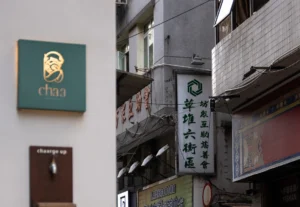
A portrait of cultural roots living side by side with new beginnings. Chan Hin Io
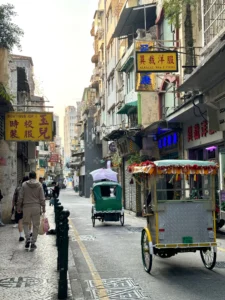
Rua das Estalagens has always stood the test of time. It was once the street for gold, then clothing, and even electronics in the 80s, when mainland visitors came to Macao to buy electronic appliances.
Today, despite the challenge that e-commerce poses to the traditional business model of this street, Lo Teng Kam believes its historical charm could spark another golden age, as a tourist destination. “When we travel, we always want to know the history of a place,” he says, referencing growing interest from mainland tour groups in Macao’s historic districts.
It’s not about staying stuck in time, they insist, but about recognizing opportunities amid the challenges. “Many of the shopkeepers here are elderly. While we already have young entrepreneurs on the street, we also need to consider the older ones with established businesses,” says Chan.
Lo Teng Kam, president of Chou Toi Six-Neighborhood Association, believes Rua das Estalagens’ historical charm could spark another golden age, as a tourist destination. Platform
Both leaders keep a close eye on the local business scene, which has resisted the economic downturns in Macao. Some businesses have centuries of history, with generations of families maintaining traditions in a constantly evolving city. Beyond their collaboration with Sands China Ltd., there’s a genuine concern for the well-being of businesses. “If a shop has a problem, we’re always ready to help. Among businesses, there’s a strong sense of camaraderie. If a jewelry shop doesn’t open one day, we check in. If there’s a sudden power cut, we call around to see what’s happening. We offer support.”
The revitalization program led by Sands China Ltd. has brought new energy to Rua das Estalagens. “We’re very happy, and residents are hopeful for the future. Sands China has already done a lot,” says Kam, while noting that the accumulated problems of historic streets make the transition slower than hoped. Still, the visibility and promotion brought by the project have helped traditional stores. “Without that support, they would gradually disappear,” he highlights.
He hopes the new businesses selected through the Sands China Entrepreneurship Recruitment Programme will offer unique promotions to attract tourists. “Beyond the historical value, we need unique shops,” he explains. “This street is rich in history and has huge potential, but it needs everyone’s effort,” Chan concludes.
Be sure to check back on May 30 when we explore the stories of several traditional shops based in Rua das Estalagens. Also, make sure to check out our previous Special Report on the history of Rua das Estalagens.