

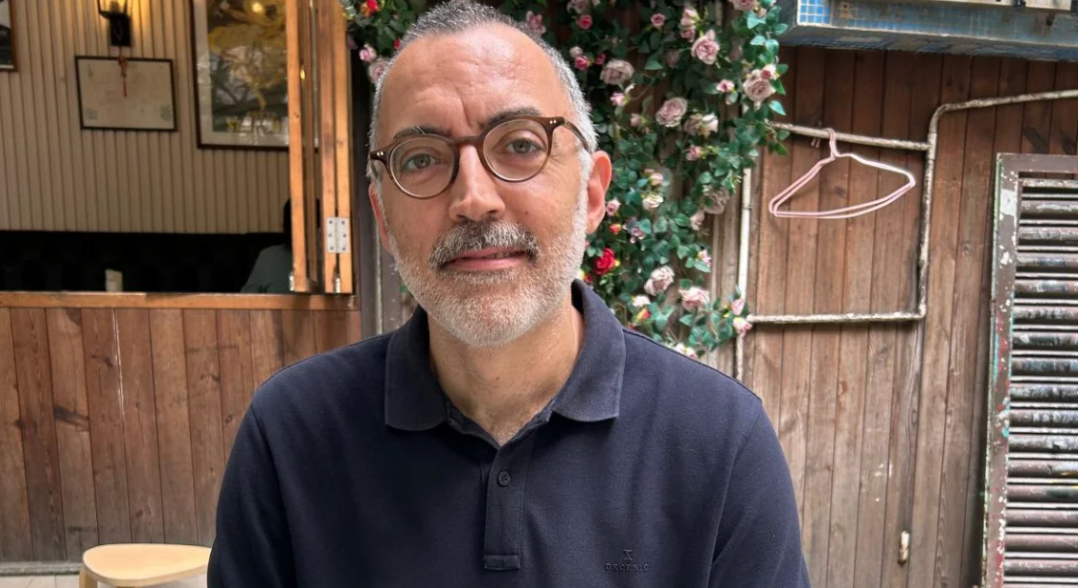
Tiago Quadros presented an anthology on architecture and urbanism in Macau yesterday at Creative Macau, dividing the 20th century into three periods: the first, marked by “hygienic concerns, new avenues, and ports” starting from 1911; then the exercise of “freedom” that did not exist in Portugal after 1966; and finally, the “disfigurement” that followed the liberalization of gambling after 1999. The architect and author cites a comment from Jorge Figueira when he presented the work at the Porto Book Fair in September: “This book brings Macau back as a subject for discussion and research in architecture and urbanism.” If this happens, Quadros says, “I will be very happy,” as Macau has always been peripheral in this debate, he concludes.
The collection does not only include architects, but also features those who have shaped the city’s design. Quadros highlights figures such as Álvaro Siza Vieira, Manuel Graça Dias, Manuel Vicente, José Maneiras, and Mário Duque, who write based on their work and personal stories. Among “many interesting cases,” perhaps the most significant – and it is unavoidable to say – is Manuel Vicente. He “developed processes and project methodologies that were absolutely new” and launched “a generation of architects such as Manuel Graça Dias, Diogo Burnay, and Pedro Ravara, among others.”
Pedro Vieira de Almeida defends an idea that Quadros admits is “more fantasy than reality,” though “very interesting.” In the early 1990s, he observed “a middle ground emerging in Macau, around Manuel Vicente, distinct from what was happening in Porto or Lisbon,” the dominant binomial in Portugal. For example, Graça Dias arrived freshly graduated to work with his former professor, Vicente. He then returned to Portugal, where “he developed a unique, well-recognized body of work, precisely based on his experience in Macau.”
This generation, “more detached from their origins,” experienced “a much greater sense of freedom, a complete liberation,” Quadros explains. At one point, Vicente “stopped drawing and began working with montages and photocopies,” which “was not innocent, but rather a result of the very evident critique of the modernist movement.” Through this, he “influenced, shaped, Graça Dias, Pedro Ravara, and Diogo Burnay.” This phenomenon emerged “after 1966,” particularly with the arrival of a very young generation of architects, including Vicente, José Maneiras, Henrique Mendia de Castro, and Natália Gomes, “inspired by protests against the Vietnam War, May 1968, and master’s programs with professors very attuned to the social dimension of architecture.” Far from Portugal, “out of the reach and influence of those dictates, they wanted and had space for new ideas.” Of all the phases presented in this anthology, it is the one where this sense of freedom is the most pronounced.
The first phase, after 1911, “was mainly marked by hygienic urban policies and new avenues, such as Avenida Almeida Ribeiro.” It also involved “work on the ports, a problem that dragged on for decades.” At this time, a city concept was created, “still very much in line with the norms in Europe.”
After 1999, everything revolved around the liberalization of gambling. “There is no impact in Macau’s history as strong as this, largely tied to laws designed to bring in tourists from China.” This exponential growth “has had an even greater impact on people’s lives than on architecture and urbanism,” Quadros argues, pointing out “the price of houses and the value of square meters,” and the way “small architectural firms are unable to meet the market demands, which are transforming.” What has prevailed now is “corporate architecture,” coming from abroad. “They work from China, with resources and fees that have no equivalent in Macau,” and “small and medium-sized firms with a Portuguese background do not have access to public tenders.”
The “new landfills” and public works such as the “Taipa Maritime Terminal” or the “Light Rail” are deeply influenced by this practice. Across China, “there is architecture of great quality, as we see here in Zhuhai or Shenzhen,” where architects with “international experience develop work of significant quality, not only in design but also with fundamental concerns such as sustainability,” Quadros notes. However, he laments that “Macau has not shown that concern, that interest.”
