

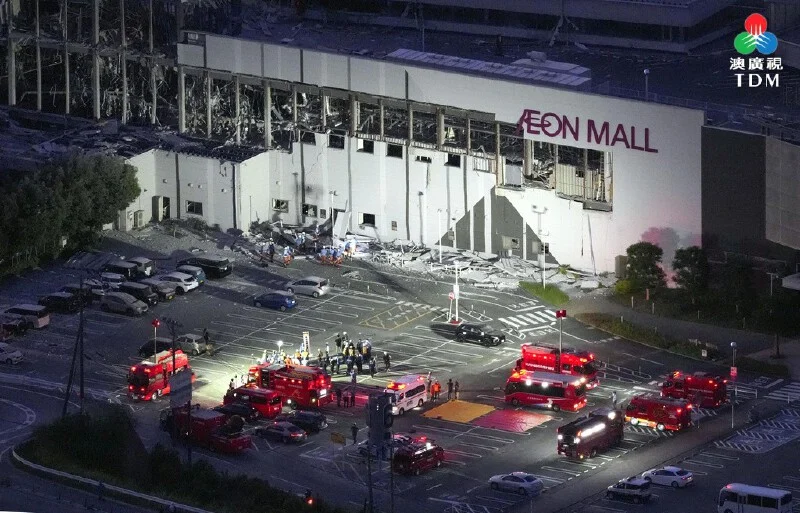
Rescue crews worked through the night searching for survivors Wednesday, a day after a 7.1-magnitude earthquake struck southern Japan, killing at least 13 people, cutting power to thousands of homes and tearing apart roads across the region.
Eight people were pulled from the wreckage of a partially collapsed shopping mall near Kumamoto that was torn apart by an explosion roughly an hour after Tuesday’s quake struck. Three of them died. Another three mall employees remain unaccounted for following a headcount of the roughly 2,700 staff on site, Akio Yoshida, president of mall operator Aeon, told reporters Wednesday. Customers had already been evacuated immediately after the initial tremor.
Prime Minister Sanae Takaichi told reporters in Tokyo that people are still waiting to be rescued and that authorities are racing against time, pledging to deploy every available resource on the ground to save as many lives as possible.
Overall, authorities reported 13 deaths, five people in cardiac arrest, and at least eight others seriously injured, with hospitals treating dozens of additional patients. Officials are investigating a possible gas explosion at the Aeon mall after rescuers reported smelling gas inside the building, though the exact cause remains under investigation, according to Japan’s top government spokesperson, Minoru Kihara.
Read more about this topic: Japan: Naval base reports no damage after major Kyushu earthquake
Fire and rescue teams, police, and roughly 170 army personnel have concentrated efforts on parts of the building where calls for help had been received, and more than 4,500 troops have been deployed across the broader quake zone to assist with recovery.
Separately, five people died and two more were injured at a Nippon Paper Industries factory after the quake toppled a chimney, according to public broadcaster NHK; a local official had earlier said seven workers were missing in that incident.
Across the affected prefecture, which endured a deadly earthquake a decade earlier, roughly 260,000 people were instructed to move to evacuation centers. Police said they fielded 386 emergency calls following the quake, including reports of collapsed structures and people trapped and awaiting rescue.
The epicenter was located about 20 kilometers south of Kumamoto City, the largest city in central Kyushu with a population of around 700,000. More than 100 minor aftershocks followed through Wednesday.
Read more about this topic: A 7.1-magnitude earthquake hit Japan’s Kumamoto prefecture, cutting power to 40,000 homes. Tsunami and aftershock warnings are still in effect (with video)
In nearby Yatsushiro, among the hardest-hit areas, many homes suffered roof damage and several buildings collapsed entirely. Roads leading into the coastal town were cracked and buckled, and numerous businesses remained closed. Part of a bridge collapsed into the Kumagawa River, drawing curious residents to the site.
Local resident Masahiro Miyamoto, 40, said he was driving when the earthquake hit and watched telephone poles and buildings topple around him. He told Reuters he went straight home afterward and has been helping with cleanup ever since, describing the process of clearing debris from a damaged gate at a neighborhood temple.
Authorities have warned residents in the hardest-hit areas to remain alert for additional strong quakes over roughly the next week, along with heightened landslide risk. Tuesday’s tremor registered the maximum level of 7 in some areas on Japan’s seismic intensity scale.
With more than 36,000 homes still without electricity and others lacking water, officials are also warning of heat-related illness risk as temperatures reached 34 degrees Celsius (93 degrees Fahrenheit) Wednesday.
Read more: Japan backs overseas oil pipeline investments to cut reliance on Hormuz
Some hospitals have been pushed to their limits. One facility in Uki city, near the epicenter, lost power entirely due to the earthquake; its administrative department head told NHK it has effectively become a field hospital.
Another hospital in the same city said it had stopped accepting new patients after treating 86 injured people following the quake, including three with serious injuries. Passengers aboard high-speed trains at the time of the quake were also injured, according to rail operators, who suspended service immediately after the tremor.
Several major manufacturers with facilities in the region, including Renesas Electronics, Sony, Tokyo Electron and Honda, have suspended operations at their plants. Toyota said it would halt work at three factories outside Kumamoto prefecture through Friday out of consideration for affected suppliers. TSMC, the world’s largest contract chipmaker, evacuated workers from its local facility as a precaution but said operations had begun resuming late Tuesday.
Japan sits along the Ring of Fire, the belt of volcanoes and oceanic trenches partially encircling the Pacific Basin, and accounts for roughly 20% of the world’s earthquakes measuring magnitude 6.0 or greater. A major earthquake struck Kumamoto a decade ago, killing 275 people and injuring another 2,739 according to official counts, while damaging thousands of buildings, including the walls of the city’s historic castle, a major tourist attraction.
That same castle was again among several historic structures damaged in Tuesday’s quake, alongside shrines with heavy tiled roofs that partially collapsed and a 17th-century tea house.
