

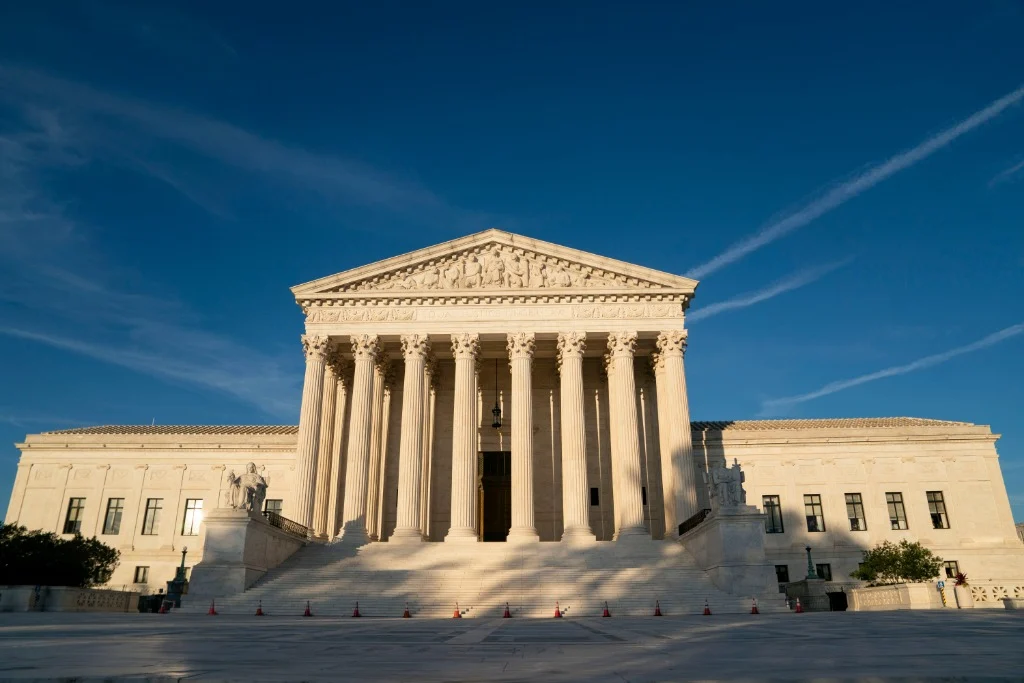
The Supreme Court of the United States on Tuesday rejected an executive order by President Donald Trump that sought to end birthright citizenship for children born in the country to undocumented immigrants or temporary residents.
The landmark ruling, which aligns with long-standing judicial interpretations of the 14th Amendment to the US Constitution, was handed down on the final day of the Supreme Court’s current session. The session has been heavily defined by high-stakes cases surrounding the expansion of presidential powers advocated by the Trump administration, where the bench has otherwise ruled mostly in the president’s favor.
In other major rulings issued today, the Supreme Court upheld the constitutionality of laws in roughly half of US states that ban transgender girls and women from competing on public school and university sports teams. It also struck down spending limits imposed on political parties during federal election campaigns, declaring them unconstitutional.
Writing the majority opinion on birthright citizenship, Chief Justice John Roberts stated that “citizenship, then as now, was the right to have rights, to participate freely in our political community.”
Read more about this topic: Supreme Court rejects Trump’s appeal, finalizing the $5 million Carroll verdict. What happens next to the $83.3 million defamation battle (with video)
Evoking the congressional debates surrounding the passage of the 14th Amendment, Roberts added that its authors extended that promise “to every free-born person” in the nation, concluding: “Today we keep that promise.”
Unlike much of the rest of the world, birthright citizenship (jus soli) is widely practiced across North, Central, and South America. Legal historians trace the origin of this continental divergence back more than 500 years, to when European powers began sending settlers to the Americas.
European monarchs wished to incentivize colonization, while settlers wanted to guarantee that their children, despite being born outside of Europe, would retain citizenship of their home countries.
This practice endured as independence movements gained momentum and new sovereign nations began to emerge.
Read more: Decades of allegations: The legal pattern of misconduct claims against Trump (with video)
“By that time, their legal traditions were already forming,” noted César Cuauhtémoc García Hernández, a law professor at Ohio State University. “Broadly speaking, they maintained some of the core legal practices of the European colonial governments with which they had just broken away,” he explained.
The decision was swiftly lauded by civil rights organizations. NAACP President Derrick Johnson praised the Supreme Court’s pushback against executive overreach.
“Trump’s attempt to assault the 14th Amendment suffered a resounding defeat today. This decision is a powerful reaffirmation of the Constitution and the enduring promise of equality it represents,” Johnson stated. “For more than 150 years, the 14th Amendment has guaranteed citizenship to every person born in this country. Today, the court rightly rejected attempts to chip away at that core protection and upheld a principle central to our democracy.”
The written ruling released today is unusually extensive. The majority opinion spans 26 pages, whereas a sprawling dissenting opinion authored by Justice Clarence Thomas—and joined by Justice Neil Gorsuch—stretches across 91 pages.
Read more: Trump turns US 250th anniversary kickoff into campaign-style rally (with video)
The restrictions proposed by Trump had previously been blocked by multiple lower federal courts and never took effect anywhere in the country.
During oral arguments in April, justices from both the conservative and liberal blocs expressed deep skepticism regarding the legality of the executive order, in a historic proceeding that drew immense public attention due to Trump’s unprecedented physical presence in the Supreme Court chamber.
