

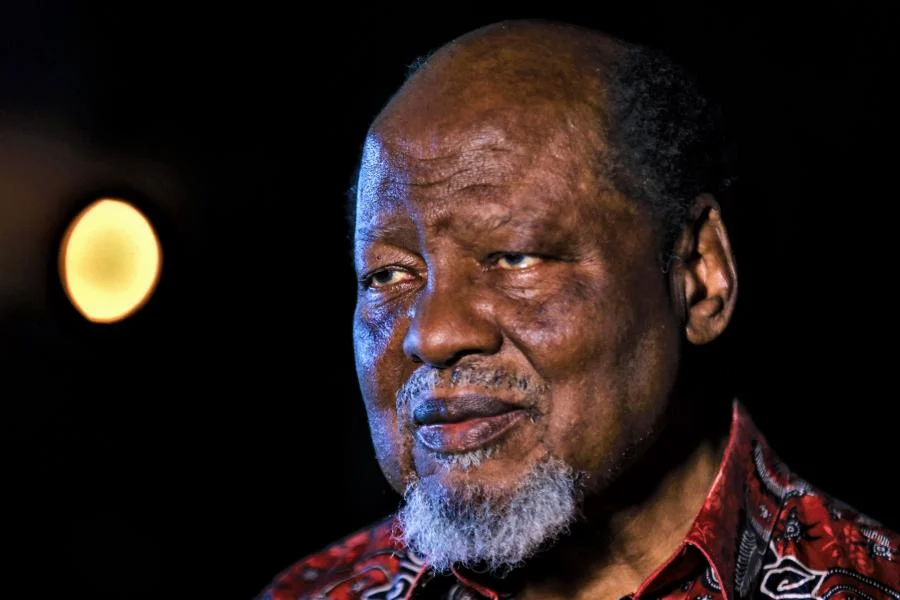
Former Mozambican President Joaquim Chissano today called for investigations into the real causes of the armed conflict in the province of Cabo Delgado, northern Mozambique, rejecting societal claims linking it to gas discoveries and poor governance in the area.
“Some may think that [the armed conflict is] because a lot of gas was discovered [in Cabo Delgado], (…) but why has there not been terrorism for a long time in Nigeria? Even if it is said that there is poor governance, that may be, we never know how things will go,” said Joaquim Chissano today during a conference on peace and security in Africa, held in Maputo.
The former head of state, who governed Mozambique from 1986 to 2005, called for investigations into the conflict in the gas-rich northern province, which has been targeted by extremist attacks for eight years, with the first attack recorded on October 5, 2017, emphasizing the need to avoid shortcuts.
“We know there are many large terrorist organizations that influence smaller organizations or create smaller organizations, but we do not have much evidence because here, sometimes they are called El Chabaab of Mozambique, sometimes ISIS [Islamic State of Iraq and Syria] of Mozambique; we do not know,” Chissano said.
Read more about this topic: Mozambique: EU to define “possible support in security” at Cabo Delgado
The former leader also highlighted that peace in a nation requires “strong and transparent” institutions, with youth and women playing leading roles in decision-making.
“Peace also requires strong, transparent, participatory institutions that are close to citizens. It requires sincere collaboration between the state and civil society. It requires that young people and women be protagonists, that communities be part of the decision-making and implementation process, and share in the resulting benefits,” he concluded.
The Armed Conflict Location & Event Data Project (ACLED) estimates that Cabo Delgado recorded two violent events in the past two weeks, one involving Islamic State extremists, causing 13 deaths and bringing the total fatalities since 2017 to 6,515.
Mozambican President Daniel Chapo stated on December 8, in an interview with Lusa, that he does not rule out a dialogue-based solution to terrorism in the north of the country, because what Mozambique wants “is peace.”
“We will continue to work, and if there is this path, this possibility, there is no problem in finding a solution. What we want is peace for the Mozambican people,” Chapo said in Porto, in an interview on the sidelines of a summit with Portugal.
“What we want is peace, and Mozambique is a nation with extraordinary experience in this area. If you recall, we had a war [between government forces and the Renamo guerrilla] of destabilization that lasted about 16 years, killed over one million people, destroyed public and private property, but ended through dialogue. That is how the General Peace Agreements were signed in Rome on October 4, 1992,” he added.
