

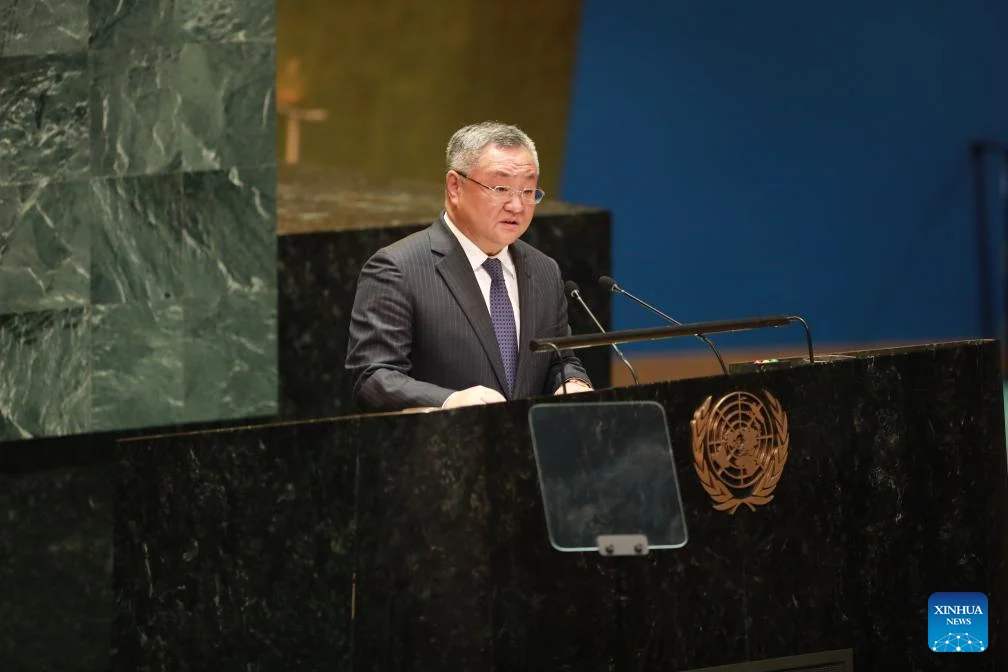
The Chinese ambassador to the United Nations (UN), Fu Cong, accused the United States (US) today, March 13, of triggering the Iranian nuclear crisis by unilaterally withdrawing from the international agreement on Tehran’s nuclear program in 2018.
The accusations were made at a UN Security Council meeting convened by the US to discuss the work of the Iran Sanctions Committee, but which ended up being marked by attempts by China and Russia to block it from taking place.
“I want to emphasize that it was precisely the United States that unilaterally withdrew from the Joint Comprehensive Plan of Action [JCPOA, nuclear agreement signed in 2015], which triggered the Iranian nuclear crisis,” said the Chinese diplomat.
“It was also the United States that, in total disregard for its own credibility, on two occasions joined Israel and resorted to the blatant use of force against Iran during the negotiation process, which rendered diplomatic efforts futile,” he added.
The United States, “as instigators of the Iranian nuclear crisis, violates international law and the purposes and principles of the UN Charter,” Fu Cong stressed, condemning US actions.
The JCPOA, signed in July 2015 in Vienna, is a nuclear agreement between Iran and the P5+1 group (US, UK, France, China, Russia, and Germany) together with the European Union. The goal was to ensure the exclusively peaceful nature of Iran’s nuclear program by limiting uranium enrichment in exchange for the suspension of economic sanctions.
In May 2018, US President Donald Trump, during his first term in the White House, withdrew the US from the agreement and reimposed sanctions on the Iranian regime. At today’s Security Council session, Beijing also accused Washington of joining Israel in aggressive military actions before the conclusion of nuclear negotiations.
Condemning these actions, Fu Cong urged the United States to reverse its position and seek diplomacy. He also called on European countries to “stop fanning the flames” of war and warned against the use of sanctions to promote narrow political interests.
Read more: Iran War “lacks legitimacy and legality”, says China’s foreign minister
In turn, US Ambassador to the UN Mike Waltz accused Moscow and Beijing of trying to protect Iran and thus maintain defense cooperation that is now once again prohibited.
“Both countries maintain military trade ties. In 2022, Russia began purchasing Iranian drones, in violation of [Security Council] Resolution 2231 (…). Russia also acquired short-range ballistic missiles from Iran and supplied attack helicopters to the country earlier this year,” he said.
“The reality is that Russia and China do not want this [Iran Sanctions] Committee because they want to continue to protect their partner, Iran,” Waltz added.
The US ambassador accused Tehran of maintaining a defiant stance, arguing that “it is the only state, the only one in the world without nuclear weapons, to have produced and accumulated uranium enriched to up to 60%.” He added that the country refuses to provide the International Atomic Energy Agency (IAEA) with up-to-date information or access to this stockpile of highly enriched uranium.
Read more: Iran War: China says “war and chaos in the region benefit no one”
Iran is legally obliged to cooperate with the IAEA under the Nuclear Non-Proliferation Treaty. However, it has not yet granted the agency’s inspectors access to nuclear sites affected by the 12-day war with Israel last June.
Last year, the UN reimposed sanctions on Iran through the so-called “snapback” mechanism provided for in the 2015 nuclear agreement, prompting an indignant reaction from Tehran, which suspended implementation of the agreement. The snapback mechanism reactivated six UN Security Council resolutions on Iran’s nuclear and ballistic missile program, reimposed economic sanctions, and reinstated the suspension of all uranium enrichment.
Iran has insisted that the program is peaceful, but the IAEA and Western countries claim that Tehran maintained an organized military nuclear program until 2003.
Also at today’s meeting, the United Kingdom—which, together with France and Germany, activated the snapback mechanism—accused Iran of “repeatedly failing to act in good faith to address international concerns.” The UK also argued for the need to establish, without delay, a Panel of Experts to independently investigate alleged violations of sanctions against Iran.
“We call on Member States that have sought to circumvent or undermine the UN sanctions reinstated under the snapback mechanism to cease this practice immediately. This approach only encourages Iran,” argued Britain’s James Kariuki.
