

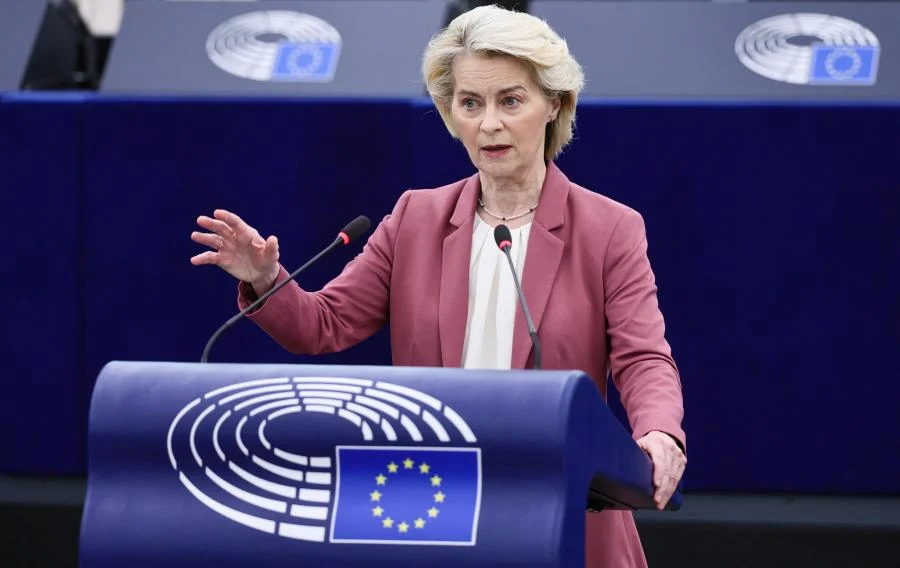
The European Commission president today admitted the possibility of imposing gas price caps, noting that rising energy costs are already costing taxpayers €3 billion, while firmly rejecting any return to Russian fossil fuel imports.
“Since the start of the conflict [in Iran], gas prices have risen 50% and oil prices 27%. Translating that into euros, 10 days of war have already cost European taxpayers more than €3 billion in fossil fuel imports. That is the price of our dependence,” she said, speaking at the European Parliament plenary session, before issuing a warning.
“In the current crisis, some are arguing that we should abandon our long-term strategy and even return to Russian fossil fuels. That would be a strategic mistake — it would make us more dependent, more vulnerable and weaker,” she said, in an allusion to Hungarian prime minister Viktor Orbán, who this week wrote a letter to the European Commission calling for the lifting of EU sanctions on Russian oil imports.
Von der Leyen acknowledged that, due to the Middle East conflict, “European families and businesses are facing strong pressure” from rising energy prices and argued that the EU must “relieve them.”
“We must comprehensively analyse how we can reduce energy bills — not by looking at just one component, but at all four components that determine the price: the cost of energy itself, which on average accounts for more than 56%; network charges (18%); taxes and levies (15%); and carbon costs (11%),” she said.
Calling for action on all four components, von der Leyen said there is currently “broad” support for the energy pricing system based on natural gas, suggesting she does not favour a full revision of that system, but rather measures to control and reduce the impact of gas on electricity prices.
“We are preparing different options: better use of Power Purchase Agreements and Contracts for Difference, state aid measures, and exploring the possibility of subsidising or capping the price of gas,” she said.
On network costs, von der Leyen acknowledged this is a “sensitive matter,” noting that such charges are necessary for investment in more modern infrastructure, while also recognising there is “room to improve network productivity so that less renewable energy is wasted.”
Read more about this topic: Vladimir Putin willing to supply hydrocarbons to European countries if “they reorient themselves” (with video)
“Last year, we installed more than 80 gigawatts of renewables in the EU — a record. But six times more renewable energy cannot access the grid. In other words, if we produced six times more renewables, much of it would be wasted. This is simply not sustainable,” she argued.
On taxes and levies — a national competence — von der Leyen highlighted significant disparities between member states, with some “taxing electricity at a much higher level than gas.” “To give you an example: one member state has no retail tax on electricity, while others apply more than 16%. There is, therefore, room to act,” she said.
Finally, on carbon pricing, von der Leyen defended the EU Emissions Trading System, stressing that without it, Europe would today be consuming “100 billion cubic metres more gas.” “That is why we need the Emissions Trading System — but we need to modernise it,” she said, calling on MEPs to work together with the Commission on all these issues.
