

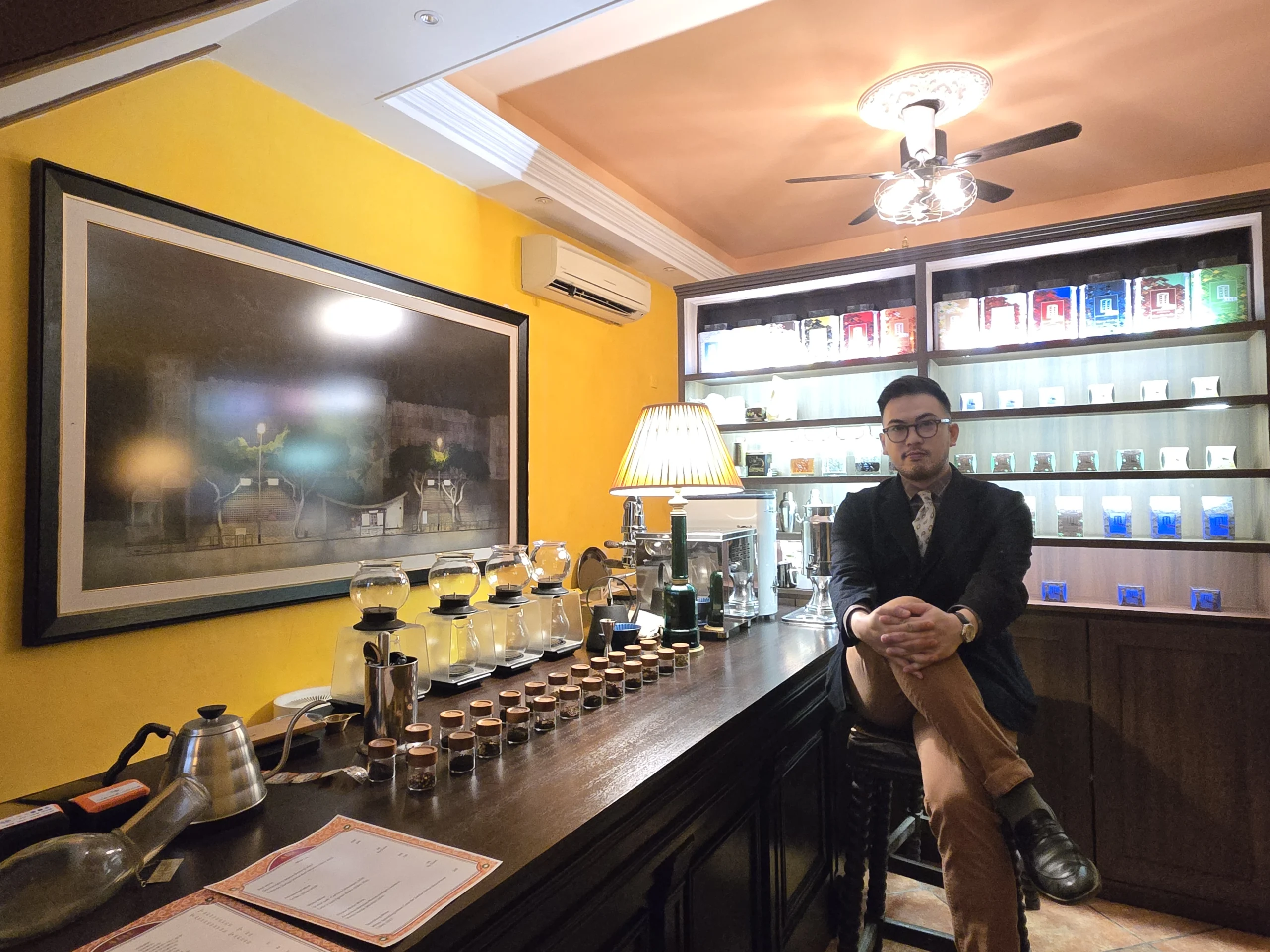
As night falls, the hustle and bustle of Macau begins to subside. For artist Filipe Dores, this is the most comfortable time of day. “The night is relatively quiet; it’s possible to really reflect on what has happened in the city throughout the day, or even the week,” he tells PLATAFORMA. This habit stems from a somewhat rebellious youth: “I was quite mischievous, I would usually go out at night and sleep in the morning.” This routine ended up shaping his particular way of observing the city.
Speaking about the starting point of his work, Filipe Dores admits that he began with an “egocentric” idea. “I wanted to create a space for myself to reflect. A very quiet space, even something tight,” he explains. “In any city, there are too many things happening, too many distractions. At first, I just wanted to give myself a place to think.”
Over time, this intimate space began to touch many other people. “I realized that everyone needs a visual space to wander through the city, calm down, and slowly organize their emotions.”
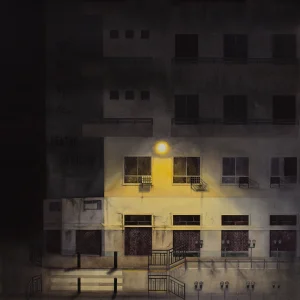
Details slightly different from objective perception are described to better express the absurd feeling between memory and reality.
Filipe Dores’s paintings are known for their delicacy, but the artist emphasizes that he does not seek objective truth: “Many think it is very realistic. For me, it is more of a presentation of memories.” In his art, he deliberately introduces small differences from reality: “I paint details slightly different from objective perception to better express the absurd feeling between memory and reality.”
For Filipe Dores, old neighborhoods and buildings are not just brick and tile, but “the life and memories of everyone.” This connection stems from his childhood, observing his grandfather build architectural models. “My love for buildings was born with my grandfather. He would make models like the Macau Military Club or the old Post Office building. I grew up watching him build them, as if they were Lego pieces.”
“Imitate the past”
When speaking about his work “Hotel Estoril,” the artist reveals emotion. The painting, which took a year to complete, was not initially intended for public display. “I kept it at home. Then a competition came up and the venue was the Tap Siac Gallery. It seemed like destiny,” he recalls. Displaying it while the building was being demolished would create, according to the artist, a stronger tension for the viewer.
“The Hotel Estoril is a legendary place, almost a foreign castle, a crucial element in the development of Macau.” The architectural complexity was the biggest challenge: only the exterior decorative elements consumed most of the work time.
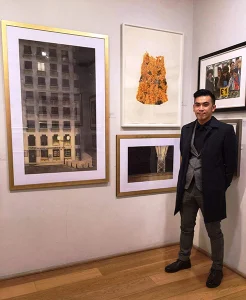
Each person holds different memories of the building. “I remember seeing an old car by the entrance when I was a child. Many don’t recall it, but some older individuals confirm and start telling stories.”
Some recently built structures no longer aim to be modern but rather more Portuguese – a somewhat late realization.
Dores still observes the transformations of the city: “We lost a way of life and the change was passive.” At the same time, he notes that the new architecture tries to imitate the past: “Some recent buildings no longer strive to be modern but more Portuguese—a somewhat late perception.”
The painter recognizes that living exclusively off art is difficult. “Being a full-time painter in Macau is complicated. The base of collectors is limited and cannot buy indefinitely.” For this reason, many artists turn to “teaching or other professions.”
In your opinion, what is lacking above all is artistic education. “Most people believe they don’t need art. Few have paintings or sculptures at home. Without this, the space for the survival of art disappears.” Nevertheless, he has never stopped creating: “Even with less time, I continue. I deeply enjoy creating.”
Aesthetic duality
Of Macanese descent, he feels privileged to combine Western education with Chinese cultural influence: “I can understand two different aesthetics.” This duality is reflected in his work: simultaneously “conservative in technical care” and bold in his “choices,” without being overly concerned with “external opinions.”
However, his mother’s death shook his artistic motivation, leading him to realize that “part of my effort was to prove something to my mother.” The experience also led him to reconsider the role of art: “Without society, there are no artists. A work is successful when it resonates with people,” he explains to PLATAFORMA.
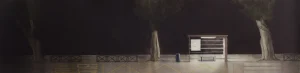
Filipe Dores refuses to define a masterpiece: “The best work is always the next one,” he says. He has also established a personal rule — never painting the same place twice. That’s why he has never depicted the Ruins of São Paulo feel them more as tourist attractions than as personal connections.”
It also considers that heritage preservation should be rethought, advocating for greater investment in the maintenance of historical buildings.
Without society, there are no artists. A work is successful when it creates resonance with people.
In addition to painting, he tries to preserve urban memory through space management. He maintains a tea house, a private restaurant, and a studio in old buildings. “If I can keep a place open through a business, preserving it is a good choice. I would never do something that violates the aesthetics of the space.”
To young creators, he advises courage, emphasizing that “the most important thing is not to be afraid of discouragement,” and further encourages them to travel and experience other realities in order to “find their own path.”
As for himself, he remains faithful to his nighttime walks. “I prefer to paint close to midnight, when everything becomes silent.” In the bustling city, Filipe Dores seeks to create, on the canvas and in the spaces he inhabits, a place where memory and emotion can continue to exist.
